Bottom line: the K-ETA 2027 rule change means every one of the 22 currently exempt countries needs a K-ETA again for arrivals from 1 January 2027. Land on or before 31 December 2026 and you still do not — but you owe an e-Arrival Card instead.
Quick Korea Travel Guide
Getting in: Incheon to central Seoul takes about an hour. Do not pay for a taxi — the AREX train and limousine buses are simple and a fraction of the price. If you land late or travel with family, book an airport transfer ahead.
Stay in touch: Korea runs on data. Get a Korea eSIM from Airalo before you land — it activates on arrival, and airport counters cost more and close earlier than you think.
Download first: Naver Map or KakaoMap (Google Maps barely works here), Kakao T for taxis, Papago for translation.
Where to book things: GetYourGuide for DMZ tours, palace tickets and day trips. KKday for KTX rail and Korea-only passes. Creatrip for what global platforms do not carry — hair salons, skin clinics, hanbok, K-pop music shows.
Getting around: A T-money card covers subway and buses nationwide. In Seoul, the Climate Card short-term pass can be cheaper if you ride a lot. You can also pre-book KTX and transport passes.
Disclosure: Some links above are affiliate links. If you book through them I may earn a commission at no extra cost to you.
The short version of the K-ETA 2027 change: if you are from the US, UK, Japan, Australia or one of 18 other places, you have been able to fly into Korea with nothing but a passport for the last three years. That ends on 31 December 2026.
From 1 January 2027, everyone on that exempt list has to apply for a K-ETA again before boarding. It is not a visa and it is not hard, but it costs money, it takes up to 72 hours, and you cannot fix it at the airport. I live in Seoul and I have watched people get turned away at check-in for exactly this.
This guide covers what actually changes, who is affected, and the one form that trips up nearly everyone even in 2026 — the e-Arrival Card. Every figure here is from k-eta.go.kr and the official e-Arrival Card site, checked in September 2026.
Quick answer
- Travelling on or before 31 December 2026: no K-ETA needed if your country is on the exempt list. You do need an e-Arrival Card.
- Travelling on or after 1 January 2027: K-ETA required before you board, for every exempt country.
- Cost: 10,000 KRW (about USD 7–8), non-refundable even if you are denied.
- Processing: usually under 72 hours. There is no rush service.
- Valid 3 years, multiple entries — or until your passport expires, whichever comes first.
- A valid K-ETA exempts you from the e-Arrival Card.
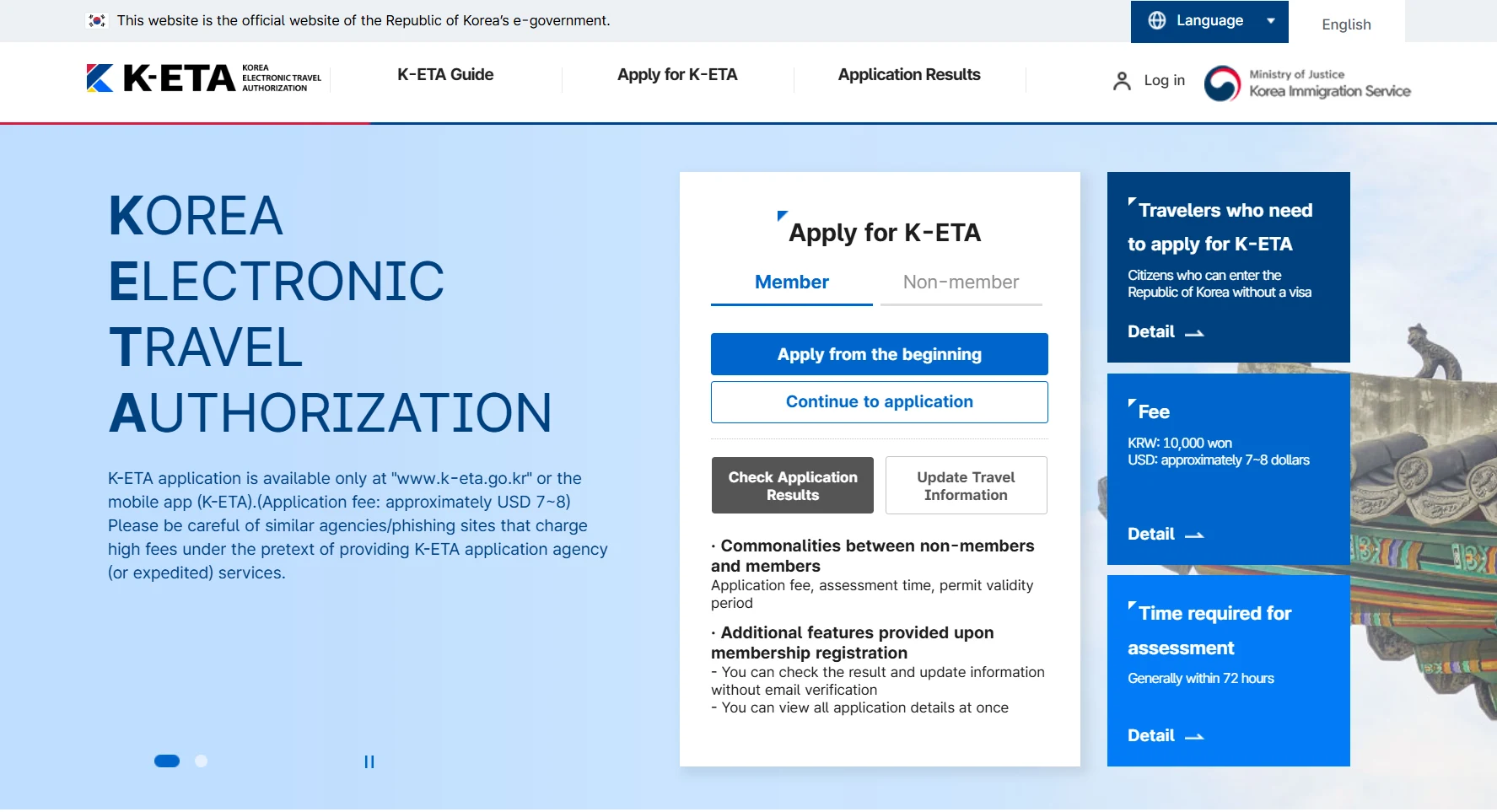
- Apply only at k-eta.go.kr or the official K-ETA app. Agency sites charge many times the real fee.
What this guide covers
What Is K-ETA (And Do You Actually Need It?)
K-ETA stands for Korea Electronic Travel Authorization. It is a pre-screening step for people who can enter Korea without a visa. You fill in passport details, travel plans and a few health and criminal-record questions, pay the fee, and wait for approval before you fly.
Two things people get wrong about it:
- It is not a visa. Approval does not guarantee entry. The immigration officer at the airport makes the final call.
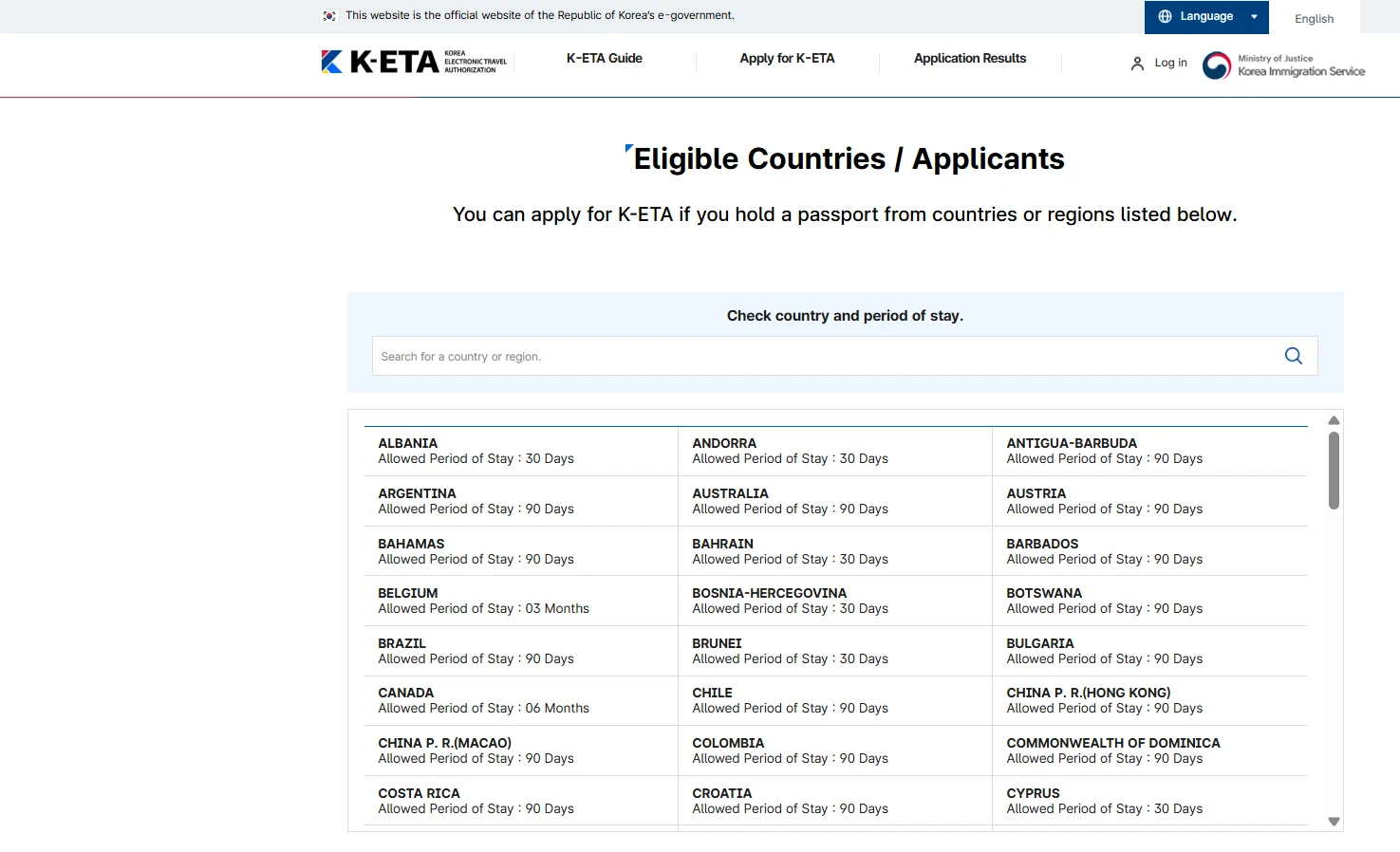
- It does not extend your stay. K-ETA is valid for 3 years, but your permitted stay is still whatever your nationality gets visa-free. Canada gets 6 months; most of Europe and the US get 90 days; some countries only 30. The official eligible-countries list shows the exact figure per passport.
So the question is not “do I want one” but “does the calendar force me to have one”. That depends entirely on your travel date.
1. The 2026 vs 2027 Rule, Side by Side
The K-ETA 2027 reversal is not a new policy, it is the expiry of a temporary one. Korea’s Ministry of Justice has been extending a temporary K-ETA exemption year by year since April 2023 to boost tourism. The current extension runs 1 January 2026 to 31 December 2026. Unless it is extended again, the requirement snaps back on 1 January 2027.
| Arriving by 31 Dec 2026 | Arriving from 1 Jan 2027 | |
|---|---|---|
| K-ETA | Not required (exempt countries) | Required before boarding |
| Cost | 0 KRW | 10,000 KRW + payment fee |
| Lead time | None | Apply 72+ hours before departure |
| e-Arrival Card | Required | Not required if K-ETA approved |
Read that bottom row again, because it is the part of the K-ETA 2027 story that catches people out. Right now, being exempt from K-ETA means you have more paperwork, not less — you still owe an e-Arrival Card. More on that below.
If your trip straddles New Year — say you fly in on 29 December 2026 and out in January — the rule that matters is your arrival date. Landing in 2026 means no K-ETA.
2. Are You on the Exempt List?
22 countries and regions currently hold the temporary exemption. If your passport is from one of these, you can enter visa-free without a K-ETA until 31 December 2026 — and you will need one from 2027.
(A) Asia
Japan, Taiwan, Hong Kong, Singapore, Macao
(B) Americas
United States, Canada
(C) Europe
United Kingdom, Germany, France, Italy, Netherlands, Spain, Poland, Sweden, Finland, Norway, Belgium, Denmark, Austria
(D) Oceania
New Zealand, Australia
Not on this list?
Then nothing changes for you in 2027 — you already need a K-ETA today, assuming your country has visa-free entry to Korea at all. If it does not, you need an actual visa from a Korean embassy, and K-ETA is irrelevant.
The reliable way to check your own status: start an application at k-eta.go.kr and scan your passport page. If you are exempt, a pop-up tells you so before you pay anything.
3. The e-Arrival Card — the Part Everyone Gets Wrong
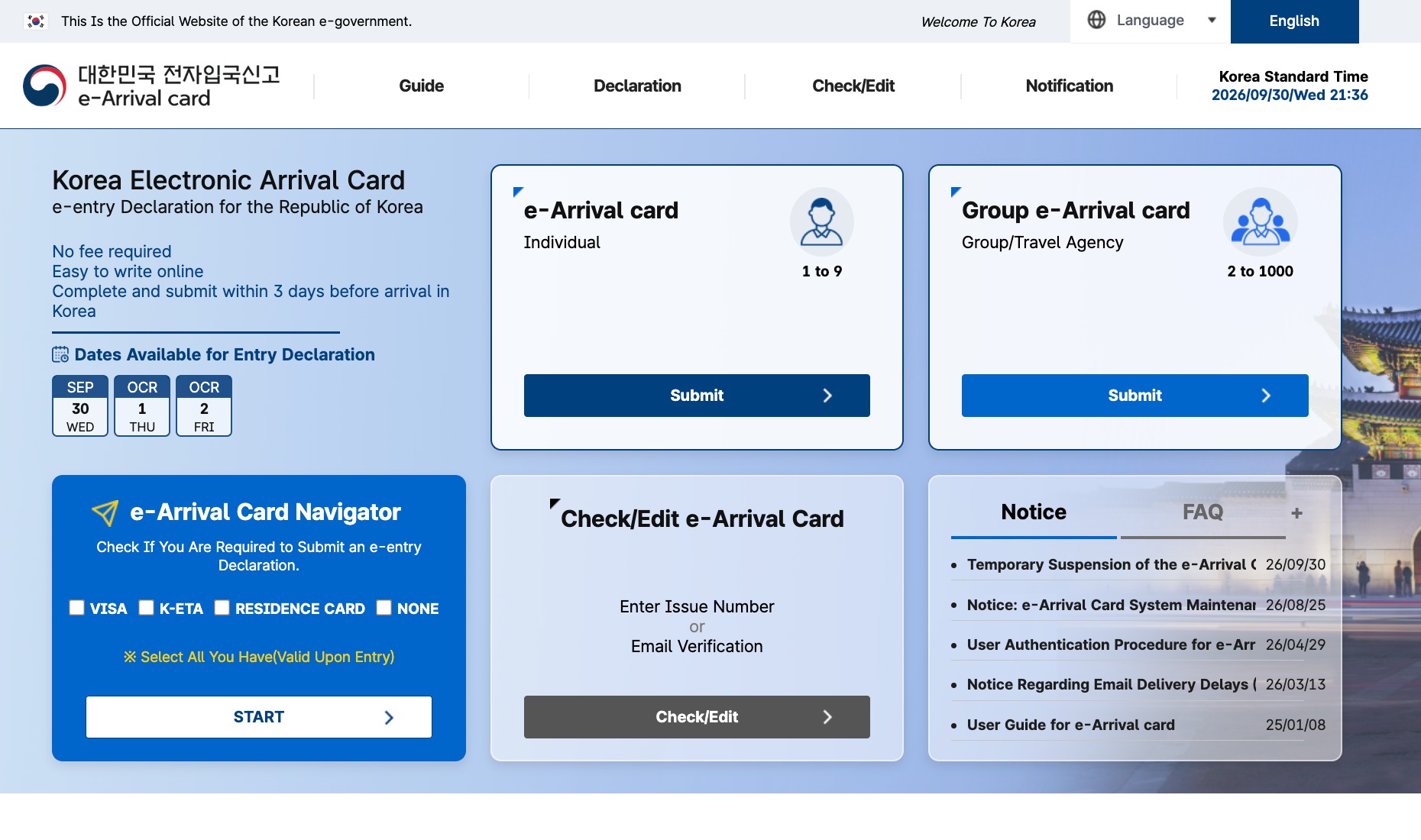
The e-Arrival Card launched on 24 February 2025 as the online replacement for the paper form you used to fill in on the plane. It applies to almost every foreign traveller who does not hold a K-ETA.
This is the single most common gap I see. People read “no K-ETA needed” and assume there is no paperwork at all. There is.
The key rules at a glance
| Cost | Free |
| When | Within 3 days before arrival, including the day you land |
| Where | e-arrivalcard.go.kr (official, no fee) |
| Who is exempt | Valid K-ETA holders · registered residents of Korea · certain group-tour visa holders |
| Group option | One submission covers 2–1,000 people |
The official site has an “e-Arrival Card Navigator” where you tick what you hold — visa, K-ETA, residence card, or none — and it tells you whether you must submit. Full walkthrough here: the e-Arrival Card guide.
Here is the quiet upside of paying for a K-ETA even while you are exempt in 2026: K-ETA holders skip the e-Arrival Card entirely, and the approval lasts 3 years. If you visit Korea more than once, one 10,000 KRW payment now covers you through the 2027 change and saves you a form every trip.
4. How to Apply, Step by Step
The whole thing takes about 15 minutes if your passport is in front of you.
- Step 1. Go to k-eta.go.kr or the K-ETA app. Nowhere else.
- Step 2. Choose member or non-member. Non-member only needs email verification — fine for a one-off trip.
- Step 3. Scan or enter your passport information page.
- Step 4. Enter travel details: purpose of entry, where you are staying, contact number, arrival and departure dates.
- Step 5. Review, then pay 10,000 KRW. An online payment fee is charged on top.
- Step 6. Wait. Usually under 72 hours, sometimes longer in peak season. Check the result on the site.
You will need your accommodation address, so book at least your first night before you apply.
Mistakes to Avoid
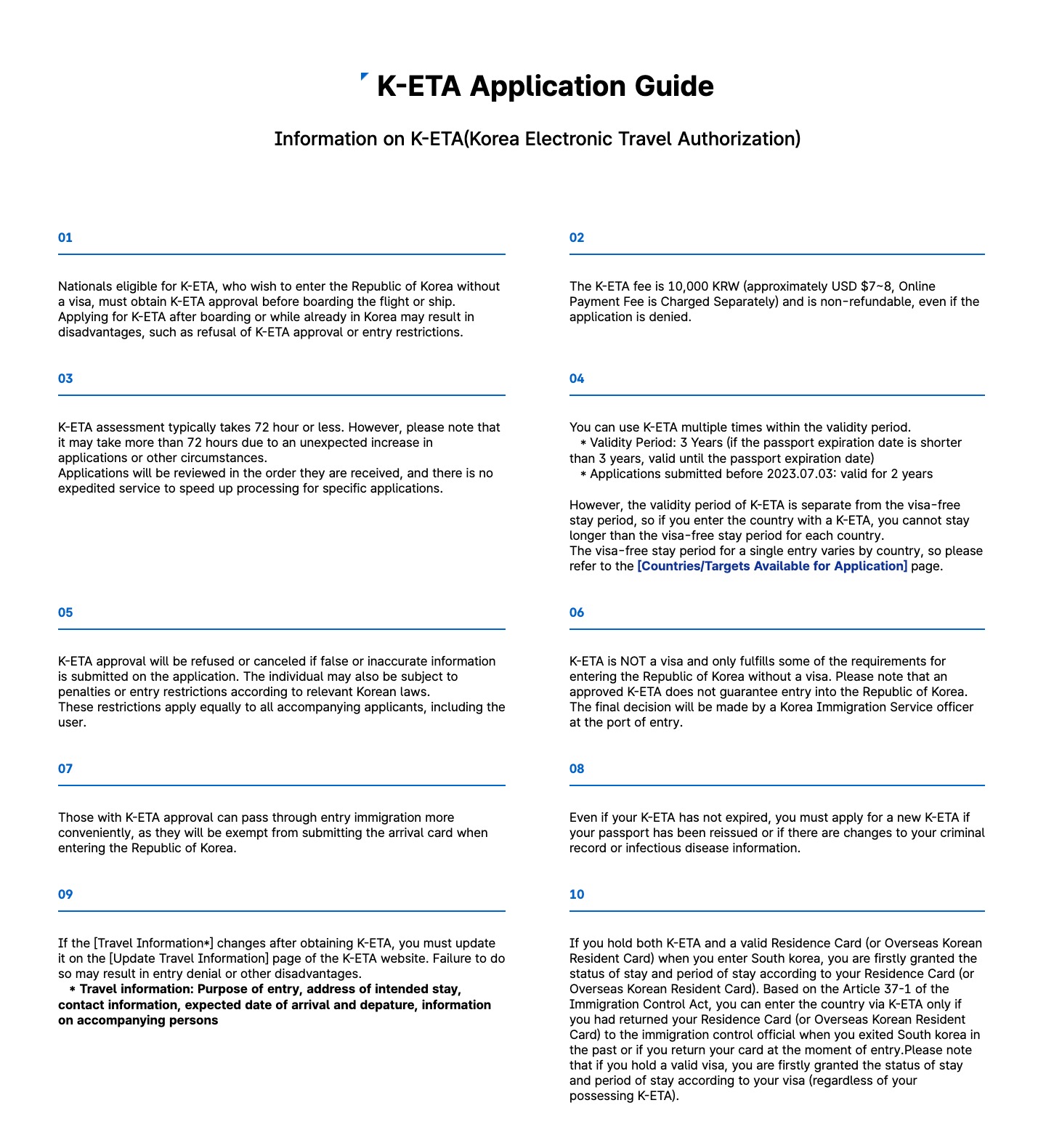
- Applying at the airport. K-ETA must be approved before you board. Applying after boarding or once inside Korea can get you refused or flagged.
- Using an agency site. The real fee is 10,000 KRW. K-ETA’s own homepage warns about phishing and “expedited service” sites charging far more. There is no expedited service.
- Leaving it to the last day. 72 hours is typical, not guaranteed. Apply a week out.
- Assuming it survives a new passport. Renew or replace your passport and your existing K-ETA is void. You must reapply.
- Not updating changed plans. If your dates, address or contact details change after approval, update them on the K-ETA site. Stale information can cost you entry.
- Thinking 3 years means a 3-year stay. It means 3 years of multiple entries, each capped at your country’s visa-free limit.
- Skipping the e-Arrival Card because you are exempt. Exempt from K-ETA is not exempt from the arrival declaration.
- Paying for an e-Arrival Card. The official site runs a standing warning about fake e-Arrival Card websites. The real one is free — if a site asks you for money, it is not the government.
Could the Exemption Be Extended Again?
Possibly. It has happened three times already. The original waiver covered April 2023 to December 2024, was pushed to December 2025, and then to December 2026 as part of the government’s “Visit Korea Year” tourism push and its stated goal of 30 million annual visitors.
So a fourth extension is plausible. But planning around it is a bad idea, for two reasons:
- The decision has landed late each time — the 2026 extension was only announced on 23 December 2025, eight days before the deadline. If you are booking a January 2027 trip in the autumn, you will not know yet.
- A K-ETA is valid 3 years and costs about USD 7. If you apply and the exemption gets extended, you have lost nothing — you still skip the e-Arrival Card on every trip, and you are covered whenever the rule does eventually return.
My honest advice on K-ETA 2027 for anyone travelling in the first half of that year: apply in advance and stop thinking about it. The downside is one coffee’s worth of money.
Frequently Asked Questions
Do I need a K-ETA for Korea?
Not if you arrive on or before 31 December 2026 and hold a passport from one of the 22 exempt countries. From 1 January 2027 you do, and you must have it approved before boarding.
Is K-ETA required for US citizens in 2026?
No. The exemption for US passport holders runs through 31 December 2026. It is required again from 1 January 2027.
How much does a K-ETA cost?
10,000 KRW, roughly USD 7–8, plus a separate online payment fee. It is non-refundable even if your application is denied.
How long does K-ETA take to process?
Usually less than 72 hours. It can take longer during busy periods and there is no paid fast-track option.
How long is a K-ETA valid?
3 years with unlimited entries, or until your passport expires if that comes sooner. Applications made before 3 July 2023 were valid 2 years.
Is K-ETA the same as a visa?
No. It only satisfies part of the requirements for visa-free entry. An immigration officer still decides whether you may enter when you land.
Do I still need the e-Arrival Card if I have a K-ETA?
No. A valid K-ETA exempts you from submitting the e-Arrival Card.
Can I apply for a K-ETA even though my country is exempt?
Yes, and there is a reason to. You skip the e-Arrival Card, and the approval covers you for 3 years including after the 2027 change.
What Else Should You Sort Before You Land?
Entry paperwork is the first of four things worth handling before you fly: your K-ETA or e-Arrival Card, a data plan, a transport card, and your first night’s accommodation. Korea is genuinely easy once you are inside — but it is a cashless, app-driven country, and arriving without data is the one mistake that makes everything else harder.
If you only do one more thing after this page: sort your Korea eSIM now, while you are still thinking about it.
Related Guides
- e-Arrival Card Korea: The Free Form Nobody Tells You About — the form you owe if you are travelling K-ETA-free in 2026
Sources
- K-ETA official site — Korea Immigration Service, Ministry of Justice (fee, processing time, validity, arrival card exemption)
- K-ETA Eligible Countries / Applicants — allowed period of stay by nationality
- Korea e-Arrival Card official site — submission window, exemptions, Navigator tool
- US Department of State — South Korea — confirmation that the exemption runs through 31 December 2026 and K-ETA is required from 1 January 2027
Last checked September 2026 against k-eta.go.kr, e-arrivalcard.go.kr and immigration.go.kr. Korean entry rules change often — if you are reading this months later, confirm the exemption status on the official site before you book.