Bottom line on T-money vs Climate Card: get a T-money card for almost every trip. You cannot tap a foreign Visa or Mastercard at a Seoul fare gate — that arrives in 2027 — and a physical T-money card can only be topped up with cash, so bring won.
Quick Korea Travel Guide
Getting in: Incheon to central Seoul takes about an hour by AREX train or limousine bus. Pre-book a transfer if you land late or travel with family.
Stay in touch: Get a Korea eSIM from Airalo before you fly. It activates on landing; airport counters cost more and close early.
Download first: Naver Map or KakaoMap (Google Maps is crippled here), Kakao T for taxis, Papago for translation.
Where to book things: GetYourGuide for DMZ tours, palace tickets and day trips. KKday for KTX rail and Korea-only passes.
Getting around: T-money covers subway and buses nationwide. You can also pre-book KTX and transport passes.
Disclosure: Some links above are affiliate links. If you book through them I may earn a commission at no extra cost to you.
The T-money vs Climate Card question comes up because three products get recommended interchangeably for Seoul transport, and they are not interchangeable at all. One works nationwide, one is Seoul-only, and one is not available to you.
There is also a myth going around that you can now just tap your own credit card at the gate. You cannot. What changed in March 2026 was the ticket machines, not the turnstiles.
Everything below is from Tmoney, Seoul Metropolitan Government and VisitKorea, checked September 2026.
Quick answer
- T-money vs Climate Card in one line: T-money is the default. Card costs ₩3,000–5,000, works on subway, bus, taxi and intercity bus anywhere in Korea.
- You cannot tap a foreign credit card at a fare gate. Seoul’s EMV rollout reaches subway Lines 1–8 in 2027.
- Physical T-money top-up is cash only for tourists. Bring won.
- Since 17 March 2026, station machines take overseas Visa/Mastercard credit and debit cards, Kakao Pay and Naver Pay — but only for single tickets and Climate Card purchase or short-term recharge, not an ordinary T-money card.
- Climate Card short-term pass pays off above roughly four rides a day, but is Seoul-only.
- K-Pass and Climate Pass are residents-only. They need a foreigner registration number.
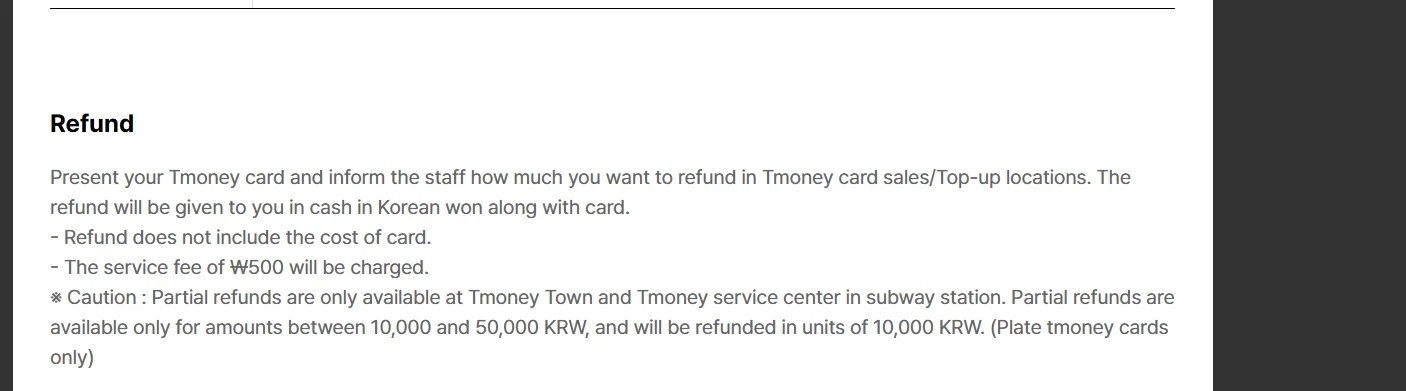
- T-money max balance ₩500,000; refund fee ₩500; the card fee itself is never refunded, and partial refunds are capped at ₩50,000.
Prepaid card with T-money function · via KKday
WOWPASS: Prepaid Card for Cashless Payment in Korea
⭐ 4.7/5 from 1,569 KKday reviews · top up in 16 currencies at self-service machines · works as a T-money card · voucher from KRW 6,000 · non-refundable after purchase (as of Oct 2026)
T-money vs Climate Card: what this guide covers
T-money vs Climate Card: Which Card You Actually Need
| T-money | Climate Card short-term | K-Pass / Climate Pass | |
|---|---|---|---|
| Available to tourists? | Yes | Yes | No — residents only |
| Coverage | All Korea | Seoul only | — |
| Cost | Card ₩3,000–5,000 + fares | Card ₩3,000 + ₩5,000–20,000 pass | — |
| Top-up with foreign card? | No (cash) | Yes, at station machines | — |
| Taxis, intercity buses | Yes | No | — |
| Best for | Almost everyone | Dense Seoul-only days | — |
If you only read one row of the T-money vs Climate Card table, read the last one. T-money for almost every trip. Add a Climate Card short-term pass on top if you have Seoul days where you will ride four or more times.
1. T-money: The Default, and Its Cash Problem
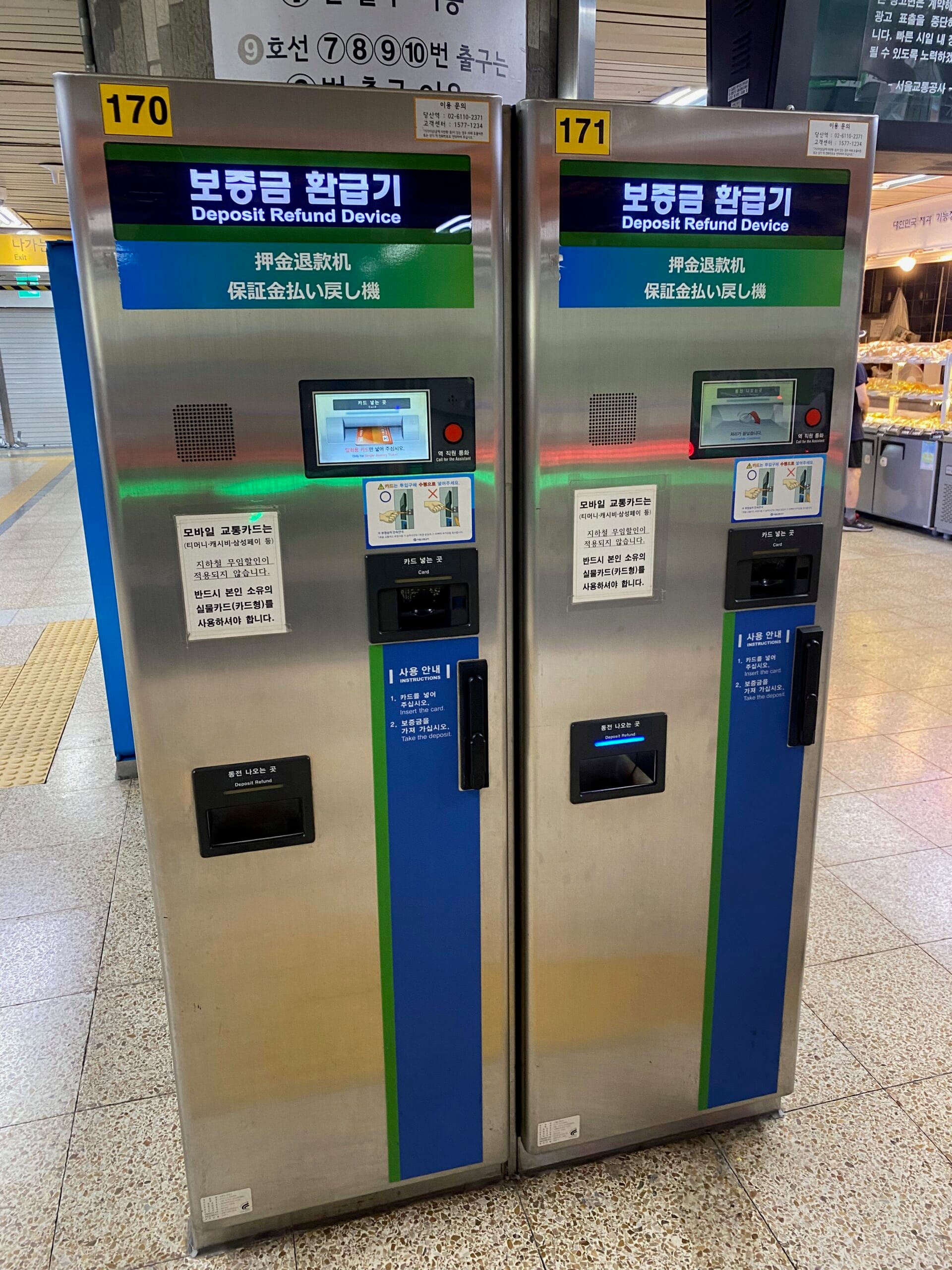
T-money is a stored-value card. You load won onto it and tap. It covers subways, city buses, express and intercity buses, taxis, trains, expressway tolls and a lot of convenience stores — anywhere in Korea, not just Seoul.
Where to buy
- Convenience stores nationwide: GS25, CU, 7-Eleven, MINISTOP, Emart24, Story Way
- Subway station Information Centers on Lines 1–8
- Tmoney Town, Seoul Station Exit 10
Card price is ₩3,000–5,000 depending on design. The tourist “Tmoney Travel Card” is ₩4,000. Note that the card fee itself is never refunded — only the remaining balance is.
The cash problem
This is the practical trap nobody warns about. Topping up a physical T-money card is a cash transaction. Convenience stores and station machines take won, in ₩1,000 units, ₩1,000 to ₩90,000 per go, up to a ₩500,000 balance.
A physical T-money card cannot be topped up with an international credit card. Seoul’s own March 2026 announcement about foreign cards at station machines lists single tickets and Climate Cards — not T-money.

So withdraw some won at the airport. You do not need much, but you do need some. If you would rather exchange foreign currency straight onto a card, a WOWPASS prepaid card also works as a T-money card.
The one exception is the Mobile Tmoney app, which has a separate “Foreigner” sign-up path for overseas cards such as Mastercard, American Express, UnionPay or JCB. Check the app for the cards it currently accepts before you rely on it, and keep some cash for the physical card. Apple Wallet’s own flow still asks for a Korea-issued card.
Transfers are where it pays off
Tapping out and onto another line or bus within 30 minutes gets you a discount of ₩100 or more, up to four transfers a day. The window stretches to an hour between 21:00 and 07:00. This is automatic — just remember to tap out.
2. Climate Card Short-Term Pass: When It Wins

Unlimited Seoul subway and bus for a fixed number of days: ₩5,000 for 1 day, ₩8,000 for 2, ₩10,000 for 3, ₩15,000 for 5, ₩20,000 for 7. The physical tourist card is ₩3,000 on top; the separate resident Climate Pass card is ₩4,000, a different product.

There is also a ₩13,000 7-day teen pass for ages 13–18, which requires Tmoney age verification. There is no 19–39 youth version of the short-term passes.
A Seoul subway ride starts around ₩1,550, so the T-money vs Climate Card break-even is roughly four rides in a day.
Its one advantage in the T-money vs Climate Card comparison is payment: since 17 March 2026 you can buy the card and recharge a short-term pass with an overseas Visa or Mastercard credit or debit card, Kakao Pay or Naver Pay at 440 machines across 273 stations on Lines 1–8, for a service fee averaging about 3.7%. No cash needed.
Those same machines do not top up an ordinary T-money card. Seoul, the operator, also confirms international credit and debit cards for Climate Card purchase and recharge, so VisitKorea’s Korea-issued-cards-only line is out of date.
Its disadvantages are real though. It is Seoul-only — no GTX, no Sinbundang Line, no subway outside Seoul, no airport or intercity buses, no taxis. It excludes Ttareungi (Seoul Bike) and the Hangang Bus. And it activates the day you charge it, so you cannot pre-charge it the night before.
Seoul’s official guidance as of 28 September 2026 lists the short-term pass area as Seoul-area subway, alighting at Incheon Airport Terminal 1 and 2 (you can get off, but you cannot board) and Seoul-licensed city and village buses — no Gyeonggi subway sections. Confirm the current coverage on the operator’s page before you travel.
Airport train · via KKday
AREX Airport Express One-Way Ticket (Incheon Airport to Seoul Station)
⭐ 4.8/5 from 31,385 KKday reviews · nonstop train, about 43 min from Terminal 1 · from KRW 11,500 (as of Oct 2026)
A refund returns what you charged minus what you used minus ₩500, and only before the pass expires.
Full detail in the Climate Card guide, including the 2026 changes and the refund trap.
3. The Contactless Credit Card Myth
You may have read that Korea now lets you tap your own bank card at the gate. Not on the Seoul subway or buses, it does not.

The key rules at a glance
| Tap foreign card at subway gate | No — Lines 1–8 get EMV terminals in 2027 |
| Tap foreign card on a Seoul city bus | No — Tmoney signed card-network agreements in September 2026; launch planned for 2027 |
| Buy a single ticket with a foreign card | Yes — 440 machines, 273 stations, Lines 1–8 |
| Buy/recharge a Climate Card with a foreign card | Yes, same machines, ~3.7% fee |
| Top up T-money with a foreign card | No — cash only |
Seoul has published a staged EMV plan: Seoul city buses in 2027 (Tmoney signed agreements with Visa, Mastercard, UnionPay, JCB and Hana Card on 17 September 2026), subway Lines 1–8 fare terminals in 2027, and full conversion by 2030. So the T-money vs Climate Card shortcut of tapping your own bank card will exist one day — just not for your 2026 trip.

4. Why K-Pass and Climate Pass Are Not for You
Both require a foreigner registration number, which comes from an Alien Registration Card, which is issued only for stays of 91 days or more. A 90-day visa-free visitor cannot get one.

They are also reimbursement schemes rather than passes — you pay normal fares and receive a percentage back later. Even if you could enrol, it would do nothing for a one-week trip.
Travel eSIM · via Airalo
South Korea eSIM (unlimited data)
Unlimited data from US$12 for 3 days · US$29 for 7 days · US$49 for 15 days · install before you fly (as of Oct 2026)
Mistakes to Avoid
- Arriving with no cash, expecting to card-top-up T-money. Physical T-money top-up is cash only.
- Trying to tap your Visa at the gate. Subway EMV arrives in 2027.
- Buying a Climate Card for a Busan or Gyeongju trip. It is Seoul-only. Use T-money.
- Signing up for K-Pass. You are not eligible without a foreigner registration number.
- Forgetting to tap out. You lose the transfer discount and some systems charge a penalty fare.
- Expecting the card fee back. Only the stored balance is refundable, minus ₩500.
- Loading ₩200,000 “to be safe”. Partial refunds are handled only at Tmoney Town (Seoul Station Exit 10, Seoul City Tower 1F) and Tmoney service centres inside subway stations, and only in ₩10,000 units from ₩10,000 up to a ₩50,000 ceiling.
Frequently Asked Questions
Can tourists use a T-money card in Korea?
Yes. Buy one at any convenience store for ₩3,000–5,000 and use it on subway, bus, taxi and intercity bus anywhere in Korea.
Can I tap my foreign credit card on the Seoul subway?
No. Seoul is rolling out EMV in stages and subway Lines 1–8 are scheduled for 2027. You can use a foreign card at ticket machines, but not at the fare gate.
Can I top up T-money with a credit card?
Not a physical card — top-up is cash only, in ₩1,000 units. The Mobile Tmoney app has a separate path for overseas cards; check the app for the cards it currently accepts before you rely on it.
How much does a T-money card cost?
₩3,000 to ₩5,000 depending on design. The tourist Tmoney Travel Card is ₩4,000. The card fee is not refundable.
Is the Climate Card better than T-money?
The T-money vs Climate Card answer: only for dense Seoul-only days, where it pays off above about four rides a day. T-money works nationwide and on taxis, which the Climate Card does not.
Can tourists get K-Pass in Korea?
No. K-Pass and the Seoul Climate Pass require a foreigner registration number, issued only for stays of 91 days or more.
What is the maximum I can load on a T-money card?
₩500,000. Refunds cost ₩500, and partial refunds are available only at Tmoney Town and Tmoney service centres in subway stations, in ₩10,000 units up to a ₩50,000 ceiling.
Does T-money work outside Seoul?
Yes. It works on public transport nationwide, including express and intercity buses, taxis and expressway tolls.
What Else Should You Sort Before You Land?
Transport cards you buy on arrival, and the T-money vs Climate Card decision takes five minutes at a convenience store. The jobs worth doing before you fly are the paperwork and the data plan — start with the K-ETA rule change if you are travelling in 2027 or later.
Sources (official pages checked)
- Tmoney — foreigner guide (top-up, balance cap, refunds, transfer discount)
- Seoul Metropolitan Government — Climate Card
- Seoul Metropolitan Government — international cards at station machines, March 2026
- Seoul Metropolitan Government (Korean) — Climate Card short-term pass service area, updated 28 September 2026
- VisitKorea — transportation cards
- K-Pass official — eligibility
Book the basics for your Korea trip
Affiliate links: we may earn a small commission at no extra cost to you.
Related Guides
- Korea Travel Toolkit: what to book before you fly
- Seoul Climate Card 2026: What Changed and What Tourists Use — the 2026 shake-up and which pass survived
- K-ETA Is Back in 2027: What Changes for 22 Exempt Countries — whether you need a K-ETA before you board
- e-Arrival Card Korea: The Free Form Nobody Tells You About — the free arrival form most visitors miss
Last checked September 2026 against Tmoney and the Seoul Metropolitan Government (news.seoul.go.kr, english.seoul.go.kr). Seoul’s EMV timeline runs to 2030, so the T-money vs Climate Card contactless answer here will change — recheck if you are reading this in 2027 or later.