Bottom line: A KTX sold out message is almost never the end of your trip — cancelled seats return to the same train all day, KORAIL’s own slower trains run the same tracks, SRT leaves from a different Seoul station, and a Seoul–Busan express bus seat costs 26,700 won with seats usually free the day before.
🇰🇷 Quick Korea Travel Guide
👉 Getting in: Check K-ETA requirements and the e-Arrival Card before you fly.
👉 Stay in Touch (eSIM): Grab a Korea eSIM on Airalo before you land — no airport counter queue.
👉 Download New Apps: See our Naver Map in English guide before you need directions.
👉 Where to Book Activities: GetYourGuide for tours and day trips; KKday for rail passes and Korea-only tickets.
👉 Getting Around: Read our T-money vs Climate Card guide — T-money also pays for intercity buses, and the Climate Card short-term pass covers Seoul itself.
👉 For more in-depth planning: Browse all our Korea Travel guides.
Disclosure: the Airalo, GetYourGuide and KKday links above are affiliate links. We may earn a commission at no extra cost to you.
The quick answer
- Cancelled tickets go straight back on sale: KORAIL accepts online cancellations up to the moment the train leaves, so refresh the departure you want.
- From 1 October 2026 KORAIL opens booking two months before departure at 07:00, instead of one month.
- ITX-Saemaeul and Mugunghwa use the same line at lower fares; Seoul–Busan by Mugunghwa takes about 5h 44m against 2h 35–50m by KTX.
- SRT is a separate operator from Suseo station with its own inventory — check it before you give up on the train.
- Seoul Express Bus Terminal to Busan: 26,700 won standard, 39,700 won udeung, 51,600 won premium, about 4 hours over 380.4 km.
- Kobus E-Pass lets you tap a transport card or transit-enabled credit card and board without a reservation whenever a seat is free.
- Gimpo–Gimhae flights exist, but with airport transfers and check-in they rarely beat the train on the Seoul–Busan run.
- A KTX sold out screen on a Friday or Sunday evening, or around Seollal and Chuseok, is normal — plan those legs first.
Rail pass · KTX · via KKday
KORAIL PASS – KTX Train Ticket
⭐ 4.8/5 from 685 KKday reviews · 2-day pass ₩131,000, 3-day ₩186,000 · free cancellation 1 day before (as of Oct 2026)
What this guide covers
What “KTX sold out” actually means on KORAIL’s site
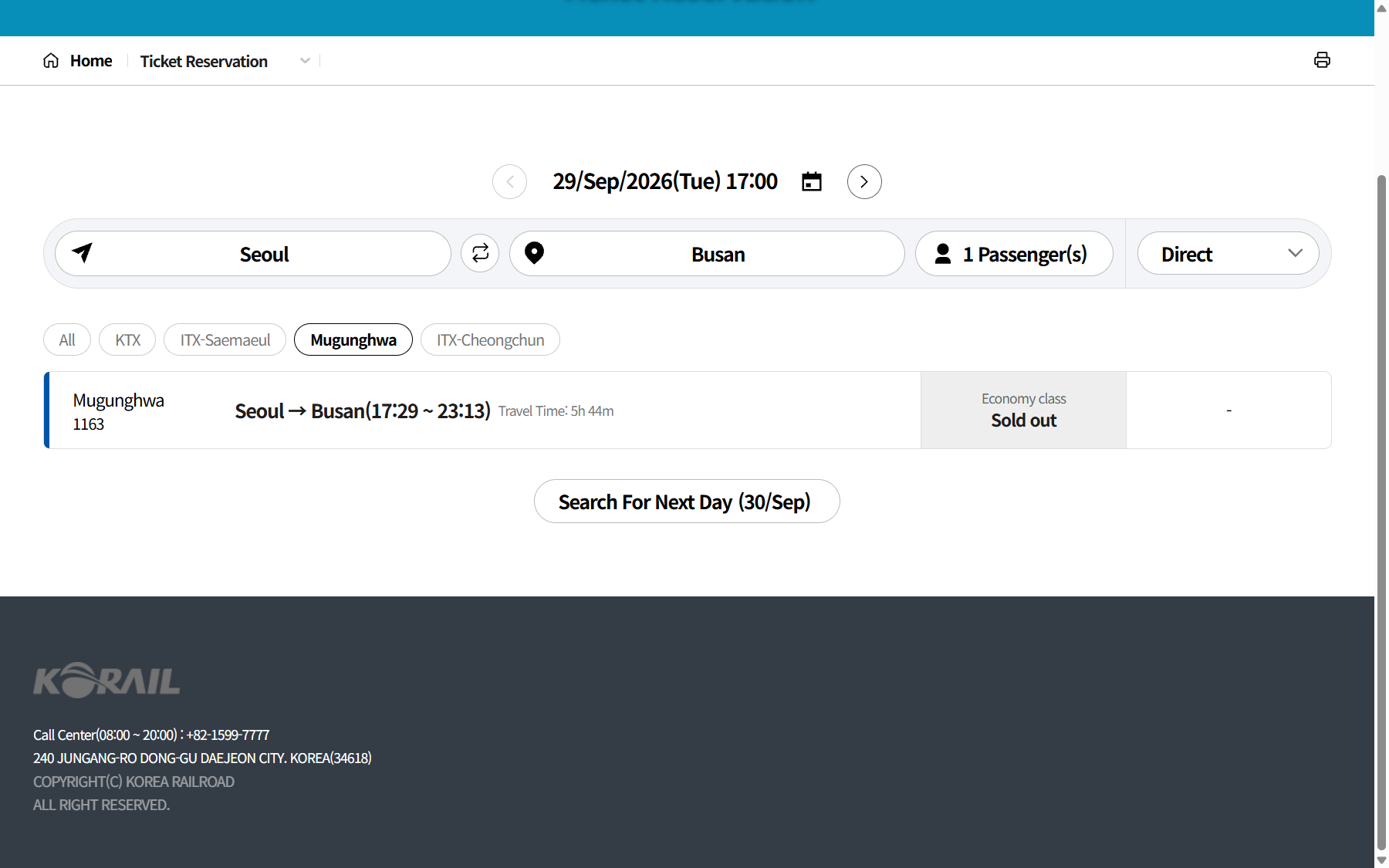
When KORAIL’s English booking page says a train is sold out, it is telling you one specific thing: no reserved seats are left in that class on that departure at that moment. It is not a statement about the corridor, the day, or the other operators running trains on the same tracks. That distinction is why experienced travellers in Korea treat a KTX sold out result as a prompt to check four other things rather than as a dead end.
KORAIL’s own ticketing guide sets the boundaries. You can buy on the KORAIL website until departure, at a ticket vending machine until 10 minutes before, and at a station counter until the train actually leaves. Refunds run in the other direction: you can cancel online right up to the departure time, and after that only at a station ticket office. Both rules matter when a KTX sold out screen is standing between you and Busan.

1. Refresh the same train: cancelled seats come back
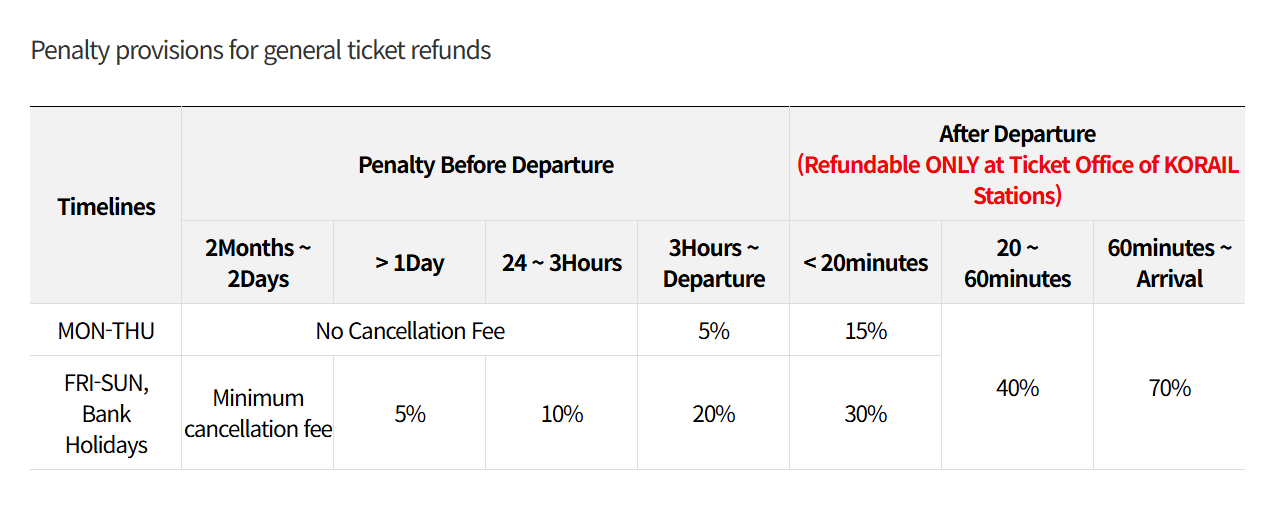
The single most useful habit is boring: reload the same search. KORAIL’s refund rules mean cancellations are cheap right up to departure. On Monday to Thursday trains there is no cancellation fee until 3 hours before departure and only 5% in the last 3 hours; on Friday to Sunday and bank holidays the fee starts at a minimum charge and rises to 5% (more than a day out), 10% (24 to 3 hours before) and 20% (inside 3 hours). Plans change constantly, and every cancelled seat is resold immediately (as of Oct 2026).
After departure a refund is only possible at a station ticket office and costs 15% to 30% in the first 20 minutes, 40% from 20 to 60 minutes and 70% after that, which is why seats keep reappearing right up to departure. If your date is fixed and a KTX sold out banner is blocking it, check morning and evening for two or three days rather than once.
2. Book in the right window (it changed on 1 October 2026)
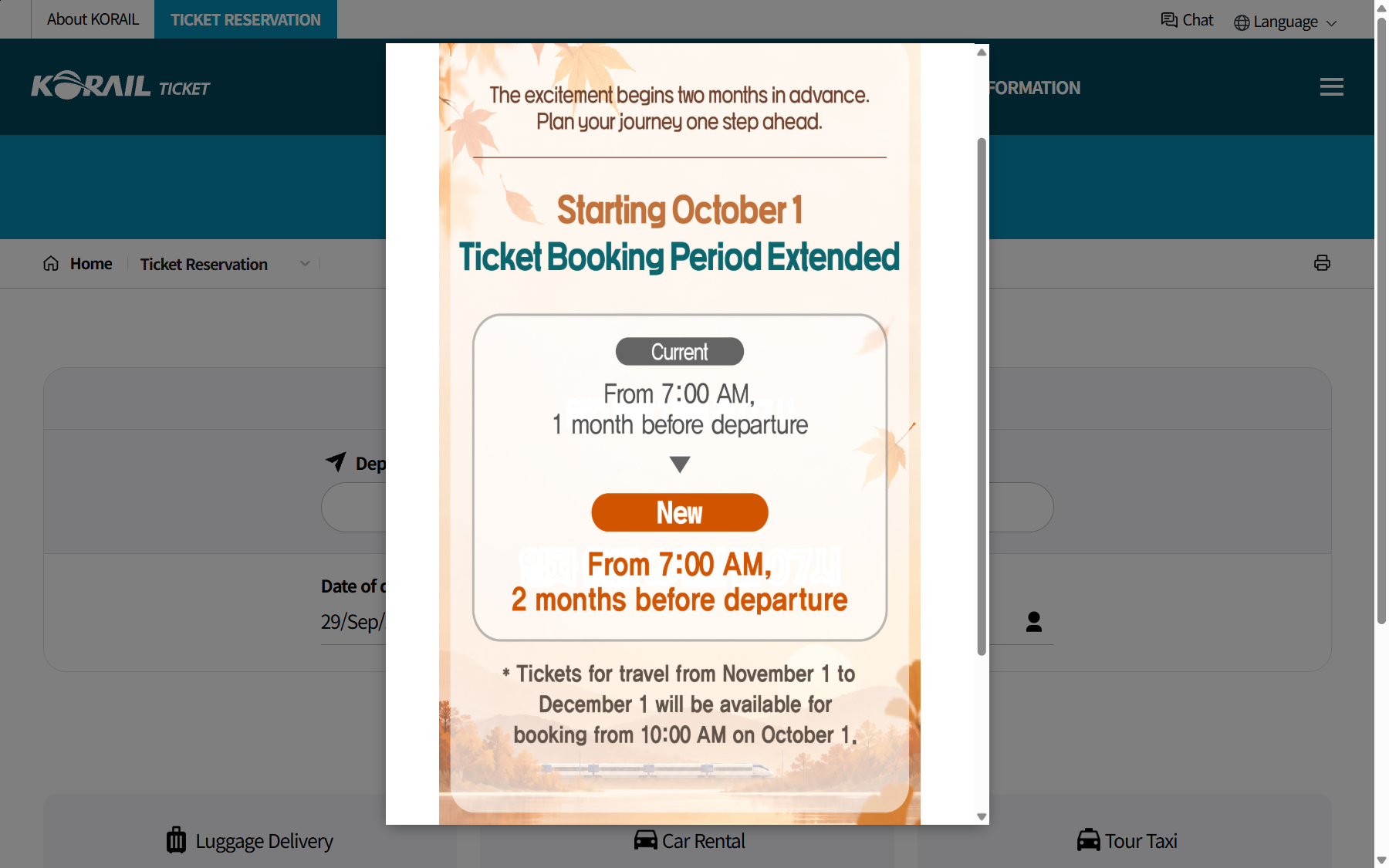
Until now KORAIL released tickets at 07:00 exactly one month before the departure date. That is changing. KORAIL and the Ministry of Land, Infrastructure and Transport announced that from 1 October 2026 the advance booking window doubles to two months, still opening at 07:00, and that tickets for travel between 1 November and 1 December 2026 went on sale from 10:00 on 1 October. The stated reason is that foreign visitors book flights two months out and could not book trains that far ahead.
For a visitor this changes the planning rhythm. If your Korea trip is more than two months away, no train inventory exists yet and a KTX sold out result is meaningless. If it is inside two months, book the intercity legs first and fill in the rest of the itinerary around them.
3. Switch train type: ITX-Saemaeul, Mugunghwa and SRT
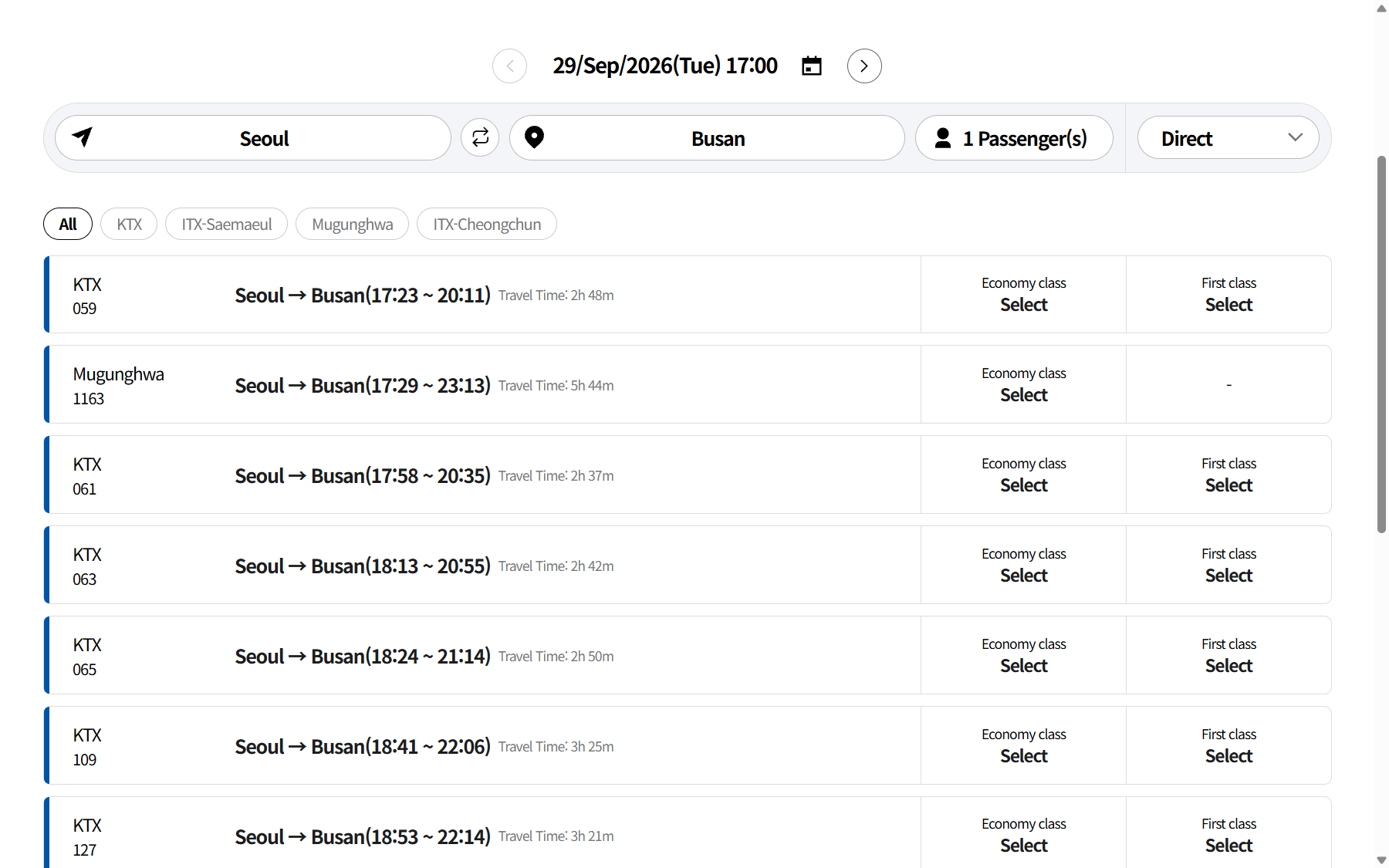
KTX is not the only train on the line. KORAIL’s search page lets you filter by ITX-Saemaeul, Mugunghwa and ITX-Cheongchun, all of which run conventional (non-high-speed) services over the same corridors. Seoul–Busan KTX departures run 2h 35m to 2h 50m, while Mugunghwa 1163 covers the same journey in 5h 44m (as of Oct 2026). That is the trade: more hours, fewer people competing for the seat.
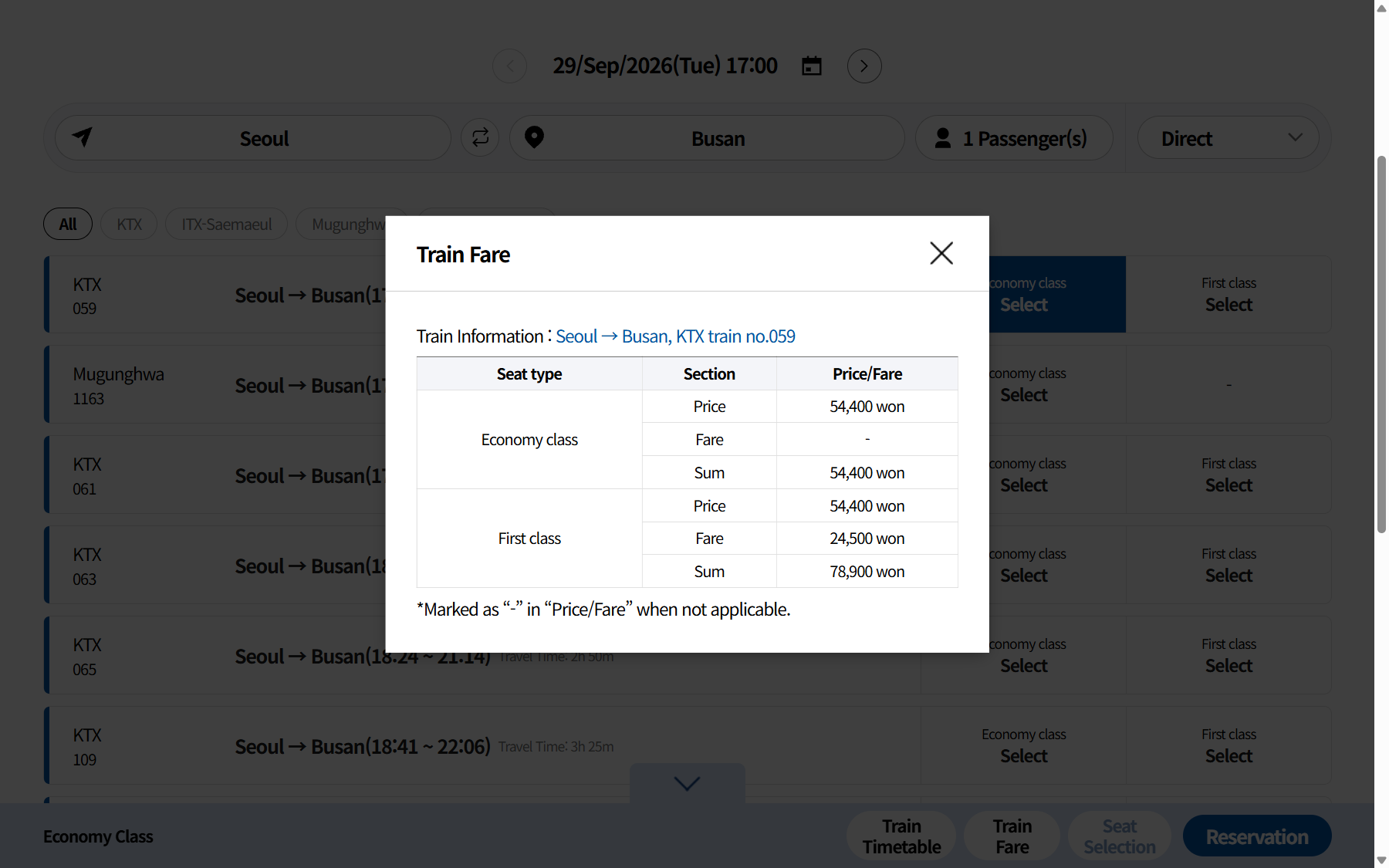
Fares differ too. KORAIL’s fare window lists a Seoul → Busan KTX economy seat at 54,400 won (78,900 won in first class) (as of Oct 2026). Conventional trains are priced below that, but KORAIL publishes fares per departure rather than as a public table, so check the exact number in the booking flow on your date instead of trusting a blog figure.
Then there is SRT, run by SR rather than KORAIL. It is a genuinely separate booking system with separate inventory, and it leaves Seoul from Suseo in the south-east of the city rather than Seoul Station. SRT sells tickets from 7am one month before departure, up to 20 minutes before the train leaves on the website and 5 minutes in the app, with a minimum cancellation charge of 400 won. If KORAIL shows KTX sold out for the time you want, SRT is the fastest second look — just budget the extra time to reach Suseo on Line 3 or the Suin-Bundang Line.
4. Take the express bus — the real backup most tourists ignore
Korea’s express bus network is the backup that foreign visitors consistently forget, and it is the one with the most spare capacity. On Kobus, the official express bus booking site, Seoul Express Bus Terminal → Busan departures run almost around the clock from 01:00 to 24:00, and next-day buses commonly still show 13 to 43 free seats when the equivalent train is filling up (as of Oct 2026).
The published fare box for that route (380.4 km, about 4 hours) reads 26,700 won for standard “gosok” seats, 39,700 won for udeung (the wide three-across seats most visitors want), and 51,600 won premium. Departures between 22:00 and 04:00 are charged at late-night rates: 32,000 / 47,600 / 61,900 won. Even premium undercuts the walk-up cost of scrambling for an alternative when KTX is sold out.
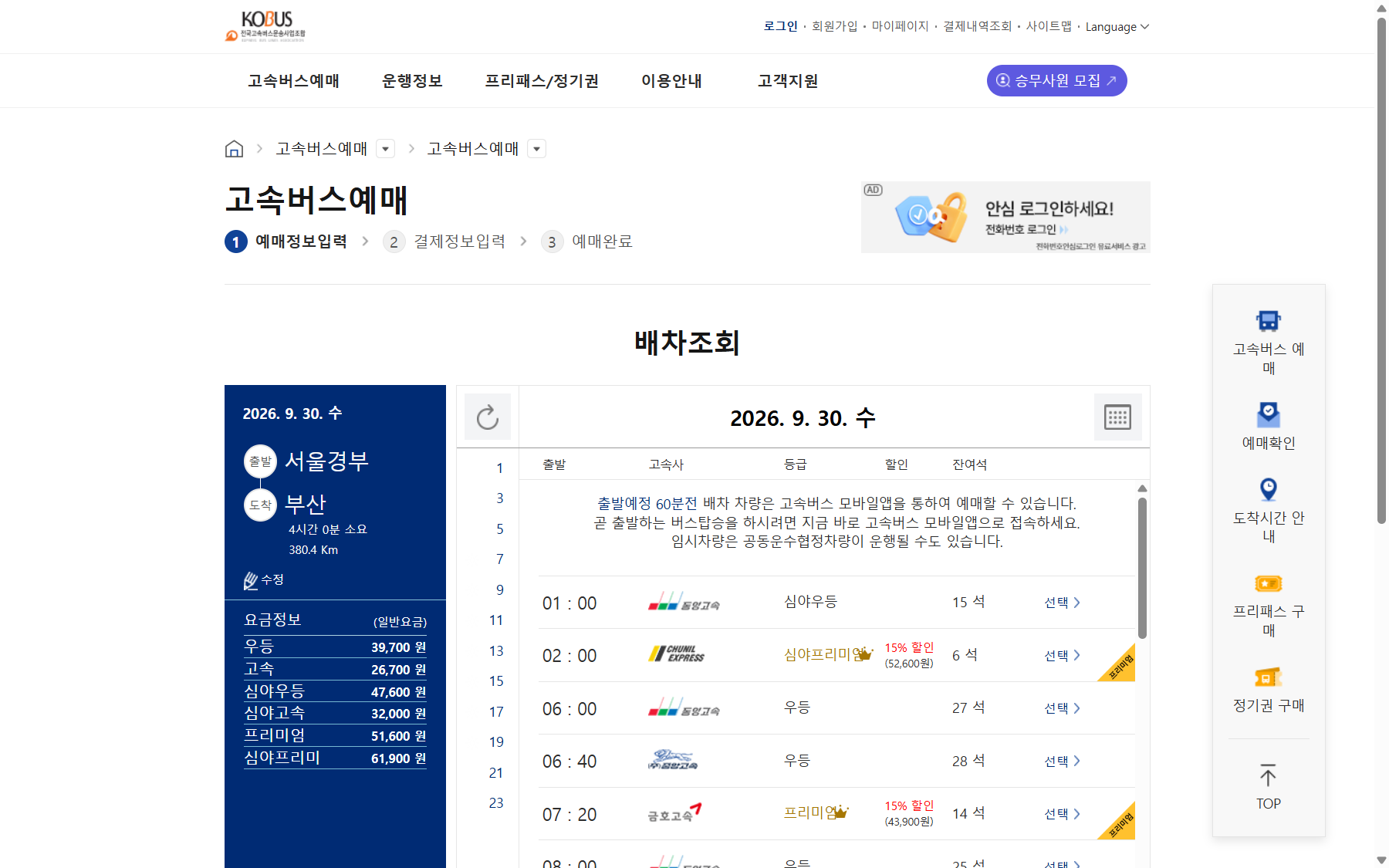
Two operator rules make buses especially forgiving. First, the Kobus website sells same-day tickets until one hour before departure, and the Kobus mobile app keeps selling inside that hour. Second, the E-Pass system lets you board with no reservation at all by tapping a transport card or a credit card with a transit function, provided the bus has an empty seat. Changes are free once, up to an hour before departure, although you cannot change the date.
The key rules at a glance
| Option | Seoul → Busan | Booking window | Source |
|---|---|---|---|
| KTX (KORAIL) | 2h 35m–2h 50m, 54,400 won economy | 07:00, 1 month ahead (2 months from 1 Oct 2026); online until departure | KORAIL |
| Mugunghwa / ITX-Saemaeul | Mugunghwa 1163: 5h 44m | Same KORAIL window and cut-offs | KORAIL |
| SRT (SR, from Suseo) | Separate inventory, separate site | 07:00, 1 month ahead; web until 20 min, app until 5 min before | SR (etk.srail.kr) |
| Express bus, standard | about 4h, 380.4 km, 26,700 won | Web until 1 hour before; app inside that hour; E-Pass walk-up | Kobus |
| Express bus, udeung / premium | 39,700 won / 51,600 won | Same as above; 22:00–04:00 costs 47,600 / 61,900 won | Kobus |
| Cancellation refunds | Mon–Thu: free until 3 hours before departure, then 5%; Fri–Sun and holidays: 5% to 20% depending on timing | Online cancellation allowed until departure | KORAIL |
5. Fly, or change which city you sleep in
Domestic flights are the last resort on the Seoul–Busan corridor rather than the first. Gimpo and Gimhae are both well outside their city centres, and once you add the airport transfer at each end plus check-in, a flight rarely beats a 2h 40m KTX door to door. Where flying genuinely wins is Jeju, which has no rail link at all, so treat “fly instead” as a Jeju answer rather than a KTX sold out answer.
If a late departure leaves you arriving in Busan after dark, pick the base by neighbourhood rather than rushing: Lotte Hotel Busan sits in Seomyeon, while Paradise Hotel Busan is on Haeundae Beach-ro near the sea.

Busan base · Seomyeon · via Agoda
Lotte Hotel Busan
⭐ 9.0/10 from 18,693 Agoda reviews · Seomyeon, Busanjin-gu · 10.1 km from Gimhae Airport · 6.9 km to BIFF Square (as of Oct 2026)
Also on Expedia: Lotte Hotel Busan · Trip.com

Busan base · Haeundae · via Agoda
Paradise Hotel Busan
⭐ 9.0/10 from 14,221 Agoda reviews · on Haeundae Beach-ro · 3.5 km to Gwangan Bridge · 6.2 km to Haedong Yonggungsa (as of Oct 2026)
Also on Expedia: Paradise Hotel Busan · Trip.com
The other under-used move is editorial, not logistical: change the shape of the trip. If every Friday-evening train south is gone, travel on Saturday morning instead and reorder your nights — our Busan vs Seoul split guide and the Seoul to Gyeongju day trip piece both work better when the long legs are booked around demand instead of against it.
Mistakes to Avoid
- Treating the first search as final. KORAIL allows online cancellation until the train departs, so a KTX sold out result at 09:00 can be a free seat by lunchtime.
- Only checking KORAIL. SRT is a different company with its own seats, departing from Suseo rather than Seoul Station, and it does not appear in KORAIL results.
- Ignoring the express bus. Seoul–Busan coaches leave through the night, cost from 26,700 won, and next-day departures commonly still have double-digit seat counts free.
- Assuming a standing ticket is bookable online. KORAIL sells standing and non-reserved seats (its KORAIL Pass terms say so), but the English site shows only “Sold out” — ask at a station window instead.
- Booking too early or too late. Nothing exists beyond the release window, and from 1 October 2026 that window is two months, not one.
- Travelling blind into Seollal or Chuseok. Demand peaks then; see our Chuseok and Seollal closures guide before locking dates.
- Relying on one foreign card. KORAIL takes credit cards, but overseas-card and Alipay/WeChat Pay support was still described as under development in September 2026 — carry a second card and some cash.
- Flying Seoul–Busan on reflex. Airport transfers usually eat the time you save; save flights for Jeju.
Frequently Asked Questions
What can I do if KTX tickets are sold out?
Refresh the same train for cancelled seats, switch to ITX-Saemaeul or Mugunghwa on the same line, check SRT from Suseo, or book an express bus. On the Seoul–Busan corridor the express bus runs roughly every 30–40 minutes and standard-grade seats cost 26,700 won, so a KTX sold out screen rarely means you cannot travel.
Do cancelled KTX tickets go back on sale?
Yes. KORAIL lets you cancel online right up to the train’s departure time, and the cancellation fee is zero or low until shortly before departure, so seats keep returning to the pool. Refresh the departure you want instead of treating the first KTX sold out result as final.
How far in advance can I book Korean train tickets?
KORAIL has sold tickets from 07:00 one month before departure. From 1 October 2026 the window doubles to two months before departure, and KORAIL says tickets for travel between 1 November and 1 December went on sale from 10:00 on 1 October. SRT still opens at 07:00 one month ahead.
Can I buy a KTX standing ticket when every seat is gone?
KORAIL sells standing and non-reserved seats on KTX and conventional trains — the KORAIL Pass conditions list them explicitly. The English booking site, however, shows only “Sold out” with no standing option, so treat standing tickets as something to ask for at a station ticket window rather than something you can count on booking online.
Is SRT a separate booking from KTX?
Yes. SRT is run by SR, not KORAIL, leaves Seoul from Suseo instead of Seoul Station, and is booked at etk.srail.kr. SRT tickets go on sale from 7am one month before departure and can be bought until 20 minutes before departure (5 minutes in the SRT app), so it is worth checking whenever KTX is sold out.
How much is the express bus from Seoul to Busan?
On the official Kobus booking page, Seoul Express Bus Terminal to Busan is 380.4 km and about 4 hours, priced at 26,700 won standard, 39,700 won “excellent” (udeung) and 51,600 won premium. Late-night departures between 22:00 and 04:00 cost more: 32,000 / 47,600 / 61,900 won.
Can I just turn up at the bus terminal without a ticket?
Often, yes. Kobus runs an E-Pass system that lets you board by tapping a transport card or a credit card with a transit function, with no advance booking, as long as the bus still has an empty seat. That is the closest thing Korea has to a walk-up backup when KTX is sold out.
Do I need to book the KTX before I arrive in Korea?
Not usually, but it helps on Friday and Sunday evenings and around Seollal and Chuseok. KORAIL takes credit cards online, and the Ministry of Land, Infrastructure and Transport said in September 2026 that support for overseas Visa, Mastercard and UnionPay cards plus Alipay and WeChat Pay is still being built, so have a backup payment method ready.
What should you sort out before your first Korean train ride?
Before you worry about a KTX sold out screen, get the basics in place: read how to get from Incheon Airport into Seoul, set up a transport card with our T-money vs Climate Card guide, install Naver Map in English so station names make sense, and check when to visit Korea so you are not fighting the whole country for the same seat.
Sources (official pages checked)
- KORAIL, “KTX Ticketing Guide” (purchase and refund rules) — korail.com
- KORAIL, “Ticket Reservation” and the two-month advance booking notice — korail.com
- KORAIL PASS conditions (standing and non-reserved seats, SRT excluded) — korail.com
- SR, “Ticket Purchase/Refund/Loss” (SRT purchase period and cancellation charges) — etk.srail.kr
- Kobus (Express Bus Association), booking guide, E-Pass and cancellation fees — kobus.co.kr
- Kobus, Seoul Express Bus Terminal → Busan fares and timetable — kobus.co.kr
- SBS News, “KTX Ticket Bookings to Open Two Months in Advance Starting Next Month” (MOLIT and KORAIL announcement, 20 Sept 2026) — news.sbs.co.kr
Book the basics for your Korea trip
Affiliate links: we may earn a small commission at no extra cost to you.
Related Guides
- Korea Travel Toolkit: what to book before you fly
- Busan vs Seoul: How to Split a 7–10 Day Trip
- Seoul to Gyeongju Day Trip: Is It Worth It?
- Chuseok and Seollal Closures: What Actually Shuts Down
- Incheon Airport to Seoul: Every Option, Real 2026 Prices
- T-money vs Climate Card: Which Seoul Transport Card
- How Much Cash to Bring to Korea
- Best Time to Visit Korea, Month by Month
- Seoul Subway Etiquette Rules Foreigners Get Wrong
- Day Trips From Seoul: Best 11 Easy Trips by Train and Tour
Last checked September 2026 against KORAIL (korail.com), SR/SRT (etk.srail.kr), Kobus (kobus.co.kr) and the Ministry of Land, Infrastructure and Transport announcement of 20 September 2026.
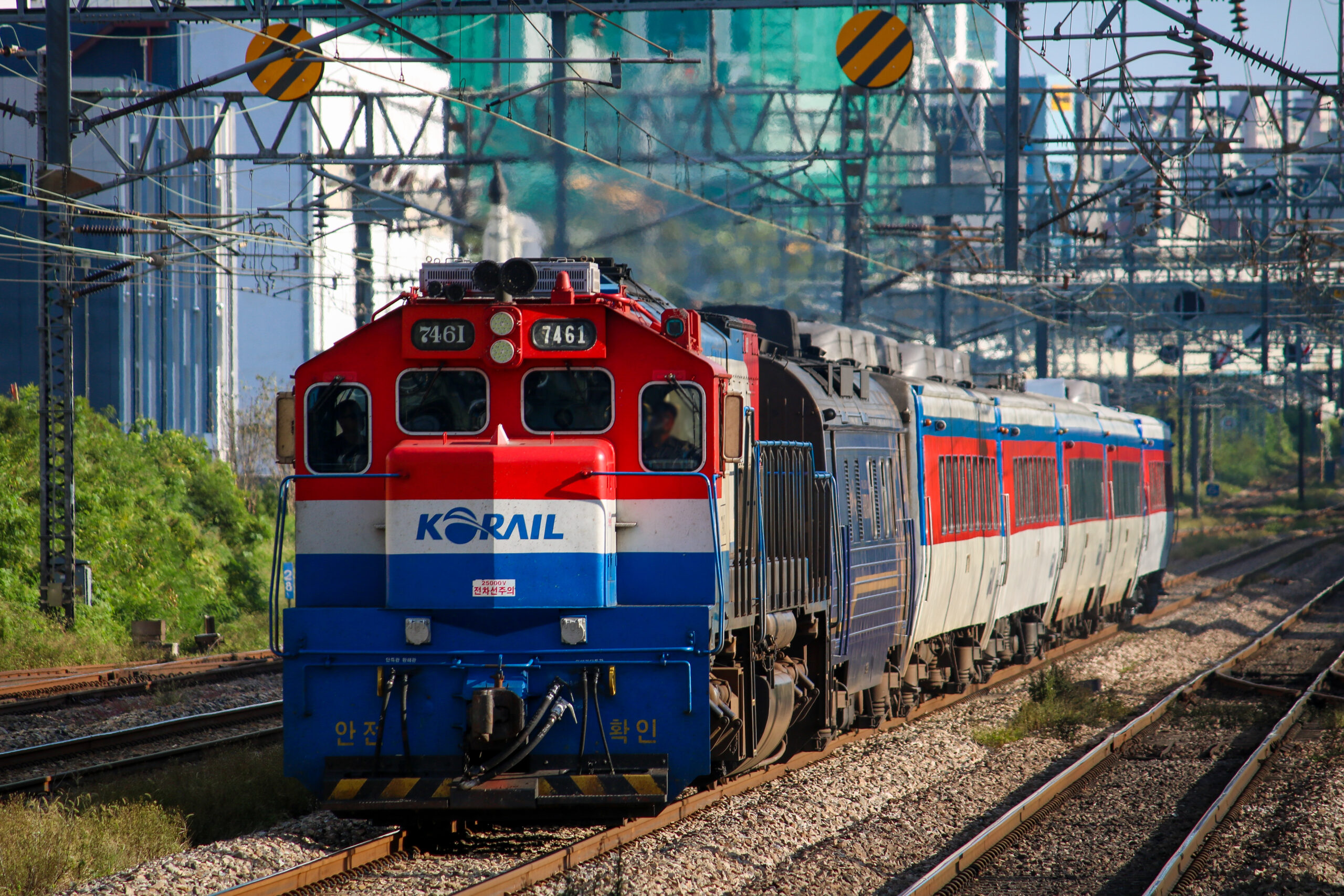
Cover photo: Mugunghwa and ITX-Saemaeul run the same routes as KTX at lower speeds and lower fares. Source: Wikimedia Commons (CC BY-SA).