Bottom line: Myeongdong is one shopping district inside Jung-gu, not a summary of Seoul, and three neighbourhoods a few subway stops away – Seongsu, Euljiro and Ikseon-dong – are documented by Seoul’s own tourism service as completely different places.
🇰🇷 Quick Korea Travel Guide
👉 Getting in: Check K-ETA requirements and the e-Arrival Card before you fly.
👉 Stay in Touch (eSIM): Grab a Korea eSIM on Airalo before you land – no airport counter queue.
👉 Download New Apps: See our Naver Map in English guide before you go hunting for alley addresses.
👉 Where to Book Activities: GetYourGuide for tours and day trips; KKday for rail passes and Korea-only tickets.
👉 Getting Around: Read our T-money vs Climate Card guide – tourists use the Climate Card short-term pass, not the residents-only Climate Pass.
👉 For more in-depth planning: Browse all our Korea Travel guides.
Disclosure: the Airalo, GetYourGuide and KKday links above are affiliate links. We may earn a commission at no extra cost to you.
The quick answer
- Myeongdong is a shopping district in Jung-gu, built around two main streets that meet mid-block – one running from Myeong-dong Station on Line 4, the other from the Lotte department store at Euljiro.
- The Korea Tourism Organization’s own description is retail: brand shops, department stores, clothes, shoes and accessories, plus donkatsu and kalguksu restaurants.
- Seongsu, in Seongdong-gu, is a former factory and workshop district that Visit Seoul now calls one of Seoul’s most influential creative neighbourhoods.
- Euljiro is an official Jung-gu “special industrial street”: roughly 80 tile and pottery shops, about 350 m of hardware stores, and a printing alley – rebranded “Hipjiro” after dark.
- Nogari Alley in Euljiro dates to 1980 and was designated a Seoul Future Heritage site in 2015.
- Ikseon-dong is an 801 m hanok alley network in Jongno-gu, 123 m from Jongno 3-ga Station Exit 4 (Lines 1, 3 and 5), free to walk, open all year.
- All four sit on the subway: Myeongdong (Line 4), Euljiro 3-ga (Lines 2 and 3), Jongno 3-ga (Lines 1, 3 and 5) and Seongsu (Line 2).
- You still cannot tap a foreign card at a Seoul fare gate; buy a T-money card or a Climate Card short-term pass first.
Walking tour pick · Seongsu-dong · via GetYourGuide
Seongsu-dong Korean Culture, K-Pop and Café Tour
3 hours with a licensed English-speaking guide · meets at Seongsu Station Exit 3 · coffee, dessert and an arts and crafts market visit · minimum 4 people (full refund if not met) · free cancellation up to 24 hours before · from ₩75,156 per person (as of Oct 2026)
What this guide covers
Why “Myeongdong is not Seoul” is a fair statement
This is not a snobbish take on a popular street. It is what the official descriptions say when you read them side by side. The Korea Tourism Organization introduces Myeongdong as “one of the primary shopping districts in Seoul” and then lists what is there: brand-name shops, department stores, clothes, shoes and accessories. That is a retail brief, and a good one.
Seoul’s own tourism service describes Seongsu, Euljiro and Ikseon-dong in completely different language – industrial heritage, specialty trades, hanok alleys, creative reuse. Same city, same subway network, entirely different reasons to walk. So spend an afternoon in Myeongdong for what it is genuinely good at, then use this guide for the three districts that show you a different Seoul without leaving the city centre.
1. What Myeongdong actually is, officially
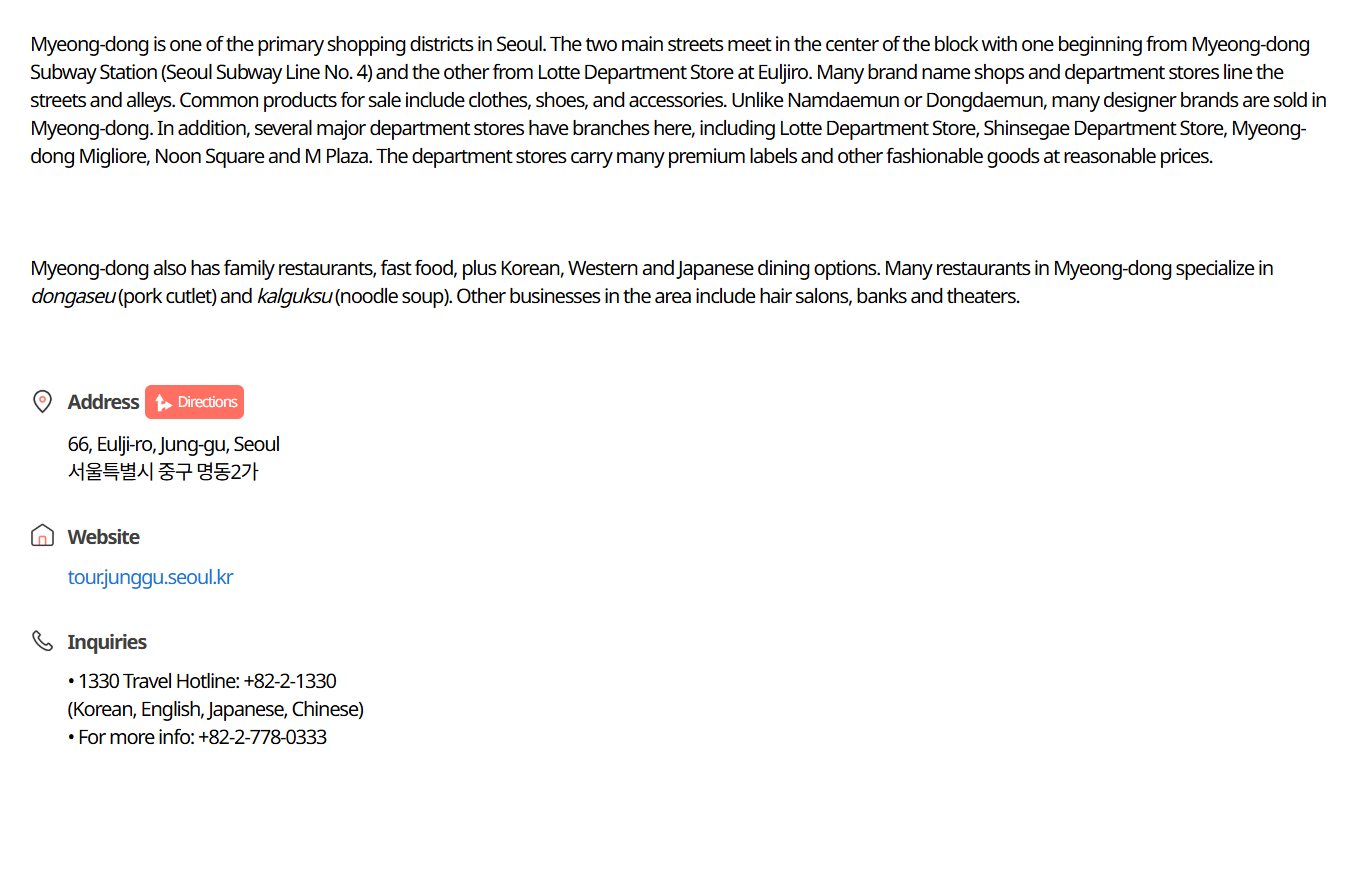
Myeongdong sits in Jung-gu, central Seoul, with the tourism listing giving the address as 66 Eulji-ro. The layout is simple once you know it: two main streets meet in the middle of the block, one starting from Myeong-dong Station on Subway Line 4 and the other from the Lotte department store at Euljiro. Everything in between is shops, alleys and food stalls.
The Korea Tourism Organization names the big anchors – Lotte Department Store, Shinsegae Department Store, Myeong-dong Migliore, Noon Square and M Plaza – and notes that unlike Namdaemun or Dongdaemun, Myeongdong carries a lot of designer brands. On the food side the official listing singles out restaurants specialising in donkatsu (pork cutlet) and kalguksu (knife-cut noodle soup), alongside family restaurants and international options.
That is a precise and useful description, and it is also the whole point: the official brief for Myeongdong is retail and convenience. Nothing in it is about neighbourhood life, industry, architecture or history. Skip the blog rankings and visitor-count superlatives: the numbers you can act on are the official ones. If you want a number you can act on, use the free 1330 travel hotline (+82-2-1330, available in English) or Jung-gu’s own tourism site. If you want to sleep in Myeongdong for the convenience, voco Seoul Myeongdong by IHG is 100 m from Hoehyeon Station.

Hotel pick · Myeongdong · via Agoda
voco Seoul Myeongdong by IHG
📍 100 m from Hoehyeon Station (Line 4) · airport limousine stop nearby · walk to Namdaemun Market and Myeongdong (as of Oct 2026)
2. Seongsu: factories turned creative district
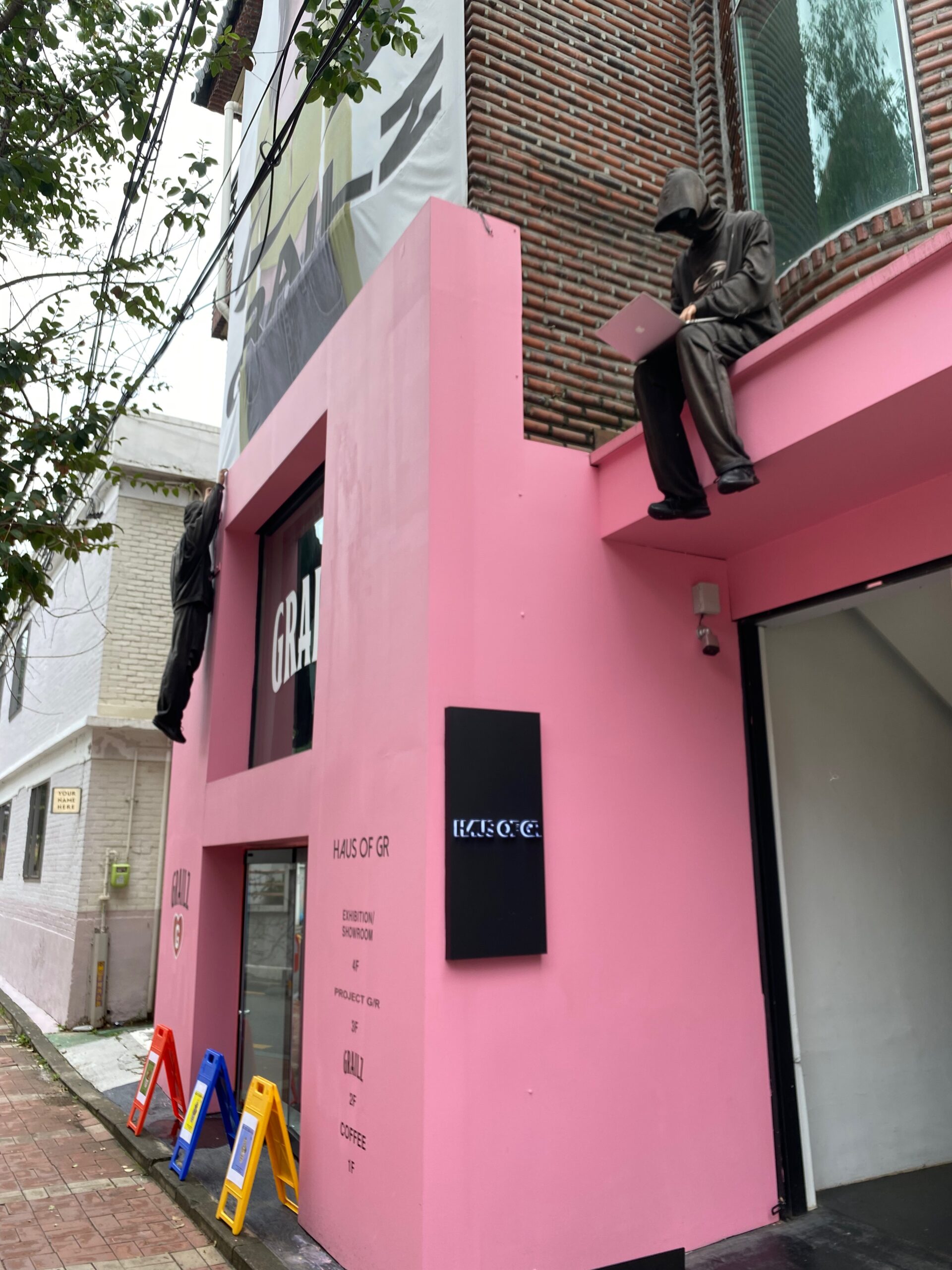
Seongsu sits in Seongdong-gu, east of the centre and just north of the Han River. Visit Seoul’s own walking feature, last edited in August 2026, puts it plainly: “Once known primarily for factories and small workshops, Seongsu has gradually evolved into one of Seoul’s most influential creative neighborhoods.” Crucially, it adds that the district did not erase that past – “brick warehouses, former shoe workshops, and industrial buildings now stand alongside cafés, beauty experiences, immersive retail spaces, and contemporary galleries.”
You will see Seongsu called “the Brooklyn of Seoul” everywhere. Treat that as a nickname the press and travel writers use, not an official designation – Seoul does not publish it. What Seoul does publish is the practical detail: the route it recommends starts a short walk from Seongsu Station Exit 3 on Line 2, and the neighbourhood is designed for slow wandering rather than a checklist. Visit Seoul’s phrasing is that Seongsu “rewards those willing to take their time”.
The pop-up scene turns over fast, so check each shop’s Instagram for what is open this week. Staying nearby? Hotel Poco Seongsu is 141 m from Seongsu Station on Line 2. For a sunset stop at the end of a Seongsu afternoon, Visit Seoul lists the Seongsu Pedestrian Overpass at 257 Gangbyeonbuk-ro, about 699 m from Seoul Forest Station Exit 3 on the Suin-Bundang Line, and suggests arriving at least 30 minutes before sunset.

Hotel pick · Seongsu · via Agoda
Hotel Poco Seongsu
⭐ 8.2/10 from 4,043 Agoda reviews · 141 m from Seongsu Station (Line 2) (as of Oct 2026)

3. Euljiro: a working industrial street that becomes Hipjiro
Euljiro starts a few minutes’ walk north of Myeongdong and is the sharpest contrast on this list, because it is still a working district. Visit Seoul’s architecture series explains that after the Korean War, industrial shops clustered along Cheonggyecheon Stream and hardware retailers concentrated in Euljiro, earning it the label “a handyman’s paradise”. Jung-gu Office has formally designated Euljiro a special industrial street so those trades stay in the city centre.
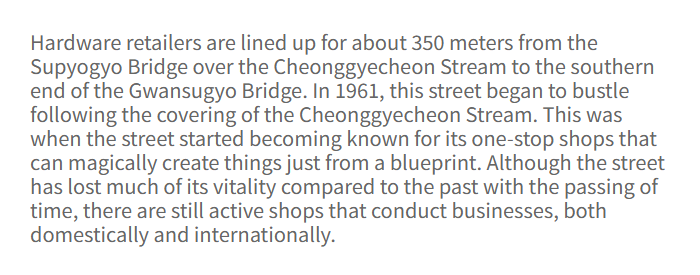
The specifics are unusually concrete for a travel page. Come out of Euljiro 3-ga Station Exit 2 or 3 and the first thing you meet is the tile and pottery street, lined with about 80 shops in near-identical three-storey buildings. Hardware retailers run for roughly 350 m from Supyogyo Bridge over Cheonggyecheon to the southern end of Gwansugyo Bridge; the street took off in 1961 after the stream was covered over. The printing alley sits in Inhyeon-dong, where printers established themselves from the end of the 1960s.
Then the light goes and the same streets become “Hipjiro”. Visit Seoul links the rebrand to the “newtro” trend, and the anchor is Nogari Alley: “an ordinary alley by day, and a pub-filled alley by night”. Its origin is dated precisely – 1980, when a pub called Eulji OB Bear started serving nogari (dried young pollack) instead of the usual bar snacks – and in 2015 the alley was designated a Seoul Future Heritage site because it was judged worth preserving. Labourers finishing work drew the first crowds; the pubs multiplied from there.
The practical consequence is that Euljiro is genuinely two neighbourhoods on the same pavement. If you walk it once, at one time of day, you have seen half of it. Note too that many of the bars sit behind unmarked doors and up unlabelled staircases – that is the well-known local convention, not an official claim, so give yourself time to find them and have Naver Map in English ready.


4. Ikseon-dong: 801 metres of hanok alleys
Ikseon-dong is the smallest of the three and the easiest to underestimate. Visit Seoul’s attraction page, last edited in September 2026, describes a hanok village that spans a length of around 801 m, connecting the Ibis Ambassador, Insadong and Nakwon Sanga – the Nakwon Music Market. Inside those alleys are “all kinds of fusion-concept cafes, restaurants, and shops that contrast with the more traditional vibe of the neighboring Insadong area”.
Access is precise: the official address is 17 Donhwamun-ro 11ga-gil, Jongno-gu, and the transport line reads Jongno 3-ga Station, Subway Lines 1, 3 and 5, Exit 4, 123 m. The Korea Tourism Organization adds the bits travellers actually ask about: opening hours vary by shop, the area is open all year round, and there is no admission fee. Enquiries go to the Insa-dong tourist information centre on +82-2-737-7885.
The draw is the setting rather than any single café. Businesses operate inside the old houses instead of replacing them, and Visit Seoul specifically recommends winter and evening visits for the atmosphere in the narrow alleys. Pair it with Insadong next door and you get the traditional-craft half of the same walk. For a base here, N285 Hotel Insadong is about 300 m from Insadong.

Hotel pick · Insadong · via Agoda
N285 Hotel Insadong
⭐ 8.7/10 from 7,218 Agoda reviews · about 300 m from Insadong · 448 m from Jonggak Station · walk to Bukchon Hanok Village (726 m) (as of Oct 2026)

The key rules at a glance
| Area | District | Nearest station and exit | What the official source says |
|---|---|---|---|
| Myeongdong | Jung-gu | Myeong-dong Station, Line 4 | “One of the primary shopping districts in Seoul”; two main streets, designer brands, department stores (KTO) |
| Seongsu | Seongdong-gu | Seongsu Station Exit 3, Line 2 | Former factories and shoe workshops, now “one of Seoul’s most influential creative neighborhoods” (Visit Seoul) |
| Euljiro | Jung-gu | Euljiro 3-ga Station Exit 2 or 3, Lines 2 and 3 | Jung-gu-designated special industrial street; ~80 tile shops; ~350 m of hardware stores (Visit Seoul) |
| Nogari Alley | Jung-gu | Euljiro 3-ga Station, Lines 2 and 3 | Dates to 1980; Seoul Future Heritage site since 2015 (Visit Seoul) |
| Ikseon-dong | Jongno-gu | Jongno 3-ga Station Exit 4, Lines 1, 3 and 5, 123 m | About 801 m of hanok alleys; free; open all year, hours vary by shop (Visit Seoul, KTO) |
| Seongsu Pedestrian Overpass | Seongdong-gu | Seoul Forest Station Exit 3, Suin-Bundang Line, 699 m | Sunset and night-view spot; arrive 30 minutes before sunset (Visit Seoul) |
5. How to string them together by subway
The geography is friendlier than it looks on a map. Euljiro 3-ga and Jongno 3-ga are adjacent stations on Line 3, so Euljiro and Ikseon-dong are one stop or a short walk apart and make an obvious pairing: hanok alleys in the afternoon, the industrial streets as the light drops, then Nogari Alley and the Hipjiro bars after dark.
Seongsu is a separate half-day. Euljiro 3-ga is also on Line 2, which runs directly east to Seongsu Station, so you can start from the same station you used for Euljiro. Because Seongsu is about grazing rather than ticking off landmarks, give it a morning-into-afternoon slot with a sunset stop at the pedestrian overpass rather than squeezing it onto the end of a Myeongdong day.
Myeongdong itself works best as a half-day at either end of the trip – it is well connected on Line 4, it has the densest concentration of cosmetics and mid-range fashion, and it is walkable to Euljiro. Treat it as a shopping errand rather than a sightseeing day and the whole “Myeongdong is not Seoul” argument stops being a complaint and becomes an itinerary.
6. What to pay with once you leave Myeongdong
Department stores in Myeongdong take international cards without drama. Small workshops, old pubs and market stalls are where visitors get caught, and the transport rules are the part people get wrong most often. You cannot tap your own overseas credit card at a Seoul fare gate: the open-loop rollout puts new readers on subway Lines 1 to 8 and on city buses in 2027. Until then you need a T-money card or a Climate Card short-term pass.
A physical T-money card is topped up with cash only, in 1,000-won units. Foreign cards can buy single tickets and Climate Card short-term passes at the newer station machines, but not load an ordinary T-money balance. Our T-money vs Climate Card guide and our cash guide cover the details, and the Climate Card guide explains why tourists use the short-term pass rather than the residents-only Climate Pass.
Mistakes to Avoid
- Booking three nights around Myeongdong and calling it Seoul. The official description of Myeongdong is a shopping district. Stay there for convenience, but plan days elsewhere.
- Visiting Euljiro once, in daylight. The tile, hardware and printing streets and the Hipjiro bar scene are the same pavement at different hours.
- Treating Seongsu as a checklist. Visit Seoul’s own framing is that it rewards taking your time; the pop-ups change constantly, so any list you copy will be stale.
- Skipping Ikseon-dong because “it’s just cafés”. The 801 m of hanok alleys is the attraction; entry is free and it is 123 m from Jongno 3-ga Exit 4.
- Using the wrong exit. Euljiro 3-ga Exit 2 or 3 puts you on the tile street; Jongno 3-ga Exit 4 puts you at Ikseon-dong. Any other exit adds a long detour.
- Quoting blog superlatives as fact. Shopping-street world rankings and pop-up counts change constantly, so rely on the official pages listed below.
- Assuming a contactless card opens the fare gate. It does not until the 2027 rollout – buy a T-money card or Climate Card short-term pass first.
- Arriving with no cash. Physical T-money reloads are cash only, and older pubs and workshops are the most likely places to be card-shy.
Frequently Asked Questions
Is Myeongdong worth visiting?
Yes, for what it is. The Korea Tourism Organization describes Myeongdong as one of Seoul’s primary shopping districts, with two main streets, department stores including Lotte and Shinsegae, and a lot of designer brands. It is efficient for cosmetics, mid-range fashion and a quick meal. It is not a cross-section of the city, which is why most visitors are happier giving it a half-day.
Which Seoul neighbourhoods should I visit instead of Myeongdong?
Seongsu in Seongdong-gu, Euljiro in Jung-gu and Ikseon-dong in Jongno-gu. Visit Seoul documents all three: Seongsu as a former factory district now full of cafés and galleries, Euljiro as a working specialty-trade street that turns into bars at night, and Ikseon-dong as roughly 801 m of hanok alleys.
Why is Seongsu called the Brooklyn of Seoul?
Because it followed a similar arc: Visit Seoul says Seongsu was “once known primarily for factories and small workshops” and has become “one of Seoul’s most influential creative neighborhoods”, with brick warehouses and former shoe workshops reused as cafés, flagship stores and galleries. The Brooklyn nickname comes from writers and the press, not from an official Seoul designation.
What is Euljiro known for?
Working trades by day and bars by night. Jung-gu Office designates Euljiro a special industrial street; Visit Seoul counts about 80 tile and pottery shops near Euljiro 3-ga Station Exits 2 and 3, roughly 350 m of hardware stores between Supyogyo and Gwansugyo bridges, and a printing alley in Inhyeon-dong. After dark the same streets are marketed as “Hipjiro”.
What is Nogari Alley in Euljiro?
A pub alley that Visit Seoul dates to 1980, when a bar called Eulji OB Bear began serving nogari, dried young pollack, instead of standard bar snacks. Workers from the surrounding workshops filled it, more pubs opened, and in 2015 Seoul designated the alley a Seoul Future Heritage site.
How do I get to Ikseon-dong Hanok Village?
Take Subway Line 1, 3 or 5 to Jongno 3-ga Station and use Exit 4; Visit Seoul lists the village 123 m from that exit, at 17 Donhwamun-ro 11ga-gil, Jongno-gu. There is no entrance fee, the area is open all year, and individual shop hours vary.
How do I get from Myeongdong to Seongsu?
Walk or ride one stop to Euljiro 3-ga, then take Line 2 east to Seongsu Station. Visit Seoul’s own Seongsu walking route starts near Seongsu Station Exit 3. For a sunset finish, the Seongsu Pedestrian Overpass is about 699 m from Seoul Forest Station Exit 3 on the Suin-Bundang Line.
Can I pay by card in these neighbourhoods?
Department stores and newer cafés take international cards. Older pubs and small workshops are less reliable, and you cannot tap a foreign card at a subway fare gate until Seoul’s open-loop rollout in 2027. Buy a T-money card – cash top-ups only, in 1,000-won units – or a Climate Card short-term pass before your first ride.
What else should you plan before you land?
Get the boring layer right and neighbourhood days get easy: read our Seoul subway etiquette guide before your first packed carriage, plan the ride in with the Incheon Airport to Seoul guide, pick a market meal with our Gwangjang Market guide, and check the best time to visit Korea before you lock in dates.
Sources (official pages)
- Korea Tourism Organization, “Myeong-dong” – english.visitkorea.or.kr
- Visit Seoul (Seoul Metropolitan Government), “Ikseon-dong Hanok Village” – english.visitseoul.net
- Visit Seoul, “A Tour of Seoul’s Streetside Architecture (3): Euljiro 3-ga’s Nogari Alley to Hipjiro” – english.visitseoul.net
- Visit Seoul, “Exploring Seongsu: Seoul’s Creative Playground” – english.visitseoul.net
- Visit Seoul, “Seongsu Pedestrian Overpass” – english.visitseoul.net
- Korea Tourism Organization, “Ikseon-dong Hanok Street” – english.visitkorea.or.kr
Book the basics for your Korea trip
Affiliate links: we may earn a small commission at no extra cost to you.
Related Guides
- Korea Travel Toolkit: what to book before you fly
- Insadong: Seoul’s Traditional Shopping Street, Done Right
- Gwangjang Market: Tourist Trap or Where Locals Actually Eat
- Seoul Nightlife: Itaewon vs Hongdae vs Gangnam
- The Korea Motel Booking Trap
- Busan vs Seoul: How to Split 7-10 Days
- Seoul Subway Etiquette: The Rules Seoul Actually Publishes
- Korea Convenience Store Guide
- Naver Map in English: The App Korea Actually Runs On
- Seoul Food Tour: Best Tours Compared by Area (2026)
- KPop Demon Hunters Seoul Locations: Best Spots to Visit
Last checked September 2026 against Visit Seoul (english.visitseoul.net) and the Korea Tourism Organization (english.visitkorea.or.kr).
Cover photo: Myeongdong’s two main shopping streets meet mid-block. Source: Wikimedia Commons.