Bottom line: Seoul nightlife is decided by the clock, not the district – the subway stops around midnight, the late-night N bus runs 00:00-04:00 for ₩2,500, and a standard taxi costs 40% more between 23:00 and 02:00, so pick your ride home before you pick your bar.
🇰🇷 Quick Korea Travel Guide
👉 Getting in: Check K-ETA requirements and the e-Arrival Card before you fly.
👉 Stay in Touch (eSIM): Grab a Korea eSIM on Airalo before you land – you will want data at 2am.
👉 Download New Apps: See our Naver Map in English guide and our Kakao T taxi guide.
👉 Where to Book Activities: GetYourGuide for tours and night walks; KKday for rail passes and Korea-only tickets.
👉 Getting Around: Read our T-money vs Climate Card guide – tourists use the Climate Card short-term pass, not the residents-only Climate Pass.
👉 For more in-depth planning: Browse all our Korea Travel guides.
Disclosure: the Airalo, GetYourGuide and KKday links above are affiliate links. We may earn a commission at no extra cost to you.
The quick answer
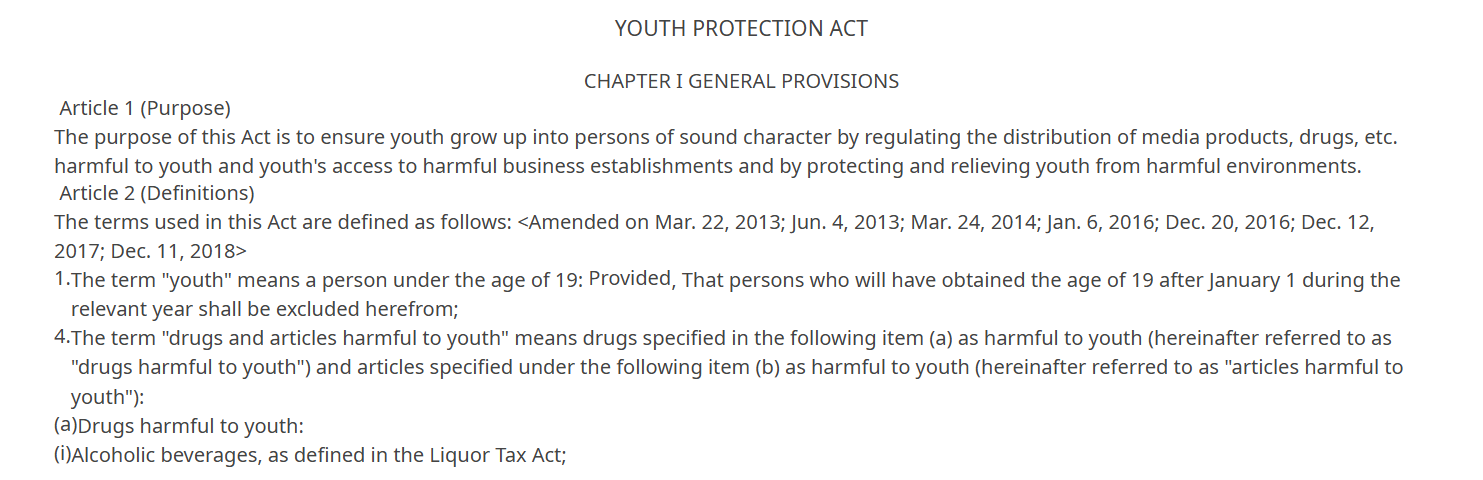
- Legal age: the Youth Protection Act defines a “youth” as under 19, excluding anyone who turns 19 later in the same calendar year – so the line is 1 January of the year you turn 19.
- Sellers of alcohol and tobacco are legally required to verify age and identity. Carry your passport, not a photo of it.
- Subway: Visit Seoul lists operating time as 05:30 to midnight, varying by station. Check the last train on the platform board.
- Late-night N bus (Owl bus): Seoul says it runs 00:00 to 04:00 (last departure), at a flat ₩2,500 adult fare.
- Standard taxi surcharges: +20% 22:00-23:00, +40% 23:00-02:00, +20% 02:00-04:00, plus 20% outside Seoul city limits.
- Deluxe, van and SUV taxis carry a flat +20% from 22:00 to 04:00 on a ₩7,000 base fare.
- Transfer discounts get more generous at night: the window is 30 minutes by day but 60 minutes between 21:00 and 07:00.
- Hongdae, Itaewon and Gangnam are all official Visit Seoul districts; the difference for a visitor is mostly transport, not scene.
What this guide covers
How to plan Seoul nightlife around the clock
Most guides to Seoul nightlife rank districts by vibe. That is the least useful thing to know, because every visitor’s night ends the same way: working out how to get back to the hotel after the trains stop. Seoul publishes exact numbers for all of it – subway hours, the late-night bus window, taxi surcharges by time band, and the transfer window that doubles after 21:00.
So this guide is built around the clock rather than around club recommendations. Busy hours, prices and music differ by venue and by week, so check a venue’s Instagram for this week’s hours before you go.
1. The legal age and the ID rule
Korea’s drinking age is set indirectly, through the Youth Protection Act. Article 2 defines a “youth” as “a person under the age of 19: Provided, That persons who will have obtained the age of 19 after January 1 during the relevant year shall be excluded herefrom.” In plain terms: you stop being a protected minor on 1 January of the calendar year in which you turn 19, not on your birthday.
The same Act puts the obligation on the seller, not the buyer: a person selling, lending or distributing drugs harmful to youth – the category that includes alcoholic beverages and tobacco – “shall verify their age and identity”, and must display the prohibition on selling to youth in the establishment. That is why a convenience store clerk or a bar door will ask for ID even when you clearly look older.
Practically, carry your passport. A foreign driving licence may not be accepted, a photo on your phone is not identity verification, and staff who get this wrong face penalties. If you would rather not carry the original around a club district, note that this is one of the few situations where a copy genuinely does not help.
2. Last subway: what Seoul actually publishes
Visit Seoul’s subway page states that the system “operates continuously from approximately 5:30 AM until midnight”, and explicitly adds that the operating time varies by subway station. That last clause is the one that catches people out: “around midnight” is a network average, and the last train through your station in your direction can be well before that.
Two habits fix this. First, check the last-train time on the platform display or in Naver Map before you settle in for the evening – our Naver Map in English guide covers switching the app to English. Second, decide early whether you are catching the last train or accepting that you are on buses and taxis, because the half-hour of indecision is what turns a ₩1,500 ride into a surcharged taxi fare.
One more Seoul nightlife detail worth knowing: the transfer discount window widens at night. Seoul’s own rules say you must board within 30 minutes of tapping off to get a transfer, but within 60 minutes between 21:00 and 07:00, with up to four transfers (five boardings). That makes a subway-then-bus combination genuinely viable late in the evening. Read our Seoul subway etiquette guide if it is your first packed late-night carriage.

3. The Owl bus, the cheapest way home
Seoul runs a dedicated late-night bus network, branded the Owl bus and numbered with an N prefix. The city’s own public transport guide, updated in September 2026, describes “the late-night (N) bus that operates from 12 AM to 4 AM (last time of departure)” and notes the service is available “regardless of distance and time”.
The fare is on Seoul’s published bus table: ₩2,500 for an adult, by card or cash, with ₩1,600 teen and ₩1,400 child fares. Owl buses are also the one category excluded from the early-morning 20% card discount, so the ₩2,500 is flat. Compare that with a surcharged taxi and the maths is not close.
Route coverage is the part to check on the day rather than trust from a blog. Seoul has published different route counts over the years – nine routes in the original rollout, with temporary additions around year-end – so look up the live N routes in Naver Map, Kakao Map or Seoul TOPIS rather than relying on a fixed list. Seoul’s stated design principle is that routes follow late-night demand, which means they change.


4. Taxis after midnight: the real surcharge table
Seoul publishes its taxi tariff in full, and the late-night bands are the part that matters for Seoul nightlife. A standard sedan taxi starts at ₩4,800 for the first 1.6 km in the daytime. At night the base fare itself changes: ₩5,800 between 22:00 and 23:00, ₩6,700 between 23:00 and 02:00, and ₩5,800 between 02:00 and 04:00.
On top of that, the published surcharge structure is +20% from 22:00 to 23:00, +40% from 23:00 to 02:00 and +20% from 02:00 to 04:00, with a further 20% for journeys outside Seoul city limits and up to 60% for late-night rides outside the city. Deluxe, van and SUV taxis work differently: a ₩7,000 base fare for the first 3 km and a flat +20% across the whole 22:00-04:00 window.
Two consequences. Leaving between 23:00 and 02:00 is the single most expensive decision you can make on a night out, so either catch the last train or wait for the Owl bus. And if your hotel is over the city boundary – Bucheon, Goyang, parts of Gyeonggi – the out-of-city surcharge stacks on the night surcharge. Our Kakao T taxi guide covers hailing in English, and our Incheon Airport guide has the airport-run numbers.

The key rules at a glance
| Item | Official value | Source |
|---|---|---|
| Legal age for alcohol | Not a “youth” from 1 January of the year you turn 19 | Youth Protection Act, Art. 2 |
| ID checks | Sellers must verify age and identity; passport recommended | Youth Protection Act, Art. 28 |
| Subway hours | Approx. 05:30 to midnight, varies by station | Visit Seoul |
| Late-night N bus (Owl bus) | 00:00-04:00 (last departure) | Seoul Metropolitan Government |
| Owl bus fare | ₩2,500 adult / ₩1,600 teen / ₩1,400 child; no early-morning discount | Seoul Metropolitan Government |
| Standard taxi base | ₩4,800 daytime; ₩5,800 (22:00-23:00), ₩6,700 (23:00-02:00), ₩5,800 (02:00-04:00) | Seoul Metropolitan Government |
| Standard taxi surcharge | +20% 22:00-23:00, +40% 23:00-02:00, +20% 02:00-04:00; +20% outside city limits | Seoul Metropolitan Government |
| Deluxe / van / SUV taxi | ₩7,000 base for 3 km; flat +20% 22:00-04:00 | Seoul Metropolitan Government |
| Transfer window | 30 minutes by day; 60 minutes 21:00-07:00; up to 4 transfers | Seoul Metropolitan Government |
| Emergency numbers | 112 police, 119 fire and ambulance, 1330 tourist hotline (24/7) | Seoul Metropolitan Government |
5. Hongdae vs Itaewon vs Gangnam, honestly
All three are official Visit Seoul districts, which is to say they are big enough that the city organises its own tourism content around them. Crowds, door prices and music policies change as venues turn over, so check each venue’s Instagram for this week’s details. The stable part is where each district sits on the network.
Hongdae is around Hongik University Station and is the most subway-redundant of the three, sitting on Line 2, the Gyeongui-Jungang Line and AREX – useful if you are heading to or from Incheon. The Korea Tourism Organization’s own accommodation pages name Hongdae and neighbouring Yeonnam-dong as prime guesthouse areas, which is the practical reason it suits a late night: you can walk home.
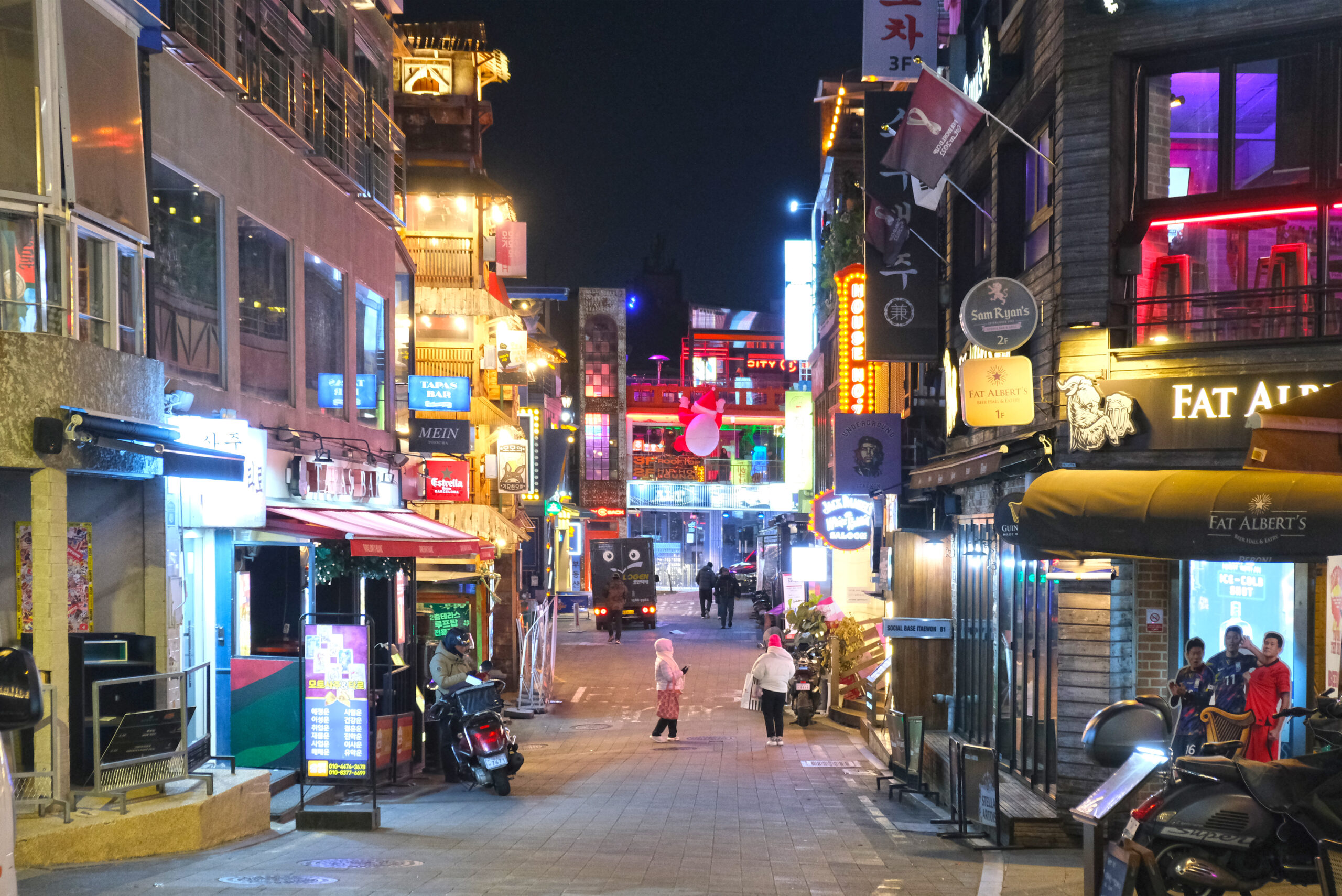
Itaewon sits on Line 6 in Yongsan-gu, close to central Seoul but on a line with fewer interchanges, so plan the connection rather than assuming one. Gangnam is on Line 2 and the Sinbundang Line south of the river; note that the Sinbundang Line is not covered by the Climate Card short-term pass, so check which line you are actually tapping into. Crossing the river after the last train is where the taxi surcharge bites hardest.
If you want a neighbourhood recommendation rather than a club recommendation, our Myeongdong is not Seoul guide covers Euljiro’s bar alleys with official sources – including Nogari Alley, which Seoul designated a Future Heritage site in 2015 and which is a short walk from central hotels.
Sleeping where you party saves the late-night taxi surcharge. In Hongdae, L7 Hongdae by Lotte Hotels and Holiday Inn Express Seoul Hongdae are both within about 300 m of Hongik Univ. Station; in Itaewon, Hamilton Hotel Itaewon is 68 m from Itaewon Station and Mondrian Seoul Itaewon is 689 m away (Agoda ratings as of Oct 2026).

Nightlife base · Hongdae · via Agoda
L7 HONGDAE by LOTTE HOTELS
⭐ 8.9/10 from 22,543 Agoda reviews · 237 m from Hongik Univ. Station · city-view rooms and a 22nd-floor rooftop bar (as of Oct 2026)

Nightlife base · Hongdae · via Agoda
Holiday Inn Express Seoul Hongdae by IHG
⭐ 8.9/10 from 16,847 Agoda reviews · 311 m from Hongik Univ. Station · breakfast available (as of Oct 2026)

Nightlife base · Itaewon · via Agoda
Hamilton Hotel Itaewon
⭐ 8.3/10 from 8,110 Agoda reviews · 68 m from Itaewon Station (Exit 1) · rooftop pool (as of Oct 2026)

Nightlife base · Itaewon · via Agoda
Mondrian Seoul Itaewon
⭐ 8.6/10 from 4,977 Agoda reviews · 689 m from Itaewon Station · rooftop bar (as of Oct 2026)
Compare more Seoul hotels on Agoda by neighbourhood.
6. Safety numbers worth saving first
Save three numbers before you go out: 112 for police, 119 for fire and ambulance, and 1330 – the Korea Travel Hotline, which Seoul lists as operating 24/7 in multiple languages and which can interpret for you in an emergency. From abroad or on a foreign SIM, 1330 is +82-2-1330. Our Korea emergency numbers guide has the full list.
We are deliberately not publishing district-by-district safety ratings. Seoul does not issue them, and any crime comparison we invented would be worse than useless. The one genuinely official piece of advice that applies to a night out is the same one Incheon Airport gives arrivals: use licensed, marked taxis and app-hailed rides rather than anyone who approaches you on the street offering a lift.
On payment, plan for cash. You cannot tap your own overseas card at a fare gate until Seoul’s open-loop rollout in 2027, and a physical T-money card is topped up with cash only, in 1,000-won units. Owl buses accept cash at ₩2,500, but a working transport card is the simpler answer – see our cash guide and Climate Card guide.
Mistakes to Avoid
- Assuming “midnight” means your station. Visit Seoul says operating hours vary by station; check the last train on the platform board.
- Leaving between 23:00 and 02:00 by taxi. That is the +40% band and a ₩6,700 base fare – the most expensive hour of the night.
- Forgetting the out-of-city surcharge. A hotel over the Seoul boundary adds 20%, and up to 60% for late-night rides outside the city.
- Not carrying your passport. Sellers are legally required to verify age and identity; a phone photo is not verification.
- Ignoring the Owl bus. A flat ₩2,500 between 00:00 and 04:00 beats any surcharged taxi fare.
- Trusting a fixed list of N routes. Seoul designs them around late-night demand and has changed them; check TOPIS or a map app on the night.
- Assuming a Climate Card covers everything. The Sinbundang Line to Gangnam is not included, and the residents-only Climate Pass is a different product.
- Taking a lift from someone who approaches you. Use marked, licensed taxis or an app – the same advice Korean airports give arrivals.
Frequently Asked Questions
What is the legal drinking age in South Korea?
Effectively 19, but measured by calendar year. The Youth Protection Act defines a “youth” as a person under 19, excluding anyone who will turn 19 later in the same year – so you are treated as an adult from 1 January of the year you turn 19. Sellers of alcohol are legally required to verify age and identity.
What ID do I need for bars and clubs in Seoul?
Bring your passport. The Youth Protection Act requires sellers of alcohol and tobacco to verify age and identity, so door staff and convenience store clerks will ask. A photo of your passport on your phone is not identity verification, and a foreign driving licence may not be accepted.
What time does the Seoul subway stop running?
Visit Seoul lists the subway operating time as approximately 5:30 AM to midnight, and states explicitly that it varies by station. Treat midnight as a network average rather than a guarantee, and check the last train for your line and direction on the platform display or in a map app.
How do I get home in Seoul after the subway stops?
Take the late-night N bus, branded the Owl bus. The Seoul Metropolitan Government says it operates from 12 AM to 4 AM (last departure), at a flat adult fare of ₩2,500 by card or cash. Otherwise it is a taxi, which carries a 40% surcharge between 23:00 and 02:00.
How much extra does a Seoul taxi cost at night?
Seoul’s published tariff sets a standard-taxi surcharge of 20% from 22:00 to 23:00, 40% from 23:00 to 02:00 and 20% from 02:00 to 04:00, with base fares of ₩5,800, ₩6,700 and ₩5,800 in those bands against ₩4,800 in the daytime. Journeys outside the city limits add 20%, and late-night rides outside the city can add up to 60%.
Is the transfer discount different at night in Seoul?
Yes. Seoul’s transfer rules require you to board within 30 minutes of tapping off, but the window is 60 minutes between 21:00 and 07:00 the following day. Transfers are allowed up to four times, five boardings in total, and you must tap when getting off.
Which Seoul district is best for a night out?
It depends on your hotel, not the scene. Hongdae has the most subway redundancy, sitting on Line 2, the Gyeongui-Jungang Line and AREX. Itaewon is on Line 6 with fewer interchanges. Gangnam is on Line 2 and the Sinbundang Line, which the Climate Card short-term pass does not cover. Crossing the river after the last train is where taxi surcharges hurt most.
What emergency numbers should I save before a night out in Seoul?
112 for police, 119 for fire and ambulance, and 1330 for the Korea Travel Hotline, which Seoul lists as 24/7 and multilingual – +82-2-1330 from a foreign number. Save all three before you go out rather than looking them up when you need them.
What should you sort before your first night out?
Three things, in order: a transport card via our T-money vs Climate Card guide, a taxi app via our Kakao T guide, and the emergency numbers saved in your phone. Then read our convenience store guide, because that is where most Seoul nights start and end.
Sources (official pages checked)
- Youth Protection Act, Articles 2 and 28 (definition of youth; duty to verify age and identity), official English translation – elaw.klri.re.kr
- Seoul Metropolitan Government, “Modes of Transport” (bus and taxi fare tables, night surcharges, transfer rules) – english.seoul.go.kr
- Seoul Metropolitan Government, “Public Transportation” (late-night N bus hours) – english.seoul.go.kr
- Seoul Metropolitan Government, “Travel Safely Around the City Even at Night With Seoul’s Owl Bus” – english.seoul.go.kr
- Visit Seoul (Seoul Metropolitan Government), “Subway” (operating hours) – english.visitseoul.net
- Tmoney, foreigner user guide (cash-only top-up) – pay.tmoney.co.kr
Book the basics for your Korea trip
Affiliate links: we may earn a small commission at no extra cost to you.
Related Guides
- Korea Travel Toolkit: what to book before you fly
- Kakao T Taxi Guide for Foreign Visitors
- Korea Emergency Numbers You Should Save
- Myeongdong Is Not Seoul: The Neighbourhoods Tourists Skip
- Seoul Subway Etiquette: The Rules Seoul Actually Publishes
- Korea Convenience Store Guide
- Gwangjang Market: Tourist Trap or Where Locals Actually Eat
- The Korea Motel Booking Trap
- How Much Cash to Bring to Korea
- Gay Bars Seoul: Best Verified Spots and Etiquette 2026 — verified gay and lesbian bars by area
- LGBT Korea: Is It Safe? Seoul Travel Guide for 2026 — LGBTQ+ travel and safety in Korea
Last checked September 2026 against the Seoul Metropolitan Government (english.seoul.go.kr), Visit Seoul (english.visitseoul.net) and the Korea Legislation Research Institute’s English translation of the Youth Protection Act (elaw.klri.re.kr).