Bottom line: the Kakao T taxi app is the app Korean drivers actually use, but Kakao Mobility built a separate app — k.ride — for foreign visitors precisely because overseas cards and overseas sign-ups keep failing on Kakao T taxi app. Install one of the two before you land, and know the metered fare so you can tell a fair ride from an airport call-van scam.
🇰🇷 Quick Korea Travel Guide
👉 Getting in: Check K-ETA requirements and file the e-Arrival Card before you fly.
👉 Stay in Touch (eSIM): Install a Korea eSIM from Airalo — a taxi app is useless without data.
👉 Download New Apps: Pair your taxi app with Naver Map in English so you can show the driver a Korean address.
👉 Where to Book Activities: GetYourGuide Seoul for tours, then KKday for KTX rail and Korea-only passes.
👉 Getting Around: Keep a T-money card or a Climate Card short-term pass topped up — see our T-money vs Climate Card guide.
👉 For more in-depth planning: Browse all our Korea Travel guides.
Disclosure: the eSIM, tour and rail links above are affiliate links. If you buy through them we may earn a commission at no extra cost to you. All fares in this guide come from Seoul Metropolitan Government, Incheon Airport and operator pages.
The short answer on the Kakao T taxi app
- Kakao T taxi app is Kakao Mobility’s domestic ride-hailing app; k.ride is the same company’s app built for international travellers, in English, Japanese and Chinese, with destination search and driver chat in 133 languages.
- k.ride takes Google, Apple or email sign-up and overseas-issued cards plus Alipay, GrabPay and similar wallets — and it explicitly does not accept cards issued in Korea.
- A Seoul standard taxi starts at ₩4,800 for the first 1.6 km, then ₩100 per 131 m or ₩100 per 30 seconds below 15.72 km/h (Seoul Metropolitan Government).
- Late-night surcharges are tiered: 20% from 22:00–23:00 and 02:00–04:00, 40% from 23:00–02:00. Leaving the city limits adds 20%, and the two together cap at 60%.
- Deluxe and jumbo taxis start at ₩7,000 for 3 km with a flat 20% night surcharge from 22:00 to 04:00.
- From Incheon Airport the International Taxi runs flat zone fares of ₩70,000–₩95,000 for a standard car and ₩100,000–₩140,000 for a deluxe or large one, tolls included.
- Incheon Airport warns in writing that illegal call vans posing as taxis solicit and overcharge — use the numbered designated stands only.
- Every licensed taxi charges the meter; there is no negotiating, and all Seoul fares are rounded to the nearest ₩10.
Private transfer · via GetYourGuide
Seoul: Private Transfer To/From Incheon Airport
⭐ 4.8/5 from 1,284 GetYourGuide reviews · private vehicle, meet-and-greet · about 1.5 hours · 90 minutes free waiting after landing · fuel and tolls included · free cancellation up to 24 hours before (as of Oct 2026)
What this guide covers
What the Kakao T taxi app is, and what it is not
Kakao T taxi app is a mobility super-app: taxis, chauffeur service, bikes, parking, intercity buses and flights all sit behind one login. For a visitor only the taxi tab matters. The app dispatches a metered taxi to your GPS position, shows the driver’s plate number and tracks the route, so you never have to explain a destination out loud.
What it is not is a tourist product. Kakao T taxi app’s own terms require a valid Kakao Account, and Kakao Mobility publishes a separate app, k.ride, described on its corporate site as a global mobility platform for foreigners that lets you sign up with Google, Apple or email and pay with overseas-issued cards. If a company builds a second app to solve sign-up and payment for visitors, that tells you how well the first one handles them.
Both apps dispatch from the same driver pool, so neither gives you access to cars the other cannot see. The practical rule: if you have a Korean phone number and a Korean card, use the Kakao T taxi app. If you have neither, start with k.ride and keep Kakao T taxi app as a backup.
1. Setting up the Kakao T taxi app before you fly

Do this at home on WiFi, not at a kerb at midnight. Install the app from the App Store or Google Play — the publisher is Kakao Mobility Corp. — and switch the interface language in the profile settings. Apple’s listing for Kakao T taxi app documents Korean, English and Japanese; k.ride supports English, Japanese and Chinese in both simplified and traditional, and translates destination search and driver chat across 133 languages.

Register your payment method in the same sitting. On k.ride that means an overseas Visa, Mastercard, American Express or JCB, or a mobile wallet such as Alipay or GrabPay. Language support is not the same as full translation: driver call screens, place names and error messages can still appear in Korean, so save your destination in Korean text in Naver Map as a fallback.
One more pre-flight task: data. Neither app works offline, and neither is much use if you are hunting for airport WiFi with a suitcase in each hand. Sort a Korea eSIM, SIM or pocket WiFi before you fly.
Travel eSIM · via Airalo
South Korea eSIM (unlimited data)
Unlimited data from US$12 for 3 days · US$29 for 7 days · US$49 for 15 days · install before you fly (as of Oct 2026)
2. Paying: the one thing that actually breaks
Payment, not language, is where visitors get stuck. Korean in-app card registration runs through domestic payment gateways tied to Korea’s identity-verification system, and overseas-issued cards are frequently rejected. This is not a rumour: Kakao Mobility’s answer was to build k.ride specifically around overseas cards and international wallets.
There are three ways to pay for any Korean taxi, and only the first depends on the app:
- In-app auto-payment — the fare is charged to a registered card when you get out. Clean when it works; the registration step is what fails.
- Pay in the car — every licensed Korean taxi has a card terminal in the back. Foreign Visa and Mastercard usually work, and this is the fallback that never depends on a gateway.
- Cash or a transport card — Korean taxis accept cash and T-money. Our cash guide explains why a few ₩10,000 notes are still worth carrying, and note that a physical T-money card can only be topped up with cash.
If you want to skip the problem entirely, the flat-fare International Taxi from Incheon takes cash or a credit card (Visa, Amex, Mastercard) and is booked on its own site, not through the Kakao T taxi app. A pre-booked private airport transfer on GetYourGuide is the other fixed-price option.
3. What a Korean taxi really costs
Seoul publishes its tariff, so an estimate in any app can be checked against the official numbers. A standard (mid-size) taxi starts at ₩4,800 for the first 1.6 km, then adds ₩100 per 131 m, or ₩100 per 30 seconds when the car is moving slower than 15.72 km/h. Deluxe and jumbo taxis start at ₩7,000 for 3 km and add ₩200 per 151 m or per 36 seconds.

At night the meter itself changes, not just a percentage at the end. Between 22:00–23:00 and 02:00–04:00 the standard base fare becomes ₩5,800 and the distance unit ₩120; between 23:00 and 02:00 it becomes ₩6,700 and ₩140. That is the 20% and 40% you see quoted. Deluxe taxis take a flat 20% from 22:00 to 04:00, with a base of ₩8,400.
Two extras catch visitors out. Crossing the Seoul city boundary adds 20% automatically from the crossing point, and combined with the night rate the total surcharge is capped at 60% for standard taxis (40% for deluxe). Seoul’s call fee of ₩1,000 by day and ₩2,000 at night applies to phone-dispatched rides; app call fees are set separately by each platform and must be registered with the ministry.
The key rules at a glance
| Item | Official figure (checked Sept 2026) | Source |
|---|---|---|
| Standard taxi base fare | ₩4,800 for the first 1.6 km, then ₩100 per 131 m or per 30 s | Seoul Metropolitan Government |
| Deluxe / jumbo base fare | ₩7,000 for the first 3 km, then ₩200 per 151 m or per 36 s | Seoul Metropolitan Government |
| Night surcharge (standard) | 20% 22:00–23:00 and 02:00–04:00; 40% 23:00–02:00 | Seoul Metropolitan Government |
| Night surcharge (deluxe) | Flat 20% from 22:00 to 04:00 | Seoul Metropolitan Government |
| Outside city limits | +20% from the boundary; combined cap 60% standard, 40% deluxe | Seoul Metropolitan Government |
| Incheon Airport base fare | ₩4,800 standard, ₩7,000 deluxe/jumbo from the designated stands | Incheon International Airport |
| International Taxi, airport to Seoul | ₩70,000 / 75,000 / 85,000 / 90,000 / 95,000 by zone A–E, tolls included | International Taxi (Seoul-designated) |
| International Taxi charter | ₩70,000 for 3 hours up to ₩240,000 for a day, tolls extra | International Taxi (Seoul-designated) |
4. Airport taxis, International Taxi and the call-van warning
Incheon Airport publishes its own taxi page, and it opens with a warning rather than a fare: illegal solicitation and overcharging by call vans posing as taxis are common, and passengers are told to use the designated taxi stands. Those stands are numbered — 5C, 6C and 6D for Seoul-bound standard taxis at Terminal 1, 7C at Terminal 2; deluxe and jumbo at 7C/8C and 7D; International Taxi at 4C and 3C.
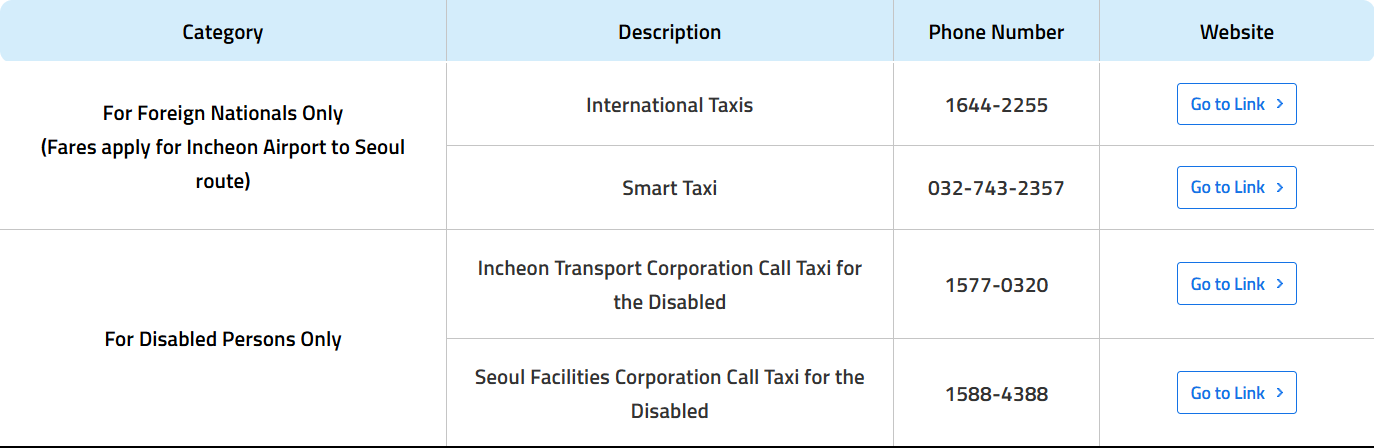
The International Taxi is a Seoul-designated service with English, Chinese and Japanese speaking drivers. Between Incheon Airport and Seoul it charges a flat zone fare — ₩70,000 for Gangseo, ₩75,000 for Mapo, Yangcheon, Guro, Yeongdeungpo, Eunpyeong and Seodaemun, ₩85,000 for Jung, Jongno, Yongsan, Gwanak, Dongjak and Geumcheon, ₩90,000 for Gangnam, Seocho, Seongdong, Dongdaemun, Seongbuk and Gangbuk, and ₩95,000 for Songpa, Gangdong, Gwangjin, Jungnang, Nowon and Dobong. Tolls are included, bookings must be made at least 24 hours ahead, and payment is cash or credit card.

A metered taxi from Incheon is not automatically cheaper. It adds the expressway toll and, at night, the 40% surcharge on top of a long distance — which is exactly when the fixed zone fare starts to look like insurance. If you land after 23:00, compare the flat fare with the meter before you commit, or take the airport bus or AREX instead (a one-way AREX Express ticket is bookable ahead).
Airport train · via KKday
AREX Airport Express One-Way Ticket (Incheon Airport to Seoul Station)
⭐ 4.8/5 from 31,385 KKday reviews · nonstop train, about 43 min from Terminal 1 · from KRW 11,500 (as of Oct 2026)

Mistakes to Avoid
- Installing the app at the kerb. Sign-up with an overseas number can take time to approve, and card registration can fail. Do both at home.
- Assuming your foreign card will register. Korean payment gateways reject plenty of overseas cards. Have “pay in the car” or cash ready before you dispatch.
- Registering a Korean card on k.ride. k.ride’s own payment screen states that cards issued in Korea are not accepted — it is the mirror image of the Kakao T taxi app problem.
- Getting into a van that approaches you at arrivals. Incheon Airport says outright that call vans posing as taxis solicit and overcharge. Walk to the numbered stand.
- Thinking the night surcharge is a small rounding. A 23:00–02:00 ride starts at ₩6,700 instead of ₩4,800 and the distance unit rises from ₩100 to ₩140 per 131 m.
- Forgetting the out-of-city surcharge. A Seoul taxi to Gyeonggi adds 20% from the boundary automatically — it is not a driver adding a fee.
- Speaking your destination in English. Show the Korean address or the place saved in Naver Map; the app loads it into the driver’s navigation anyway.
- Expecting Grab or an unmetered fare. Licensed Korean taxis charge the meter only, and Seoul treats fares taken outside the meter as an administrative violation.
Frequently Asked Questions
Can foreigners use the Kakao T taxi app?
Kakao T sign-up requires a valid Kakao Account and the app may reject an application if required verification is not completed, so results vary by country and card. Kakao Mobility publishes a separate app, k.ride, for foreign travellers, with Google, Apple or email sign-up and overseas-card payment. If Kakao T blocks you, use k.ride rather than fighting the form.
Do I need a Korean phone number for Kakao T?
Kakao T requires a Kakao Account and may ask for identity verification, which is where overseas numbers can fail. k.ride does not need a Kakao Account and signs you in with Google, Apple or email, so it is the safer choice if you have no Korean number.
Why will my international card not register on a Korean taxi app?
Korean in-app card registration runs through domestic payment gateways linked to the national identity-verification system, and many overseas-issued cards are declined. Use “pay in the car” instead: every licensed Korean taxi has a card terminal, and cash and T-money also work.
How much is a taxi in Seoul?
A standard taxi starts at ₩4,800 for the first 1.6 km, then ₩100 per 131 m or ₩100 per 30 seconds when moving below 15.72 km/h. Deluxe and jumbo taxis start at ₩7,000 for the first 3 km. Fares are rounded to the nearest ₩10.
When does the Seoul taxi night surcharge apply?
From 22:00 to 23:00 and 02:00 to 04:00 it is 20%, and from 23:00 to 02:00 it is 40%. The meter changes rather than a fee being added: the late-night base fare is ₩5,800 or ₩6,700 instead of ₩4,800. Deluxe taxis take a flat 20% from 22:00 to 04:00.
How much is a taxi from Incheon Airport to Seoul?
The International Taxi charges a flat ₩70,000 to ₩95,000 for a standard car by destination zone, or ₩100,000 to ₩140,000 for a deluxe or large one, with tolls included. A regular metered taxi starts at ₩4,800 from the designated stands and adds tolls and any night surcharge.
Can I pay a Korean taxi with T-money?
Yes. T-money is accepted for taxi fares as well as buses and the subway. Remember that a physical T-money card can only be topped up with cash, so keep some won on hand.
Is it safe to take a taxi from Incheon Airport?
Yes, from the designated stands. Incheon Airport warns that illegal call vans posing as taxis solicit passengers and overcharge, and directs travellers to the numbered stands: 5C, 6C and 6D at Terminal 1 and 7C at Terminal 2 for standard taxis.
What Else Should You Sort Before You Land?
A taxi app is the third thing to set up, not the first. Confirm whether you need K-ETA in 2027, file the free e-Arrival Card, then get data sorted with our eSIM vs SIM vs pocket WiFi comparison.
For everyday movement the subway beats a taxi on both price and traffic: compare T-money and the Climate Card, read the Climate Card short-term pass rules, and keep Korea’s emergency numbers saved in case a ride goes wrong.
Sources (official pages checked)
- Seoul Metropolitan Government — Taxi fares and surcharges (English)
- Seoul Metropolitan Government — 서울 택시요금 (full tariff table, updated 3 April 2026)
- Incheon International Airport — Taxi Guide (fares, stands, call-van warning)
- International Taxi — Seoul zone fares and charter rates
- k.ride (Kakao Mobility) — languages, sign-up and payment methods
- Kakao Mobility — k.ride service page
Book the basics for your Korea trip
Affiliate links: we may earn a small commission at no extra cost to you.
Related Guides
- Korea Travel Toolkit: what to book before you fly
- Incheon Airport to Seoul: Every Option, Real 2026 Prices
- Korea eSIM vs SIM vs Pocket WiFi
- Naver Map in English: The App Korea Actually Runs On
- T-money vs Climate Card: Which Seoul Transport Card
- How Much Cash to Bring to Korea
- Korea Emergency Numbers: What to Actually Call
- Seoul Subway Etiquette
- K-ETA Is Back in 2027
- Korea Travel Apps: Best Picks and What Works Abroad 2026 — other apps that work with a foreign phone and card
Last checked September 2026 against the Seoul Metropolitan Government taxi tariff, Incheon International Airport’s Taxi Guide, International Taxi and Kakao Mobility’s k.ride pages.