Bottom line: a good Korea packing list is short: passport plus the right entry form, a plug adapter for 220V two-round-pin sockets, a card and a little cash, an eSIM, clothes for a very seasonal climate, and your own toothbrush, because hotels with 50 or more rooms may no longer hand them out free.
Quick Korea Travel Guide
Getting in: check whether you need a K-ETA or the free e-Arrival Card first.
Stay in touch: install a Korea eSIM from Airalo before you fly, or compare options in eSIM vs SIM vs pocket WiFi.
Download first: Naver Map in English and Kakao T for taxis.
Where to book things: GetYourGuide Seoul for tours and day trips, KKday Seoul for rail and Korea-only passes.
Getting around: a T-money card or a Climate Card short-term pass; see T-money vs Climate Card.
Disclosure: the Airalo, GetYourGuide and KKday links are affiliate links. If you book through them I may earn a commission at no extra cost to you.
Most packing lists for Korea are generic travel lists. This Korea packing list starts from the official rules that change what goes in your bag: voltage from the Korea Tourism Organization, liquid and power bank limits from Incheon Airport, medicine limits from Korea Customs and the Ministry of Food and Drug Safety, and the hotel toiletry rule from the government’s legal notice. Last checked October 2026.
Quick answer
- Documents: passport plus a K-ETA or the free e-Arrival Card.
- Power: 220V, 60 Hz, two-round-hole sockets (Type C and F). Most chargers only need a plug adapter.
- Power banks: carry-on only, up to 2 per person under 160 Wh; no use or charging in flight since 20 April 2026.
- Liquids: 100 ml containers in one 1 L ziplock bag; kimchi and gochujang go in checked bags.
- Medicine: up to 6 bottles or a 3-month supply; controlled ingredients need an MFDS permit first.
- Toiletries: hotels with 50+ rooms cannot give single-use items free since 29 March 2024.
- Money: cards work almost everywhere, but physical T-money top-ups are cash only.
Travel eSIM · via Airalo
South Korea eSIM (unlimited data)
Unlimited data from US$12 for 3 days · US$29 for 7 days · US$49 for 15 days · install before you fly (as of Oct 2026)
What this guide covers
What Belongs on a Korea Packing List?
Korea is easy to shop in. Convenience stores open late, Daiso sells travel accessories for a few thousand won and Olive Young stocks the toiletries most people pack. So split your Korea packing list into things you cannot buy after landing (documents, prescription medicine, a working phone, day-one clothes) and things you can, which you pack only for convenience. Sections 1 to 3 cover the first group; sections 4 and 5 cover clothes, toiletries and medicine, where Korean rules and the climate matter more than most lists admit.
1. Documents: Passport, K-ETA or e-Arrival Card
The first line of any Korea packing list is paperwork. Travellers from the 22 countries on Korea’s temporary K-ETA exemption list do not need a K-ETA until the end of 2026, but they must file the free e-Arrival Card online in the three days before landing. From 1 January 2027 the K-ETA is required again for those countries, and a valid K-ETA exempts you from the arrival card. Details: K-ETA in 2027 and the e-Arrival Card guide.
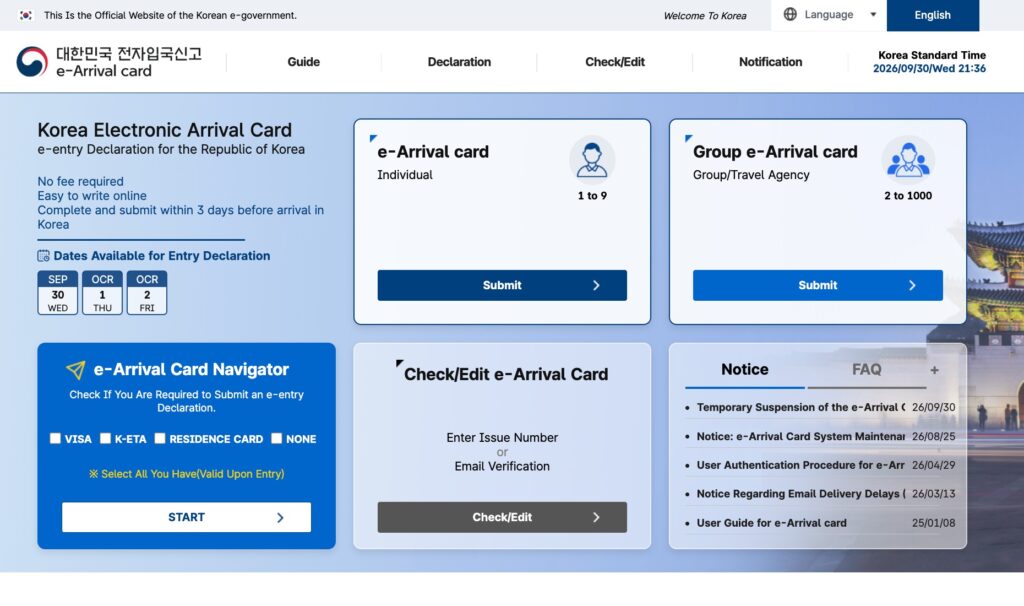
- Passport valid for your stay; you also need it at the till for an immediate tax refund.
- K-ETA or e-Arrival Card confirmation as a screenshot. The official K-ETA fee is ₩10,000; anything pricier is an agency.
- Hotel address in Korean for taxi drivers.
- Insurance details and Korea emergency numbers.
2. Money and Cards for Your Korea Packing List
The Korea Tourism Organization says Visa, Mastercard and American Express are widely accepted, and hotels, convenience stores, taxis and chains take cards. The exception is transport: a physical T-money card is topped up with cash only, in ₩1,000 units.
Pack two cards on different networks and plan to withdraw a modest amount of won for top-ups, market stalls and small family-run places; how much cash to bring to Korea does the maths, and the WOWPASS guide covers the prepaid travel card many visitors use instead of cash. Cash or other means of payment above US$10,000 must be declared to customs.
Prepaid card with T-money function · via KKday
WOWPASS: Prepaid Card for Cashless Payment in Korea
⭐ 4.7/5 from 1,569 KKday reviews · top up in 16 currencies at self-service machines · works as a T-money card · voucher from KRW 6,000 · non-refundable after purchase (as of Oct 2026)
3. Phone, Apps, Plugs and Power Banks
Data and apps
An eSIM installed at home is the simplest option for most trips; Airalo’s Korea eSIM sells 3- to 30-day packages, and the trade-offs are in Korea eSIM vs SIM vs pocket WiFi. Google Maps still has no turn-by-turn directions in Korea, so install Naver Map in English, Kakao T and Papago on home Wi-Fi.
Plug adapter and voltage
The Korea Tourism Organization: “The standard voltage in Korea is 220 volts at 60 Hertz, and the outlet has two round holes.” Those are the Type C and F shapes used in most of continental Europe. If a charger says “100-240V”, the only power item your Korea packing list needs is a plug adapter. Single-voltage 110V devices, typically hair dryers and straighteners, need a converter or should stay home. Which devices need what is covered in the Korea plug type and voltage guide.
Forgot one? The same page says hotel front desks lend or sell adapters, and airports, duty-free shops and convenience stores stock them. Daiso is the cheap option in the city.

Power banks: the 2026 rule
Incheon Airport allows power banks under 160 Wh in carry-on only, up to two per person; 100 to 160 Wh needs airline approval, and none may go in checked baggage. The Korean government added that from 20 April 2026 you may not charge a power bank from the seat or use one to charge a phone in flight. Airlines also ask you to tape the terminals or use a separate pouch.

4. Clothes on a Korea Packing List: Pack for the Season
The Korea Meteorological Administration’s 1991-2020 normals for Seoul run from a 2.1°C average high in January to 30.0°C in August, and about 63% of the year’s rain falls from June to August. Month-by-month detail is in the best time to visit Korea.
| Season | Seoul normals (high / low) | What to pack |
|---|---|---|
| Spring (Mar-May) | 11.0 / 1.9°C in March, 23.6 / 13.5°C in May | Layers, a light jacket, a warm layer for March mornings |
| Summer (Jun-Aug) | 27.6-30.0°C highs; July rain 414.4 mm | Breathable clothes, compact umbrella, quick-dry shoes, sunscreen |
| Autumn (Sep-Nov) | 26.2°C high in September, 11.9 / 3.5°C in November | T-shirts plus a mid-layer; a proper coat from mid-November |
| Winter (Dec-Feb) | 2.1 / -5.5°C in January | Padded coat, thermal layers, gloves, hat, lip balm |
Add comfortable walking shoes for long station transfers, and shoes that slip off easily: you remove them in bathhouses, at many floor-seating restaurants and in some temple halls (see jjimjilbang etiquette).
5. Toiletries and Medicine: Korea Packing List Rules That Surprise People
Hotel toiletries are no longer a given
Since 29 March 2024, lodgings with 50 or more rooms may not hand out single-use items free of charge under Korea’s resource recycling law, according to the Ministry of Government Legislation. Many hotels now use refillable shampoo dispensers and sell or withhold toothbrushes and razors. Smaller guesthouses are outside the rule, but pack a toothbrush and travel-size basics for night one anyway.

Everything else is easy to buy: Olive Young has sunscreen and full-size toiletries in every shopping district, and Daiso sells travel bottles and pouches from ₩1,000. If you plan to shop for skincare, leave room in your case.

Liquids in your carry-on
On international flights from Incheon, liquids, gels and sprays travel in carry-on only in containers of 100 ml or less, inside one transparent 1 L ziplock bag per person. The airport’s own examples include toothpaste, sunscreen, kimchi, gochujang and doenjang; checked baggage has no volume limit for food. Forgot a bag? The airport sells them at 3rd-floor convenience stores.

Medicine: personal limits and controlled ingredients
Korea Customs allows medicine for personal use up to 6 bottles in total, or a 3-month supply by dosage if you need more. Single-ingredient ephedrine or pseudoephedrine products face a requirements check, and erectile-dysfunction drugs clear only in the prescribed quantity.

Controlled substances are the strictest item on any Korea packing list. The Ministry of Food and Drug Safety (MFDS) requires anyone entering Korea with medicine containing narcotic or psychotropic ingredients to get a permit first, regardless of nationality; applications have been online since 27 December 2024. Korea Customs names codeine, morphine, oxycodone, methylphenidate and amphetamines as examples. Keep medicine in original packs with the prescription and a doctor’s letter in English; Incheon Airport accepts liquid medicine over 100 ml in the cabin only with a doctor’s note or prescription in Korean or English.

The key rules at a glance
| Item | Rule | Source |
|---|---|---|
| Voltage | 220V, 60 Hz, Type C/F sockets | Korea Tourism Organization |
| Power banks | Carry-on only, max 2 under 160 Wh; no use in flight | Incheon Airport, korea.net |
| Liquids | 100 ml containers, one 1 L ziplock bag | Incheon Airport |
| Medicine | 6 bottles or a 3-month supply | Korea Customs |
| Controlled medicine | MFDS permit before travel | MFDS |
| Hotel toiletries | No free single-use items at 50+ room lodgings | Ministry of Government Legislation |
Printable Korea Packing List Checklist
Screenshot or print this. The last column shows what you can leave behind.
| Category | Item | Buy in Korea? |
|---|---|---|
| Documents | Passport; K-ETA or e-Arrival Card screenshot; hotel address in Korean | No |
| Money | Two cards on different networks; some won | Won yes (ATM) |
| Phone | eSIM; Naver Map, Kakao T, Papago | SIM yes; apps before you fly |
| Power | Type C/F adapter; 100-240V chargers; max 2 power banks in carry-on | Yes |
| Clothes | Seasonal layers; walking shoes; slip-on shoes | Yes |
| Toiletries | Toothbrush and travel-size basics | Yes |
| Medicine | Original packs, prescription, doctor’s letter, MFDS permit if needed | Prescription items no |
| Bags | 1 L ziplock bag; foldable shopping bag | Yes |
Mistakes to Avoid
- Power bank in checked luggage. Not allowed, and a third one in carry-on is over the limit.
- A 110V-only hair dryer. An adapter does not change the voltage.
- Assuming the hotel has a toothbrush. Large hotels cannot give one out free.
- ADHD medication or codeine without a permit. A foreign prescription alone is not enough.
- Kimchi in your carry-on on the way home. Over 100 ml it is confiscated at security.
- Packing for the average. March mornings are near freezing; November can bring first snow.
Frequently Asked Questions
What should I pack for Korea?
Passport and K-ETA or e-Arrival Card, two cards and some won, an eSIM, a Type C/F plug adapter, seasonal clothes, walking shoes, a toothbrush and prescription medicine in original packs.
Do I need a plug adapter in Korea?
Yes, unless your plugs have two round pins. Korea uses 220V at 60 Hz with Type C and F sockets. Chargers marked 100-240V need only the adapter.
How many power banks can I take on a flight from Korea?
Up to two per person under 160 Wh, in carry-on only, per Incheon Airport. Since 20 April 2026 you cannot use or charge them during the flight.
Can I bring my medication to Korea?
Yes, up to 6 bottles or a 3-month supply for personal use. Medicine with narcotic or psychotropic ingredients needs an MFDS permit before you travel.
Do Korean hotels provide toiletries?
Not always. Since 29 March 2024 lodgings with 50 or more rooms cannot give single-use items for free, so pack a toothbrush.
Should I bring cash to Korea?
A little. Cards are widely accepted, but physical T-money top-ups are cash only.
What Should You Buy After You Land?
Once the essentials on your Korea packing list are covered, the rest can wait. Convenience stores cover forgotten chargers and umbrellas at any hour, and most visitors buy skincare at Olive Young anyway. Keep receipts for the tax refund and check duty free limits before packing for home.
Sources (official pages checked)
- Korea Tourism Organization, electricity and voltage
- Incheon Airport, restricted items
- Incheon Airport, carry-on restricted items FAQ
- Korea.net, in-flight power bank rules from 20 April 2026
- Korea Customs, personal-use allowances (Korean)
- Korea Customs, medicines with narcotic ingredients (Korean)
- MFDS, permit for controlled medicine
- Ministry of Government Legislation, hotel single-use items (Korean)
- Tmoney, foreigner guide
- Korea e-Arrival Card
- K-ETA
- WMO, Seoul climate normals (KMA data)
Book the basics for your Korea trip
Affiliate links: we may earn a small commission at no extra cost to you.
Related Guides
- Korea Travel Toolkit: what to book before you fly
- Best Time to Visit Korea, Month by Month
- K-ETA Is Back in 2027
- e-Arrival Card Korea
- How Much Cash to Bring to Korea
- WOWPASS Korea
- Korea eSIM vs SIM vs Pocket WiFi
- Korea Plug Type and Voltage
- Naver Map in English
- Kakao T Taxi App Guide
- Seoul Subway Guide
- Olive Young Seoul
- Daiso Korea Must-Buys
Last checked October 2026 against english.visitkorea.or.kr, airport.kr, korea.net, customs.go.kr, mfds.go.kr, easylaw.go.kr and KMA climate normals. Airlines can be stricter than the airport; confirm with yours before you fly.