Bottom line: the Seoul subway is the easiest way around the city: tap a T-money card or a Climate Card short-term pass, pay ₩1,550 for the first 10 km, transfer free within 30 minutes, and use Naver Map to pick the right direction and exit. Foreign bank cards still do not open the gates.
Quick Korea Travel Guide
Getting in: AREX connects Incheon Airport to the Seoul subway. The Express needs its own ticket, sold as a voucher on KKday; the all-stop train takes your transit card. Full comparison: Incheon Airport to Seoul.
Stay in touch: live train times and maps need data, so install a Korea eSIM from Airalo before you fly.
Download first: Naver Map in English for routes, transfers and exit numbers.
Where to book things: GetYourGuide Seoul lists tours that start at subway stations.
Getting around: T-money or a Climate Card short-term pass; see T-money vs Climate Card.
Disclosure: the Airalo, KKday and GetYourGuide links are affiliate links. If you book through them I may earn a commission at no extra cost to you.
This Seoul subway guide uses the operators’ own pages: Seoul city’s fare table, Seoul TOPIS’s line guide, Seoul Metro’s accessibility data and timetables, and the Ministry of Land’s notice on re-entry. For behaviour on the train, see Seoul subway etiquette; this guide covers the mechanics. Last checked October 2026.
Quick answer
- Fare: ₩1,550 by transit card, ₩1,650 with a single-journey ticket, for the first 10 km; +₩100 per extra 5 km.
- Cards: T-money or a Climate Card short-term pass. Your foreign bank card cannot be tapped at the gate; Seoul plans that for Lines 1-8 in 2027.
- Transfers: free within 30 minutes (60 minutes from 21:00 to 07:00), as long as you tap in and out.
- Wrong direction? Tap out and back in at the same station within 15 minutes and no new base fare is charged.
- Hours: roughly 05:30 to around midnight; weekday last trains run later than weekend ones.
- Line 9: runs express and local trains on the same tracks; express trains skip stations.
- Airport: AREX all-stop is ₩4,750 from Terminal 1 to Seoul Station on a transit card.
Prepaid card with T-money function · via KKday
WOWPASS: Prepaid Card for Cashless Payment in Korea
⭐ 4.7/5 from 1,569 KKday reviews · top up in 16 currencies at self-service machines · works as a T-money card on the subway · voucher from KRW 6,000 · non-refundable after purchase (as of Oct 2026)
What this guide covers
How the Seoul Subway Works
The Seoul subway is a network of numbered lines (1 to 9) plus named lines such as AREX, the Suin-Bundang Line, the Sinbundang Line and the Gyeongui-Jungang Line. Several operators run it, including Seoul Metro, Korail and the Line 9 operator, but one transit card works on all of them and transfers are seamless. Seoul city’s TOPIS line guide is a useful one-page overview of where each line goes.

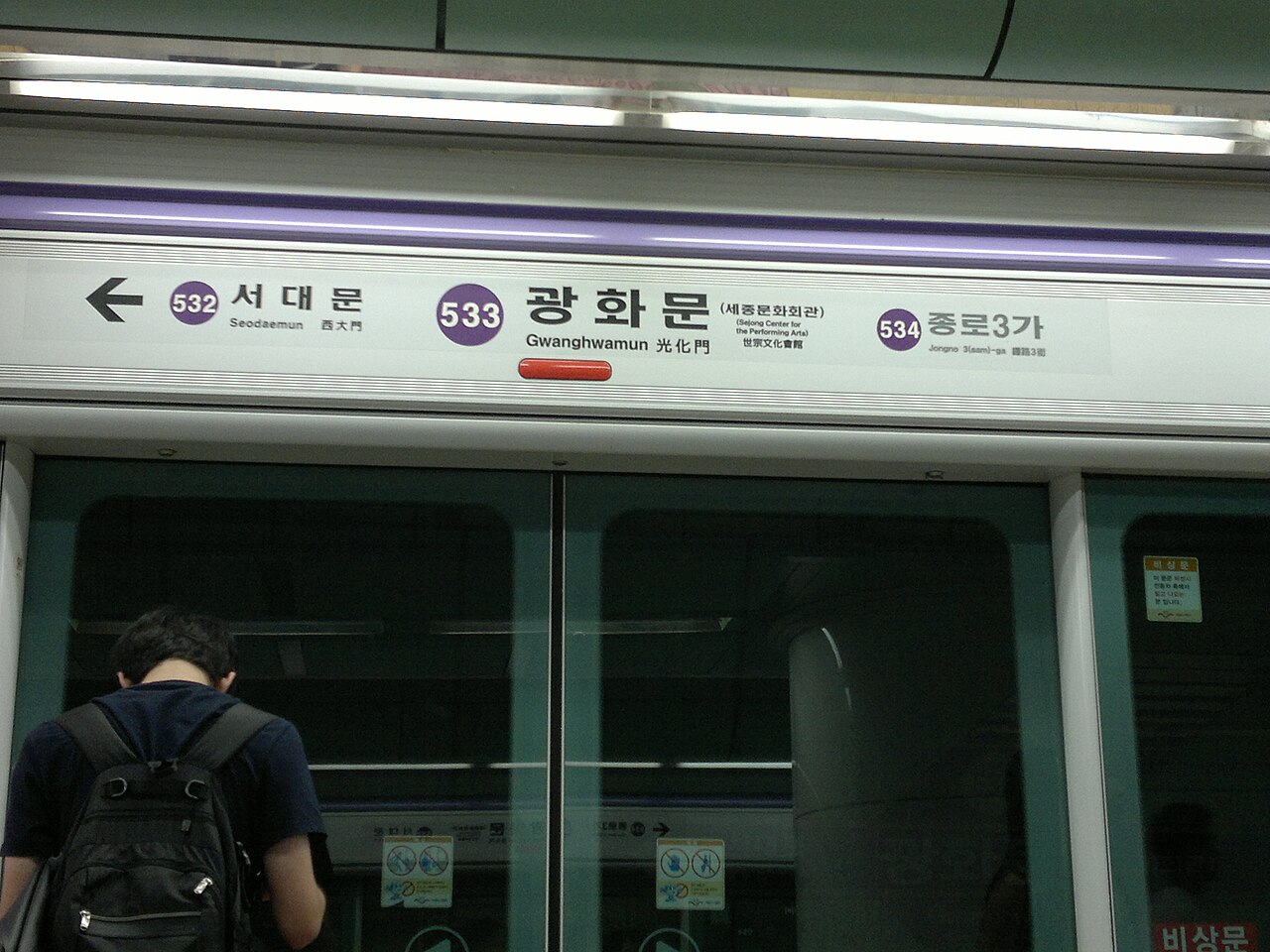
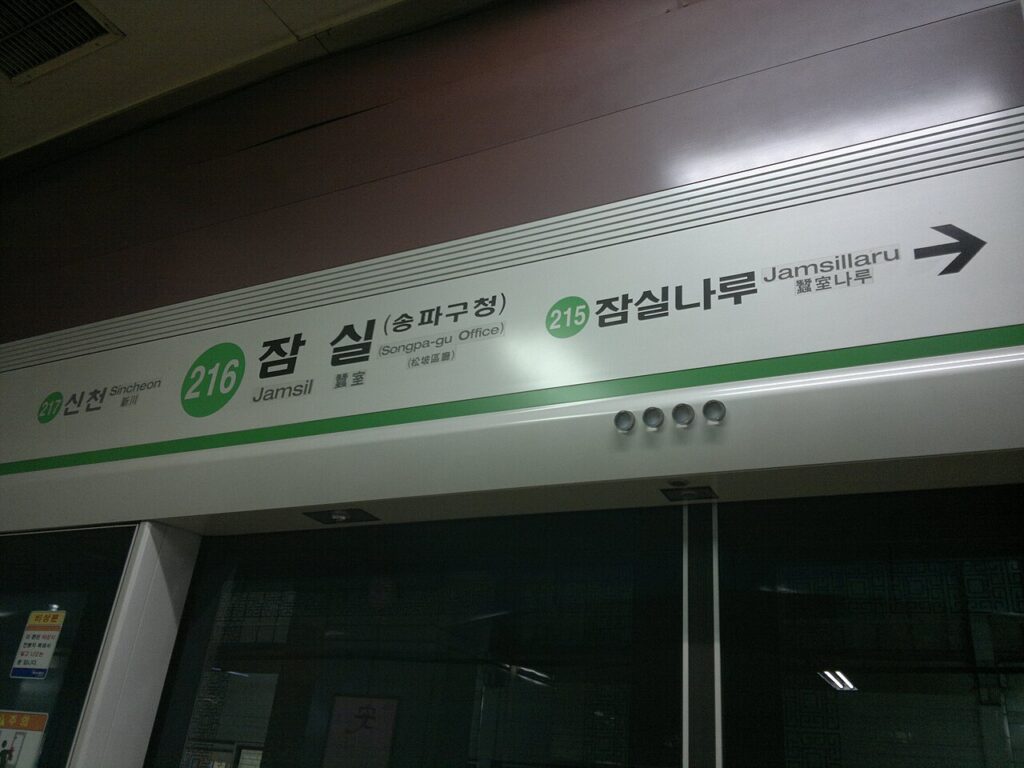
Every station has a number. On Seoul Metro lines the first digit is the line, so Myeong-dong is 424 (Line 4) and Jamsil on Line 2 is 216. Platform signs show the station you are at and the next station in each direction, which is how you choose the right side.
1. Seoul Subway Tickets and Cards
You have three ways to pay, and a foreign credit card is not one of them at the gate.
- T-money card: a rechargeable card sold at convenience stores and station machines, also valid on buses and taxis. Top-ups are cash only. Details in T-money vs Climate Card. A WOWPASS card also has a T-money function; see the WOWPASS guide.
- Climate Card short-term pass: unlimited rides on Seoul’s subway and city buses for 1, 2, 3, 5 or 7 days at ₩5,000 to ₩20,000, plus ₩3,000 for the card. It does not cover the Sinbundang Line or boarding AREX at the airport. See the Climate Card guide.
- Single-journey ticket: bought at station machines for the fare plus a ₩500 deposit, which Seoul city says you get back from the deposit refund machine at your destination. It costs ₩100 more than a card fare.
Since 17 March 2026, Seoul’s new ticket machines on Lines 1-8 accept overseas Visa and Mastercard cards for single-journey tickets and Climate Card purchases. The gates themselves still need a transit card: Seoul’s own roadmap puts EMV contactless gates on subway Lines 1-8 in 2027.

2. Seoul Subway Fares in 2026
Seoul city’s fare table, in force since 28 June 2025, is the reference. An adult pays ₩1,550 with a transit card or ₩1,650 with a single-journey ticket for the first 10 km. Teens pay ₩900 by card and children ₩550. The first ride before 06:30 is 20% cheaper on a card (₩1,240).

Longer trips add ₩100 for every 5 km beyond 10 km, and Seoul TOPIS lists ₩100 per 8 km beyond 50 km. A few lines charge extra on top, notably the Sinbundang Line. Note that the Line 9 operator’s English fare page still shows the old ₩1,400 base fare. Seoul city’s ₩1,550 is the current figure.
The key rules at a glance
| Rule | Figure | Source |
|---|---|---|
| Adult base fare, transit card | ₩1,550 (first 10 km) | Seoul city |
| Adult single-journey ticket | ₩1,650 + ₩500 refundable deposit | Seoul city |
| Distance surcharge | +₩100 per 5 km over 10 km; +₩100 per 8 km over 50 km | Seoul city, TOPIS |
| Early-morning discount | 20% off the first card ride before 06:30 | Seoul city |
| Free transfer window | 30 min; 60 min from 21:00 to 07:00 | Seoul city |
| Re-entry at the same station | Within 15 min, no new base fare (transit cards) | Seoul city, MOLIT |
| Climate Card short-term pass | ₩5,000 (1 day) to ₩20,000 (7 days) + ₩3,000 card | Seoul city |
| AREX all-stop, T1 to Seoul Station | ₩4,750 by transit card | AREX |
| Riding without a valid ticket | Fare plus 30 times the fare | Line 9 operator |
3. Transfers, Directions and the 15-Minute Rule
Transfers inside the Seoul subway are free: you walk to the other line’s platform, often without touching a gate. Changing between subway and bus counts as one journey if you tap in and out and board the next ride within 30 minutes (60 minutes between 21:00 and 07:00). At a few interchanges you pass a separate transfer gate and tap again; no extra base fare is charged.
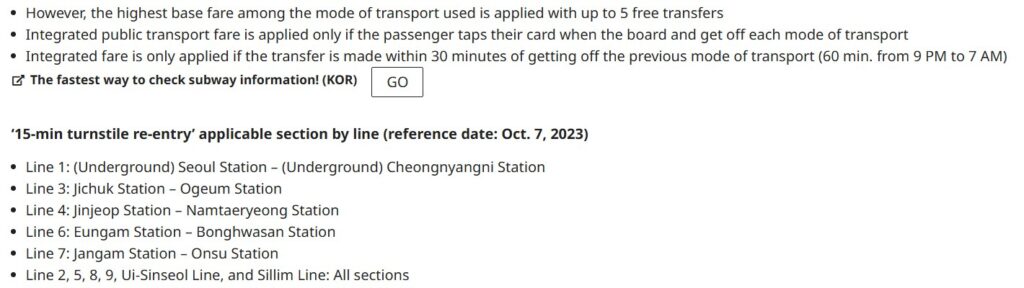
Direction is the most common problem. Signs name the end station or the next station, not “north” or “south”, and Line 2 is a loop signposted as inner circle and outer circle. If you go through the wrong gate or need a toilet outside the gates, Seoul has let transit-card users tap out and back in at the same station within 15 minutes without a new base fare since 7 October 2023. The Ministry of Land extended the same rule to Korail-run lines, including parts of Lines 1, 3 and 4 and the Suin-Bundang and Gyeongui-Jungang lines, from 20 June 2026. It does not apply to single-journey tickets.
4. Apps, the Seoul Subway Map and Exits
Google Maps gives no turn-by-turn directions in Korea, so most visitors use Naver Map in English or KakaoMap for the Seoul subway: both show the route, transfer stations, the train’s direction and the exit number to use. For a full Seoul subway map, Seoul Metro’s Cyber Station site has an English map with station search.
Exits are numbered, and big stations have more than ten. Check the exit number before you tap out; coming up on the wrong side of an eight-lane road can add ten minutes.
Travel eSIM · via Airalo
South Korea eSIM (unlimited data)
Unlimited data from US$12 for 3 days · US$29 for 7 days · US$49 for 15 days · install before you fly (as of Oct 2026)
5. First and Last Trains
Visit Seoul describes Seoul subway hours as about 05:30 to midnight, varying by station. Seoul Metro’s timetable data (updated 11 October 2026) gives a typical example: Line 2 trains from Hongik Univ. Station start at 05:30, and the last inner-circle train leaves at 00:49 on weekdays (it terminates at Euljiro 1-ga) but at 23:49 on weekends and holidays. Check your own station’s last train in Naver Map before a late night. After the last train, Seoul’s late-night buses and taxis take over; see the Kakao T guide.
6. Line 9 Express Trains and the Airport Line
Seoul TOPIS describes Line 9 as a line that “operates express trains and local trains, connecting Gimpo Airport to the Gangnam area in 30 minutes”. Express trains share the platform and skip smaller stations, so check that your stop is an express stop before boarding. Line 9’s fare page lists no separate express fare. Line 9 trains are among the most crowded at weekday rush hour.
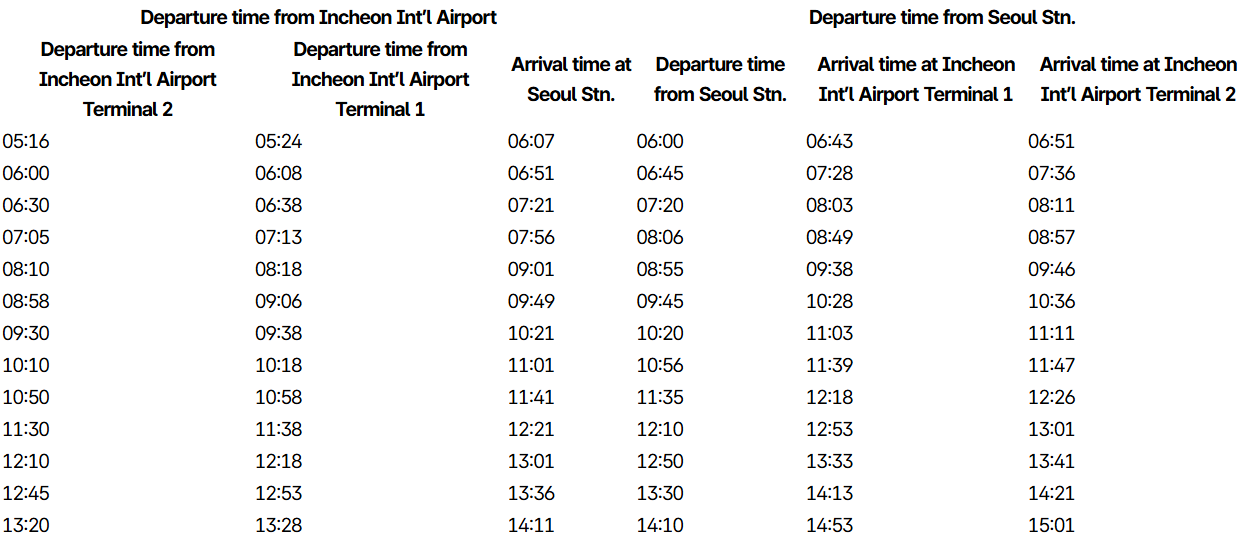
AREX links Incheon Airport, Gimpo Airport, Hongik Univ. and Seoul Station. The all-stop train costs ₩4,750 from Terminal 1 to Seoul Station on a transit card; the AREX Express costs ₩13,000, runs nonstop to Seoul Station in 43 minutes from Terminal 1 and needs a separate reserved ticket. Climate Card passes let you get off at the airport but not board there. All options are in Incheon Airport to Seoul.
Airport train · via KKday
AREX Airport Express One-Way Ticket (Incheon Airport to Seoul Station)
⭐ 4.8/5 from 31,385 KKday reviews · nonstop train, about 43 min from Terminal 1 · from KRW 11,500 (as of Oct 2026)
7. Accessibility, Elevators and Luggage
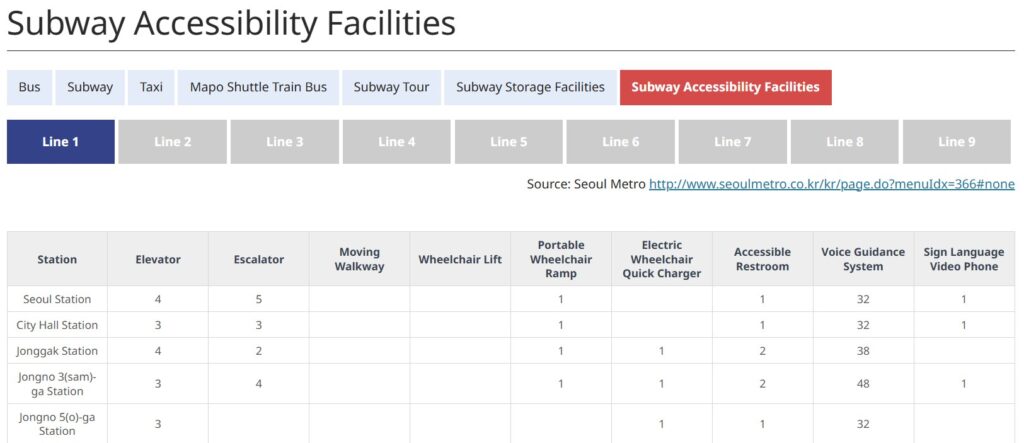
Seoul city publishes an elevator, escalator and wheelchair-lift count for every Seoul Metro station. Numbers vary a lot: Myeong-dong (Line 4) has 2 elevators and 5 escalators, Hongik Univ. (Line 2) 2 elevators and 8 escalators, while Seoul Station on Line 1 has 4 elevators. With large suitcases, look up your station first and use Naver Map’s exit view to find the elevator exit.
Priority seats, pink seats and how to queue are covered in Seoul subway etiquette. Large luggage is allowed, but avoid weekday commuting peaks with it.
Mistakes to Avoid
- Trying to tap a foreign bank card at the gate. It will not work until Seoul’s EMV rollout reaches the subway, planned for 2027.
- Skipping the tap-out. Without it you lose the transfer discount and may be charged a higher fare.
- Boarding a Line 9 express that skips your stop. Check the express stop list on the platform screen.
- Choosing direction by the line colour only. Read the next-station name on the sign, especially on circular Line 2.
- Throwing away a single-journey ticket. The ₩500 deposit comes back only from the refund machine.
- Using last-train times from an old blog. Weekend last trains run about an hour earlier on many lines.
- Taking a Climate Card to board AREX at the airport. The pass covers alighting at the airport, not boarding.
Frequently Asked Questions
How much is the Seoul subway fare?
An adult pays ₩1,550 with a transit card or ₩1,650 with a single-journey ticket for the first 10 km, plus ₩100 for each extra 5 km. Seoul city set these fares on 28 June 2025.
Can I use my credit card on the Seoul subway?
Not at the gates. Since March 2026 new ticket machines on Lines 1-8 accept overseas Visa and Mastercard cards for tickets and Climate Cards, but tapping a foreign card at the gate is planned for 2027.
How do I use the Seoul subway as a tourist?
Buy a T-money card or a Climate Card short-term pass, plan the route in Naver Map, tap in at the gate, follow the next-station signs for direction, and tap out at your destination.
What time does the Seoul subway close?
Most lines run from about 05:30 to around midnight. Weekday last trains run later than weekend ones; for example, the last inner-circle Line 2 train from Hongik Univ. leaves at 00:49 on weekdays and 23:49 on weekends.
Is there a free transfer on the Seoul subway?
Yes. Transfers between lines are free, and subway-bus transfers within 30 minutes (60 minutes from 21:00 to 07:00) count as one journey if you tap in and out.
Where can I get a Seoul subway map in English?
Seoul Metro’s Cyber Station site has an English map and route search, and Naver Map and KakaoMap show the Seoul subway map in English inside the app.
Ready for the Unwritten Rules?
Once the mechanics of the Seoul subway are sorted, the remaining questions are about behaviour: where not to sit, how to queue and what to do with a backpack. Read Seoul subway etiquette next, and keep Kakao T on your phone for the nights you miss the last train.
Sources (official pages checked)
- Seoul city, subway fares, transfers and 15-minute re-entry
- Seoul city, public transportation guide (single-journey tickets)
- Seoul city, subway accessibility facilities
- Seoul TOPIS, subway lines and fares
- Korea Policy Briefing (MOLIT), 15-minute re-entry on Korail lines from 20 June 2026 (Korean)
- Seoul city, 15-minute re-entry from 7 October 2023 (Korean)
- Seoul Open Data, Seoul Metro first and last trains (Korean)
- Seoul Metro Line 9, fare system
- AREX, all-stop fares
- AREX, Express fares and journey times
- Seoul Metro, Cyber Station English map
Book the basics for your Korea trip
Affiliate links: we may earn a small commission at no extra cost to you.
Related Guides
- Korea Travel Toolkit: what to book before you fly
- Seoul Subway Etiquette Rules Foreigners Get Wrong
- T-money vs Climate Card
- Seoul Climate Card 2026
- WOWPASS Korea
- Incheon Airport to Seoul
- Naver Map in English
- Kakao T Taxi App Guide
- How Much Cash to Bring to Korea
- Korea Packing List
Last checked October 2026 against english.seoul.go.kr, topis.seoul.go.kr, data.seoul.go.kr, korea.kr, metro9.co.kr and airportrailroad.com. Fares and timetables change; confirm on the operator page before you travel.