Bottom line: The Korean basic phrases worth learning for a trip come to about 30 lines, grouped by situation: five patterns (igeo juseyo, ___ isseoyo?, ___ eodiyeyo?, ___-e ga juseyo and eolmayeyo?) plus a few numbers cover most restaurants, shops, taxis and emergencies, and each line below comes with Hangul and Revised Romanization.
Quick Korea Travel Guide
Getting in: File the free e-Arrival Card unless you hold a valid K-ETA, and check the K-ETA exemption dates.
Stay in touch: Get a Korea eSIM from Airalo; Papago and Naver Map need data.
Pay: A WOWPASS card on KKday works as a payment and T-money card; see our WOWPASS review and Apple Pay in Korea.
Getting around: How to use the Seoul subway and T-money vs Climate Card.
Plan more: Best apps for Korea, the Korea Travel Toolkit and GetYourGuide Seoul for classes and tours.
Disclosure: Some links above are affiliate links. If you book through them I may earn a commission at no extra cost to you.
Most phrase lists run through greetings and stop. This guide sorts Korean basic phrases by the moment you need them: greeting staff, ordering food, paying, riding a taxi or subway, buying medicine, calling for help and checking into a hotel. Each row gives the Hangul to show someone, the romanization to say aloud and when it fits. If you want the alphabet first, our Korean alphabet guide covers the letters and ten starter phrases.
Quick answer
- Core set: 안녕하세요 (annyeonghaseyo), 감사합니다 (gamsahamnida), 이거 주세요 (igeo juseyo), 얼마예요? (eolmayeyo?) and 화장실 어디예요? (hwajangsil eodiyeyo?).
- Politeness: end sentences with 요 (yo) when you speak to staff, drivers and strangers.
- Romanization: signs and maps use Revised Romanization, which follows pronunciation, so 종로 is Jongno (National Institute of Korean Language).
- Restaurants: tipping is not expected, water and side dishes cost nothing extra, and the call bell on the table summons staff (Korea Tourism Organization, KTO).
- Tax refund: show your passport at shops with a Tax Refund or Tax Free sign; the minimum is KRW 15,000 per receipt (KTO).
- Emergencies (as of Nov 2026): 112 for police, 119 for fire and ambulance, 1330 for the Korea Travel Helpline.
- Rule for Korean basic phrases: learn the five patterns, point at the menu or your phone screen, and leave the rest to Papago.
Travel eSIM · via Airalo
Airalo South Korea eSIM (unlimited data)
Unlimited data from US$12 for 3 days · US$29 for 7 days · US$49 for 15 days · install before you fly (as of Oct 2026)
What this guide covers
What Are the Most Useful Korean Basic Phrases for Travelers?
Useful Korean basic phrases are short, polite and reusable: a pattern plus a word you can point to. Korean has levels of politeness, and staff, drivers and strangers expect the polite style that ends in 요 (yo) or 습니다 (seumnida). Every phrase here uses it. The casual forms friends use, such as 안녕 (annyeong), do not suit shop staff.
Romanization on this page follows the Revised Romanization system of the National Institute of Korean Language. It writes what is pronounced: 종로 is Jongno and 압구정 is Apgujeong. Two spellings catch people out: eo is one vowel, close to the u in “sun”, and eu is one vowel too, like “oo” with spread lips. Our Hangul guide has the full letter chart.
There is no audio on this page. Say each syllable evenly with the same weight, since Korean has no tones. If you need to hear a line spoken, Papago translates by voice and camera; see our apps guide for what works with a foreign phone number.
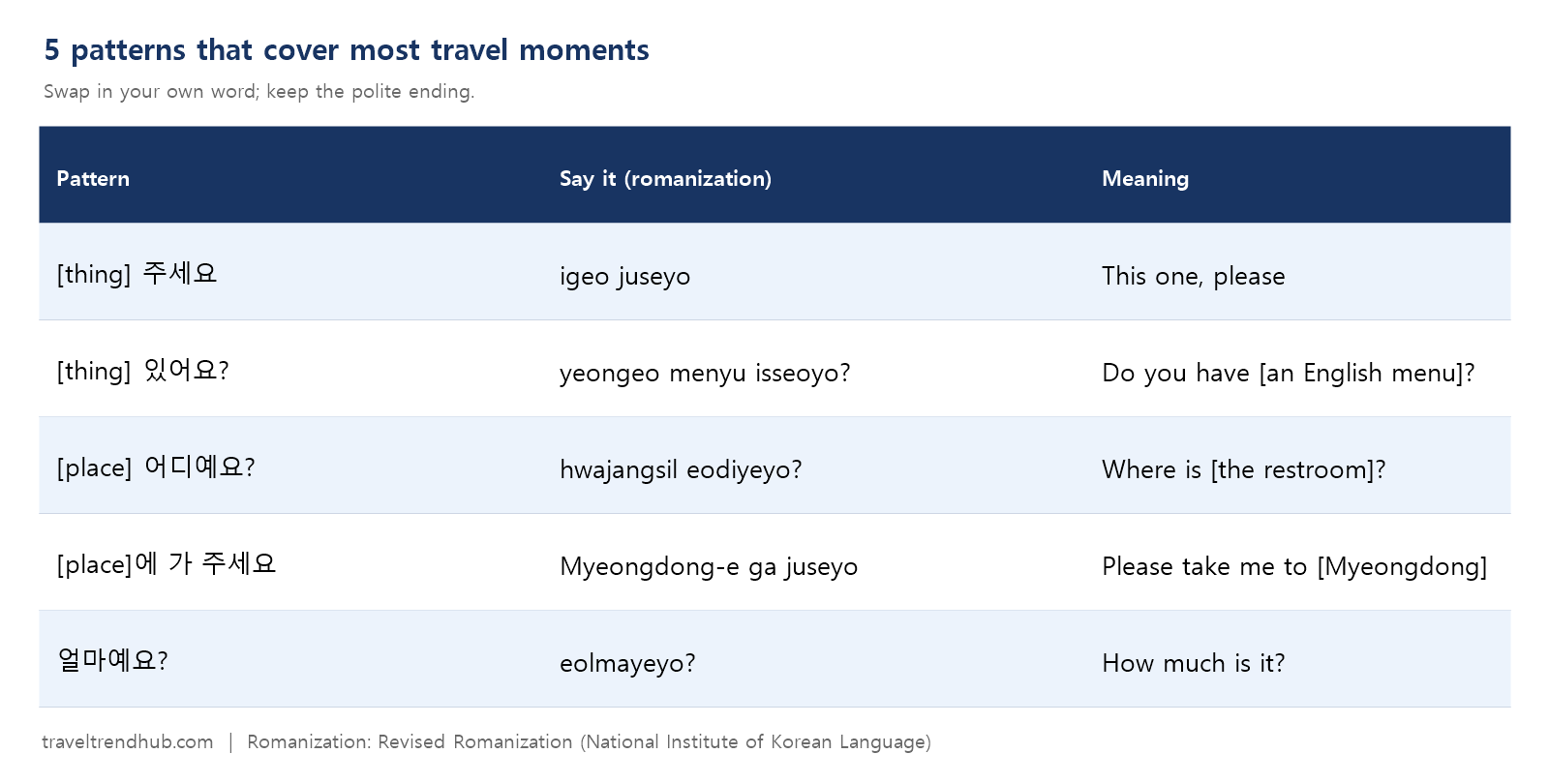
The five patterns in the chart work like this:
- 이거 주세요 (igeo juseyo): “This one, please.” Point and say it.
- [thing] 있어요? (isseoyo?): “Do you have it?” For example 영어 메뉴 있어요? (yeongeo menyu isseoyo?), “Do you have an English menu?”
- [place] 어디예요? (eodiyeyo?): “Where is it?” For example 화장실 어디예요? (hwajangsil eodiyeyo?).
- [place]에 가 주세요 (e ga juseyo): “Please go to [place].” For example 명동에 가 주세요 (Myeongdong-e ga juseyo).
- 얼마예요? (eolmayeyo?): “How much is it?”
Korean Basic Phrases by Situation
Each table groups Korean basic phrases by situation, and brackets mark words to swap. Show the Hangul column on your phone if your pronunciation fails; staff can read it at a glance.
1. Greetings and polite basics
| English | Korean | Romanization | When to say it |
|---|---|---|---|
| Hello | 안녕하세요 | annyeonghaseyo | Entering a shop, restaurant or hotel |
| Thank you | 감사합니다 | gamsahamnida | After any help or service |
| I am sorry | 죄송합니다 | joesonghamnida | After a mistake or a bump |
| Excuse me (making way) | 실례합니다 | sillyehamnida | Squeezing past someone or interrupting politely |
| One moment / let me through | 잠시만요 | jamsimanyo | On a crowded subway or stairs |
| It is OK / no, thank you | 괜찮아요 | gwaenchanayo | Declining a bag, a sample or an offer |
| Goodbye (you are leaving) | 안녕히 계세요 | annyeonghi gyeseyo | Leaving a shop or restaurant |
| Goodbye (they are leaving) | 안녕히 가세요 | annyeonghi gaseyo | Seeing off a guest or staff member |
| Before eating | 잘 먹겠습니다 | jal meokgetseumnida | When food arrives |
| After eating | 잘 먹었습니다 | jal meogeotseumnida | When you finish and leave |
Staff often greet first, so a nod and 안녕하세요 is enough. The two goodbyes depend on who is leaving: 안녕히 계세요 is said by the person going, 안녕히 가세요 by the person staying. The two meal phrases are common courtesies at a Korean table.
2. Korean basic phrases for restaurants and cafes
Korea Tourism Organization (KTO) says tipping is not required or expected, and that requests for more water or side dishes cost nothing extra. Many tables have a call bell: press it once and wait. Some restaurants let you serve yourself water and side dishes, and others use order machines or kiosks. For grill restaurants, our Korean BBQ guide explains the table routine.
| English | Korean | Romanization |
|---|---|---|
| Two people | 두 명이에요 | du myeong-ieyo |
| Menu, please | 메뉴판 주세요 | menyupan juseyo |
| Do you have an English menu? | 영어 메뉴 있어요? | yeongeo menyu isseoyo? |
| This one, please | 이거 주세요 | igeo juseyo |
| One more of this, please | 이거 하나 더 주세요 | igeo hana deo juseyo |
| Water, please | 물 주세요 | mul juseyo |
| More side dishes, please | 반찬 더 주세요 | banchan deo juseyo |
| Is this spicy? | 이거 매워요? | igeo maewoyo? |
| Less spicy, please | 덜 맵게 해 주세요 | deol maepge hae juseyo |
| Please grill it for me | 구워 주세요 | guwo juseyo |
| I have a peanut allergy | 땅콩 알레르기가 있어요 | ttangkong allereugiga isseoyo |
| No meat, please | 고기 빼 주세요 | gogi ppae juseyo |
| Takeaway, please | 포장해 주세요 | pojanghae juseyo |
| It is delicious | 맛있어요 | masisseoyo |
| Check, please | 계산해 주세요 | gyesanhae juseyo |
| Can I pay by card? | 카드 돼요? | kadeu dwaeyo? |
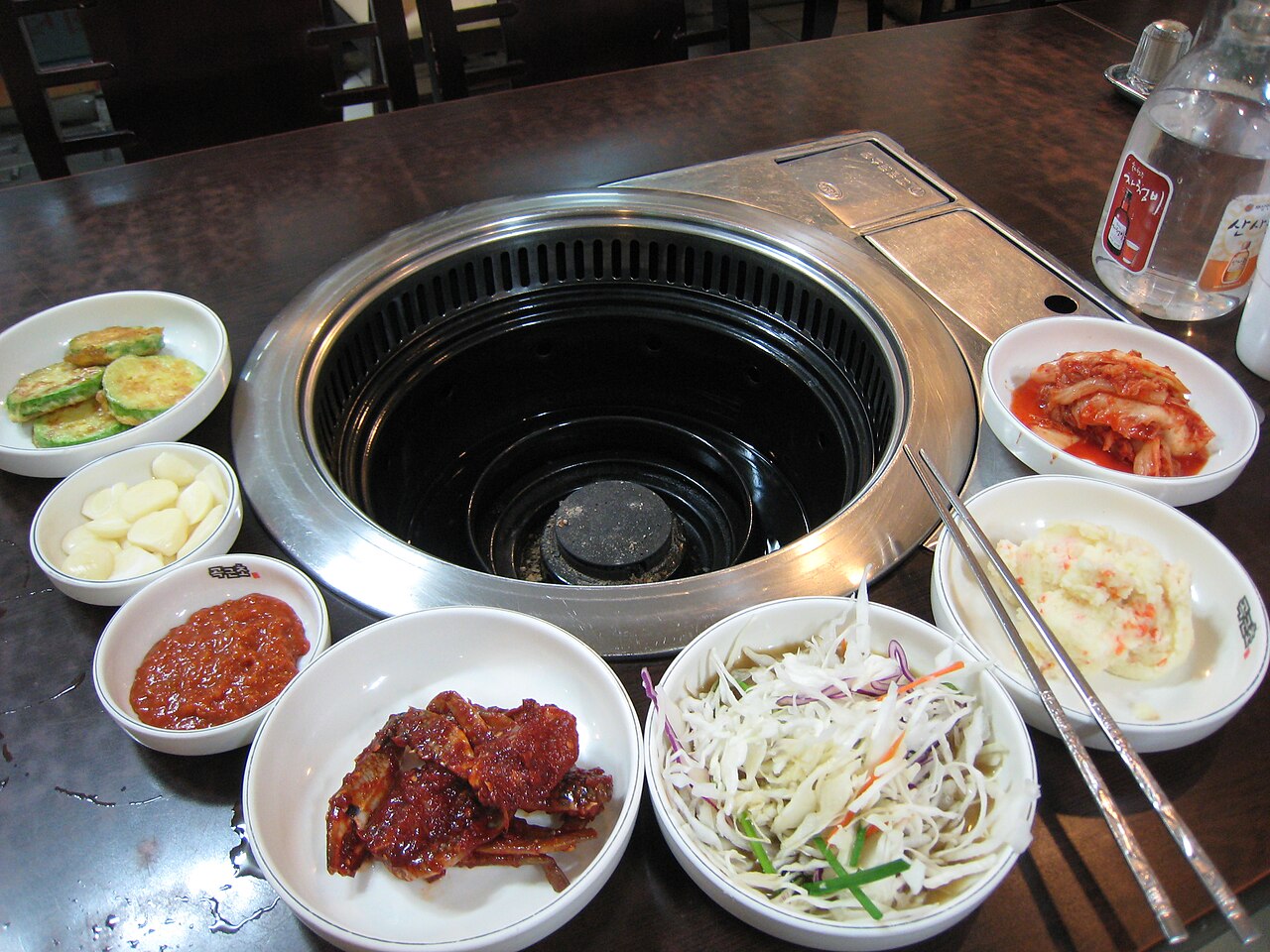
If you avoid meat or fish, say 고기 빼 주세요 and still ask what is in the broth and side dishes; our vegan Korean food guide lists what to check, and the street food guide covers stall ordering. State an allergy at the start of the order, with the ingredient name.
3. Korean basic phrases for shopping and tax refund
| English | Korean | Romanization |
|---|---|---|
| How much is this? | 이거 얼마예요? | igeo eolmayeyo? |
| Can you lower the price a little? | 좀 깎아 주세요 | jom kkakka juseyo |
| May I try this on? | 입어 봐도 돼요? | ibeo bwado dwaeyo? |
| Do you have another color? | 다른 색 있어요? | dareun saek isseoyo? |
| Do you have a bigger one? | 더 큰 거 있어요? | deo keun geo isseoyo? |
| Do you have a smaller one? | 더 작은 거 있어요? | deo jageun geo isseoyo? |
| Can I get a tax refund here? | 택스프리 돼요? | taekseupeuri dwaeyo? |
| Here is my passport | 여권 여기 있어요 | yeogwon yeogi isseoyo |
| A bag, please | 봉투 주세요 | bongtu juseyo |
| I do not need a bag | 봉투 필요 없어요 | bongtu piryo eopseoyo |
| Please heat it up (convenience store) | 데워 주세요 | dewo juseyo |
| Can I exchange or refund this? | 교환 또는 환불 돼요? | gyohwan ttoneun hwanbul dwaeyo? |
Ask for the refund while you pay and show your passport. KTO says shops with a Tax Refund or Tax Free sign qualify, the minimum is KRW 15,000 per receipt and goods must be unused; the full rules and limits are in our Korea tax refund guide. Bargaining with 깎아 주세요 suits some market stalls; chain stores and convenience stores keep fixed prices.
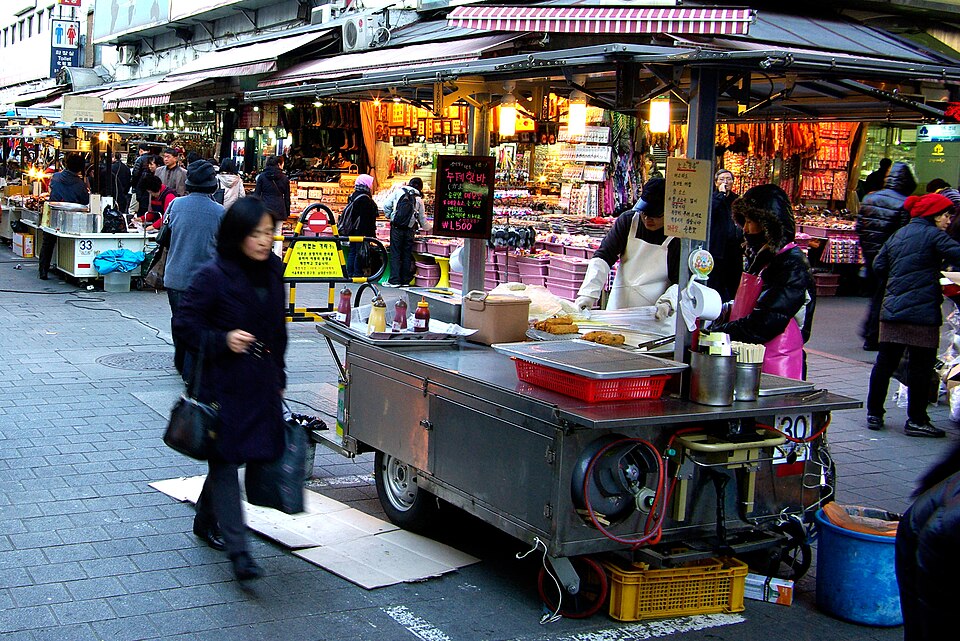
At a stall, point, say 이거 주세요 and hold up fingers for the count. In a convenience store, ask 데워 주세요 for the microwave and see the convenience store guide for what to buy. Many shops sell bags separately, so say 봉투 필요 없어요 if you carry your own. For souvenirs, see Daiso must-buys and Olive Young.
4. Numbers, prices and counting
Korean uses two number sets. Prices, floors, dates and portions use the Sino-Korean set. Counting people, items and cups uses the native set, which shortens before a counter: 하나 becomes 한, 둘 becomes 두, 셋 becomes 세 and 넷 becomes 네.
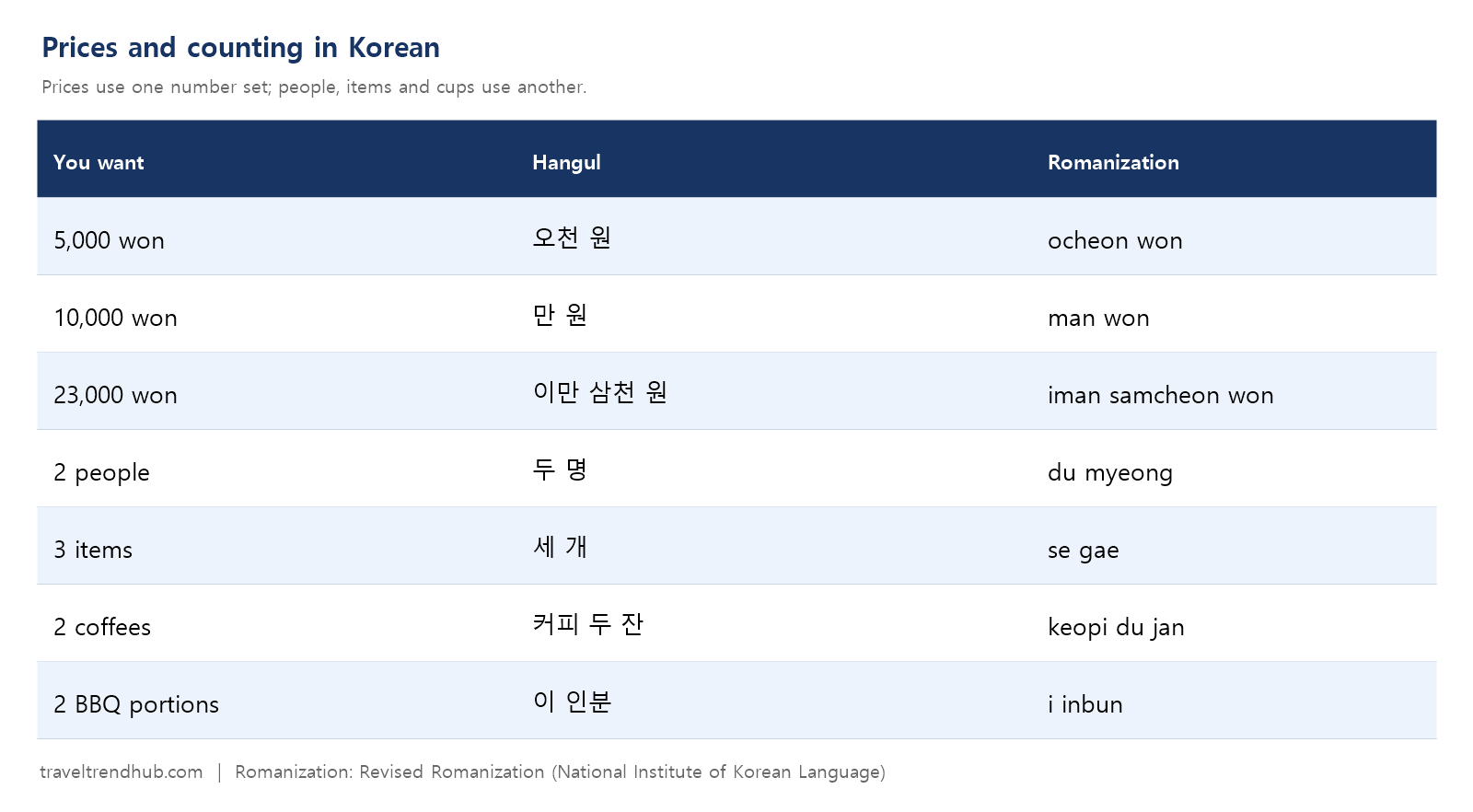
| Number | Sino-Korean (prices) | Romanization | Native (counting) | Romanization |
|---|---|---|---|---|
| 1 | 일 | il | 하나 / 한 | hana / han |
| 2 | 이 | i | 둘 / 두 | dul / du |
| 3 | 삼 | sam | 셋 / 세 | set / se |
| 4 | 사 | sa | 넷 / 네 | net / ne |
| 5 | 오 | o | 다섯 | daseot |
| 6 | 육 | yuk | 여섯 | yeoseot |
| 7 | 칠 | chil | 일곱 | ilgop |
| 8 | 팔 | pal | 여덟 | yeodeol |
| 9 | 구 | gu | 아홉 | ahop |
| 10 | 십 | sip | 열 | yeol |
| 100 / 1,000 / 10,000 | 백 / 천 / 만 | baek / cheon / man | – | – |
Combine them like this when you use Korean basic phrases for prices and counting: 오천 원 (ocheon won) is 5,000 won, 두 명 (du myeong) is two people, 세 개 (se gae) is three items, 커피 두 잔 (keopi du jan) is two cups of coffee and 삼겹살 이 인분 (samgyeopsal i inbun) is two portions of pork belly.
5. Korean basic phrases for taxis, subway and buses
Show the destination in Hangul on your phone; Naver Map shows Hangul beside the romanization, and Kakao T sends the address to the driver. These lines cover the rest.
| English | Korean | Romanization |
|---|---|---|
| Please go to Myeongdong | 명동에 가 주세요 | Myeongdong-e ga juseyo |
| Please go here (show your phone) | 여기로 가 주세요 | yeogiro ga juseyo |
| Please turn on the meter | 미터기 켜 주세요 | miteogi kyeo juseyo |
| Please stop here | 여기서 세워 주세요 | yeogiseo sewo juseyo |
| Open the trunk, please | 트렁크 열어 주세요 | teureongkeu yeoreo juseyo |
| I will pay by card | 카드로 계산할게요 | kadeuro gyesanhalgeyo |
| Receipt, please | 영수증 주세요 | yeongsujeung juseyo |
| Does this bus go to Myeongdong? | 이 버스 명동에 가요? | i beoseu Myeongdong-e gayo? |
| Where do I transfer? | 어디에서 갈아타요? | eodieseo garatayo? |
| Which exit number is it? | 몇 번 출구예요? | myeot beon chulguyeyo? |
| Please top up my T-money | 티머니 충전해 주세요 | timeoni chungjeonhae juseyo |
| What time is the last train? | 막차 몇 시예요? | makcha myeot siyeyo? |
| I am getting off | 내릴게요 | naerilgeyo |
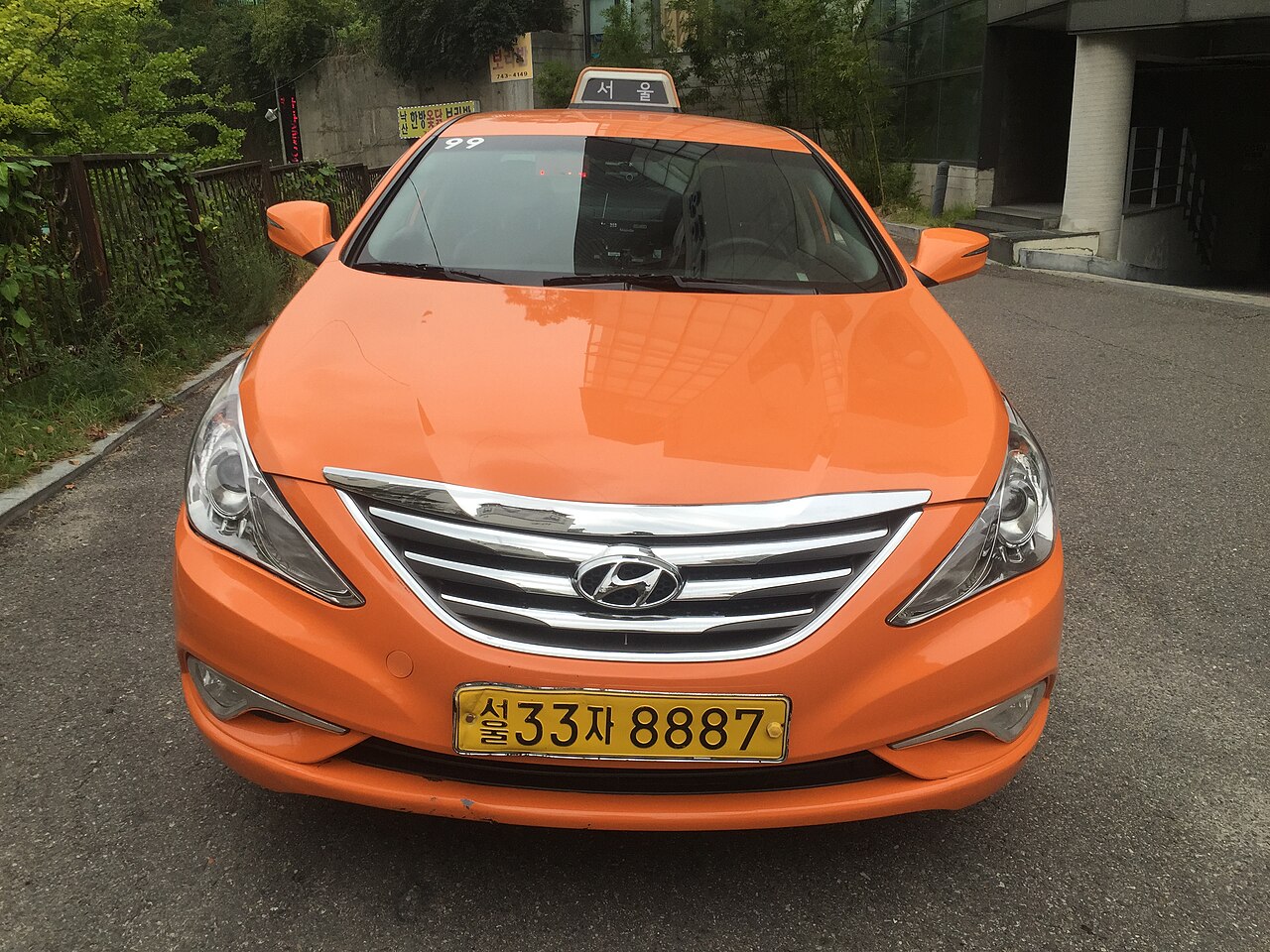
Ask for the meter before you set off and keep the receipt; our taxi scams guide and how to report a taxi overcharge explain what to do if the fare looks wrong. After midnight, check the late night taxi guide and ask 막차 몇 시예요? to learn the last train. Our Seoul subway guide and T-money vs Climate Card cover fares and cards.
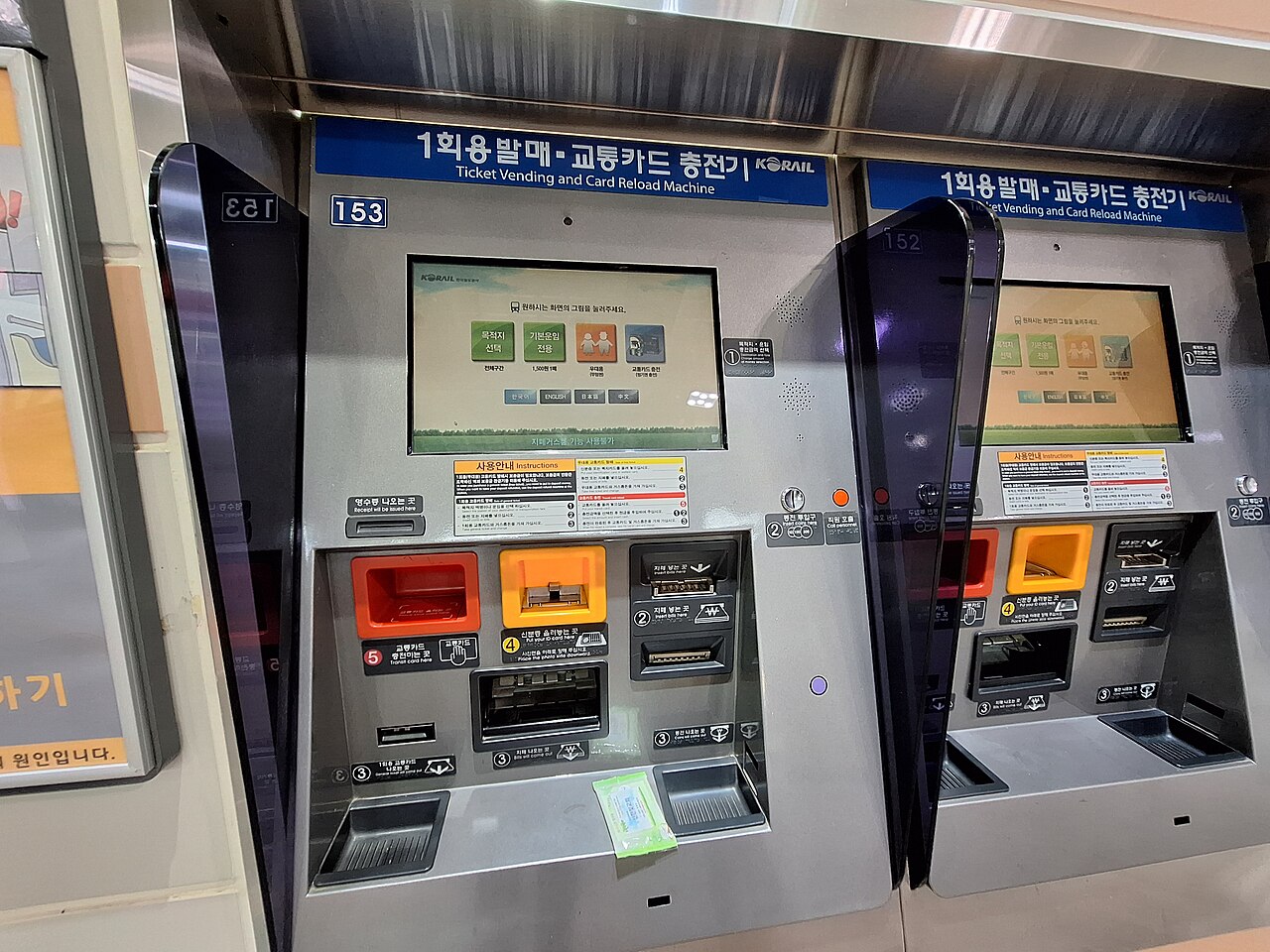
The ticket machine in the photo below uses three sign words worth knowing. The screen also has language buttons for Korean, English, Japanese and Chinese.
| Hangul | Romanization | Meaning |
|---|---|---|
| 1회용 발매 | ilhoeyong balmae | single-use ticket sales |
| 교통카드 충전 | gyotongkadeu chungjeon | top up a transit card |
| 목적지 선택 | mokjeokji seontaek | choose your destination |
6. Pharmacy, health and emergencies
| English | Korean | Romanization |
|---|---|---|
| Help! | 도와주세요 | dowajuseyo |
| Please call the police | 경찰 불러 주세요 | gyeongchal bulleo juseyo |
| Please call an ambulance | 구급차 불러 주세요 | gugeupcha bulleo juseyo |
| It hurts here | 여기가 아파요 | yeogiga apayo |
| I have a headache | 머리가 아파요 | meoriga apayo |
| My stomach hurts | 배가 아파요 | baega apayo |
| I have a fever | 열이 있어요 | yeori isseoyo |
| Where is a pharmacy? | 약국 어디예요? | yakguk eodiyeyo? |
| Do you have digestive medicine? | 소화제 있어요? | sohwaje isseoyo? |
| Do you have a painkiller? | 진통제 있어요? | jintongje isseoyo? |
| Do you have cold medicine? | 감기약 있어요? | gamgiyak isseoyo? |
| I want to go to a hospital | 병원에 가고 싶어요 | byeongwone gago sipeoyo |
| I lost my passport | 여권을 잃어버렸어요 | yeogwoneul ireobeoryeosseoyo |
| I lost my wallet | 지갑을 잃어버렸어요 | jigabeul ireobeoryeosseoyo |
| I lost my phone | 휴대폰을 잃어버렸어요 | hyudaeponeul ireobeoryeosseoyo |
| Is there anyone who speaks English? | 영어 할 수 있는 분 있어요? | yeongeo hal su inneun bun isseoyo? |
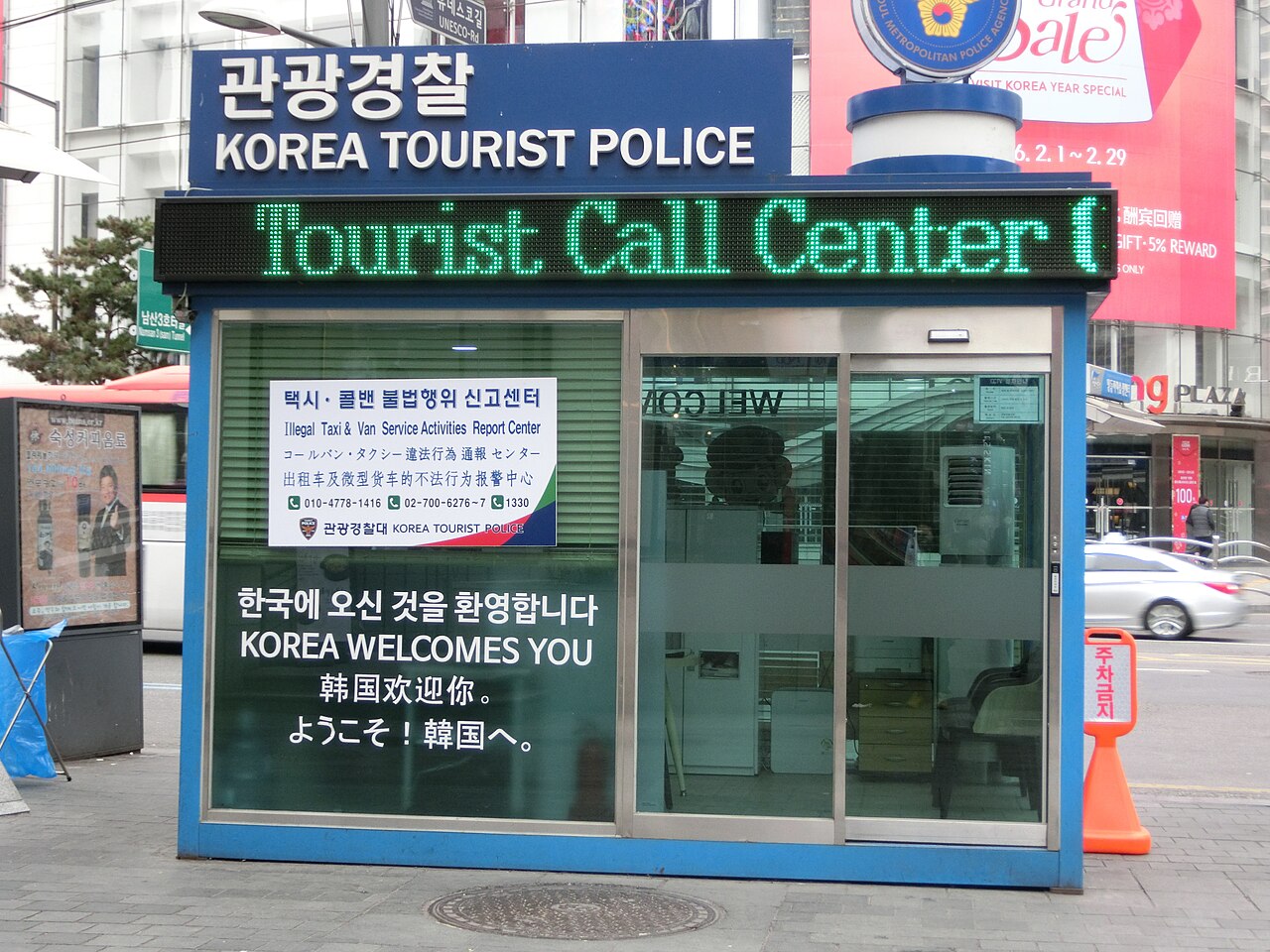
Among Korean basic phrases for health, name the symptom first at a pharmacy and let the pharmacist suggest an over-the-counter product; for anything serious, ask for a hospital. Numbers to save (KTO emergency list, updated 11 Sep 2026): 112 for police, 119 for fire, rescue and medical emergencies, 1339 for infectious-disease emergencies, and the 1330 Korea Travel Helpline for travel information and interpretation in Korean, English, Japanese, Chinese, Russian, Vietnamese, Thai and Malay. Our Korea emergency numbers guide lists the other help lines, and the tourist scams guide covers theft and fraud.
7. Hotel check-in and asking for help
| English | Korean | Romanization |
|---|---|---|
| I have a reservation | 예약했어요 | yeyakaesseoyo |
| I would like to check in | 체크인 할게요 | chekeuin halgeyo |
| What time is check-out? | 체크아웃은 몇 시예요? | chekeuauseun myeot siyeyo? |
| Can you store my luggage? | 짐 맡길 수 있어요? | jim matgil su isseoyo? |
| What is the Wi-Fi password? | 와이파이 비밀번호가 뭐예요? | waipai bimilbeonhoga mwoyeyo? |
| More towels, please | 수건 더 주세요 | sugeon deo juseyo |
| The room is too cold | 방이 너무 추워요 | bangi neomu chuwoyo |
| The room is too hot | 방이 너무 더워요 | bangi neomu deowoyo |
| From what time is breakfast? | 조식은 몇 시부터예요? | josigeun myeot sibuteoyeyo? |
| Please call a taxi | 택시 불러 주세요 | taeksi bulleo juseyo |
Front desks in tourist areas often handle English, and these Korean basic phrases work when the desk is busy or the shift changes. For storage between check-out and your flight, see luggage storage in Seoul; for choosing an area, see where to stay in Seoul.
The key rules at a glance
| Question | Answer (as of Nov 2026) |
|---|---|
| Which politeness level? | Polite style ending in 요 (yo) or 습니다 (seumnida) |
| Which romanization? | Revised Romanization, based on pronunciation |
| Fastest way to order? | Point and say 이거 주세요 (igeo juseyo) |
| Tipping? | Not required or expected (KTO) |
| Extra water and side dishes? | No extra charge (KTO) |
| Tax refund minimum? | KRW 15,000 per receipt, with passport (KTO) |
| Police and ambulance? | 112 and 119 |
| Travel helpline? | 1330, multilingual (KTO) |
Mistakes to Avoid With Korean Basic Phrases
- Learning romanization only and never matching it to the Hangul on signs; ten minutes with the alphabet guide fixes that.
- Using casual endings with staff: stay with 요 (yo) and 주세요 (juseyo).
- Pointing at a menu in silence; add 이거 주세요 (igeo juseyo).
- Reading eo and eu as two sounds: each is one vowel.
- Pressing the table call bell repeatedly; KTO warns it can be louder than you expect.
- Calling 1330 for an ambulance; 119 dispatches one and 1330 gives travel help and interpretation.
- Bargaining in chain stores; keep 깎아 주세요 (kkakka juseyo) for market stalls.
- Skipping the allergy line: say 알레르기가 있어요 (allereugiga isseoyo) with the ingredient at the start of the order.
Frequently Asked Questions
What are the most useful Korean basic phrases for travelers?
The core set is 안녕하세요 (annyeonghaseyo, hello), 감사합니다 (gamsahamnida, thank you), 이거 주세요 (igeo juseyo, this one please), 얼마예요? (eolmayeyo, how much), 화장실 어디예요? (hwajangsil eodiyeyo, where is the restroom) and 도와주세요 (dowajuseyo, help).
How do you say hello in Korean?
Say 안녕하세요 (annyeonghaseyo). It is the polite greeting for any time of day and suits shops, restaurants and hotels.
How do you say thank you in Korean?
Say 감사합니다 (gamsahamnida). It is polite enough for staff, drivers and strangers.
How do you ask how much something costs in Korean?
Point and say 이거 얼마예요? (igeo eolmayeyo?). Prices are usually shown in digits, and the numbers table above helps you say them.
How do you ask for the bill in a Korean restaurant?
Say 계산해 주세요 (gyesanhae juseyo) or press the call bell. Some restaurants use a counter or kiosk, so follow the staff.
Do I need to speak Korean to travel in Korea?
No. The 1330 Korea Travel Helpline offers interpretation, and Seoul Metro launched real-time AI interpretation screens at the Myeongdong Station customer support center in December 2023, with more stations planned, according to VisitKorea. A few Korean basic phrases still make shops, taxis and restaurants easier.
What number do I call in a Korean emergency?
Call 112 for police and 119 for fire, rescue and medical emergencies. The 1330 Korea Travel Helpline is for travel information and interpretation, as of November 2026.
Should I learn Hangul or just phrases before a trip?
Phrases give the fastest start, and the Korean alphabet takes only a few hours to learn well enough to read signs and menus. Our Hangul guide covers the letters and free lessons.
What Should You Learn Next?
After the Korean basic phrases, set up data and navigation: a Korea eSIM from Airalo, then Naver Map and Kakao T. Then pack with the Korea packing list, and read living in Korea: the first month if you plan to stay longer. If you prefer a teacher, a small classroom session can set the sounds in place:
Hangul class · Jongno · via KKday
Korean Alphabet (Hangul) Class in Jongno, Seoul
2 hours · taught in English · KRW 60,000 per traveler · tea and snacks included · ages 13 and up (as of Oct 2026)
The KKday Hangul class is a classroom session near Gyeongbokgung Station; dates and prices change, so confirm both on the provider page.
Sources (official pages checked)
- National Institute of Korean Language, Romanization of Korean
- Korea Tourism Organization, Korean food and visiting a Korean restaurant
- Korea Tourism Organization, Duty free and tax refunds
- Korea Tourism Organization, Emergency calls and the 1330 Korea Travel Hotline (updated 11 September 2026)
- VisitKorea, Korea Travel Cheat Sheet: 3 New Transportation Services (real-time interpretation at Seoul subway stations)
Book the basics for your Korea trip
Affiliate links: we may earn a small commission at no extra cost to you.
Related Guides
- Korea Travel Toolkit
- Korean Alphabet (Hangul) for Travelers
- Best Apps for Korea
- Kakao T Taxi Guide
- Korea Emergency Numbers
- Korea Tax Refund Guide
- Korean BBQ for First-Timers
- Seoul Subway Guide
- Tourist Scams in Korea
- Korea Packing List
- Korea Tipping: Best No-Tip Rules and Etiquette (2026)
- LoL Park Seoul: How to Watch LCK and T1 in Person (2026 Guide)
Last checked November 2026 against the National Institute of Korean Language, the Korea Tourism Organization and VisitKorea.