Bottom line: The Korean alphabet (Hangul) has 24 basic letters that stack into syllable blocks, so most travelers can learn to sound out station names and menus before they land: study the chart below, practice on real signs, and carry the 10 phrases at the end of this guide.
Quick Korea Travel Guide
Getting in: File the free e-Arrival Card unless you hold a valid K-ETA, and check the K-ETA exemption dates.
Stay in touch: Get a Korea eSIM from Airalo; Naver Map and Papago need data.
Pay: A WOWPASS card on KKday works as a payment and T-money card; see our WOWPASS review and Apple Pay in Korea.
Getting around: How to use the Seoul subway and T-money vs Climate Card.
Plan more: Best apps for Korea, the Korea Travel Toolkit and GetYourGuide Seoul for classes and tours.
Disclosure: Some links above are affiliate links. If you book through them I may earn a commission at no extra cost to you.
Most pages on the Korean alphabet stop at a chart of letters. This guide goes further for travelers: how Hangul works, how to read subway signs, menus and convenience store labels, ten phrases with romanization, free ways to practice and Seoul classes listed in October 2026.
Quick answer
- Name: the Korean alphabet is Hangul (Hangeul in Korean government spelling), with 24 letters: 14 consonants and 10 vowels.
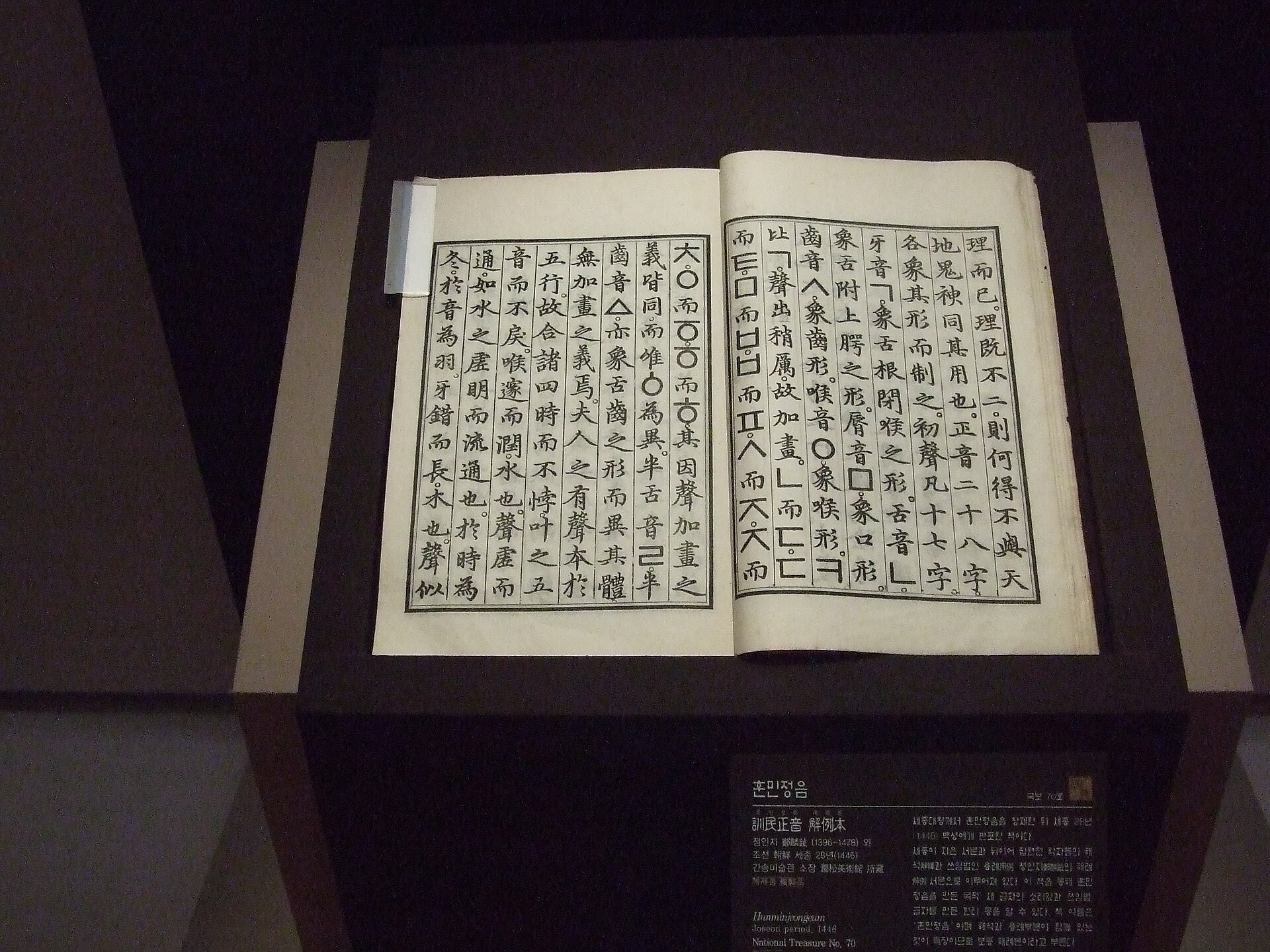
- Creator: King Sejong the Great completed it in the twelfth lunar month of 1443; the book Hunminjeongeum followed in 1446 and joined UNESCO’s Memory of the World Register in 1997.
- How it works: letters stack into syllable blocks, so 한 is ㅎ + ㅏ + ㄴ, read as han.
- Romanization: signs use Revised Romanization: ㅓ is eo, ㅡ is eu, and ㅇ is silent at the start of a block.
- Free practice: the Online King Sejong Institute, its apps and Duolingo.
- Classes: a 2-hour Hangul class lists from KRW 60,000 on KKday (as of Oct 2026).
- Rule for the Korean alphabet: learn the 24 letters, practice on real signs, and keep Papago and Naver Map for the rest.
Hangul and calligraphy class · Seoul · via GetYourGuide
Seoul: Korean Calligraphy Class with an Artist
⭐ 5.0/5 from 19 GetYourGuide reviews · 2 hours · small group of up to 4 · basics of the Korean alphabet and its history · from ₩80,000 per person · free cancellation up to 24 hours before (as of Oct 2026)
What this guide covers
What Is the Korean Alphabet (Hangul)?
Hangul is the writing system of Korea and the Korean alphabet in everyday English. Modern Hangul uses 24 letters, 14 consonants and 10 vowels, plus double consonants and compound vowels built from them. Letters are grouped into square syllable blocks, and each block is one syllable.
King Sejong the Great, the fourth king of the Joseon Dynasty, completed the alphabet in the twelfth lunar month of 1443, according to the Korea Heritage Service. He called it Hunminjeongeum, “proper sounds for the instruction of the people”. It had 28 letters; four have since dropped out of use. The book Hunminjeongeum was published in the ninth lunar month of 1446, and UNESCO listed the manuscript in 1997.
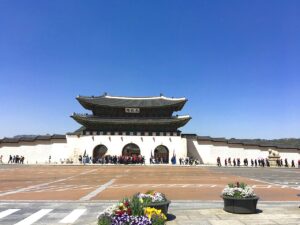
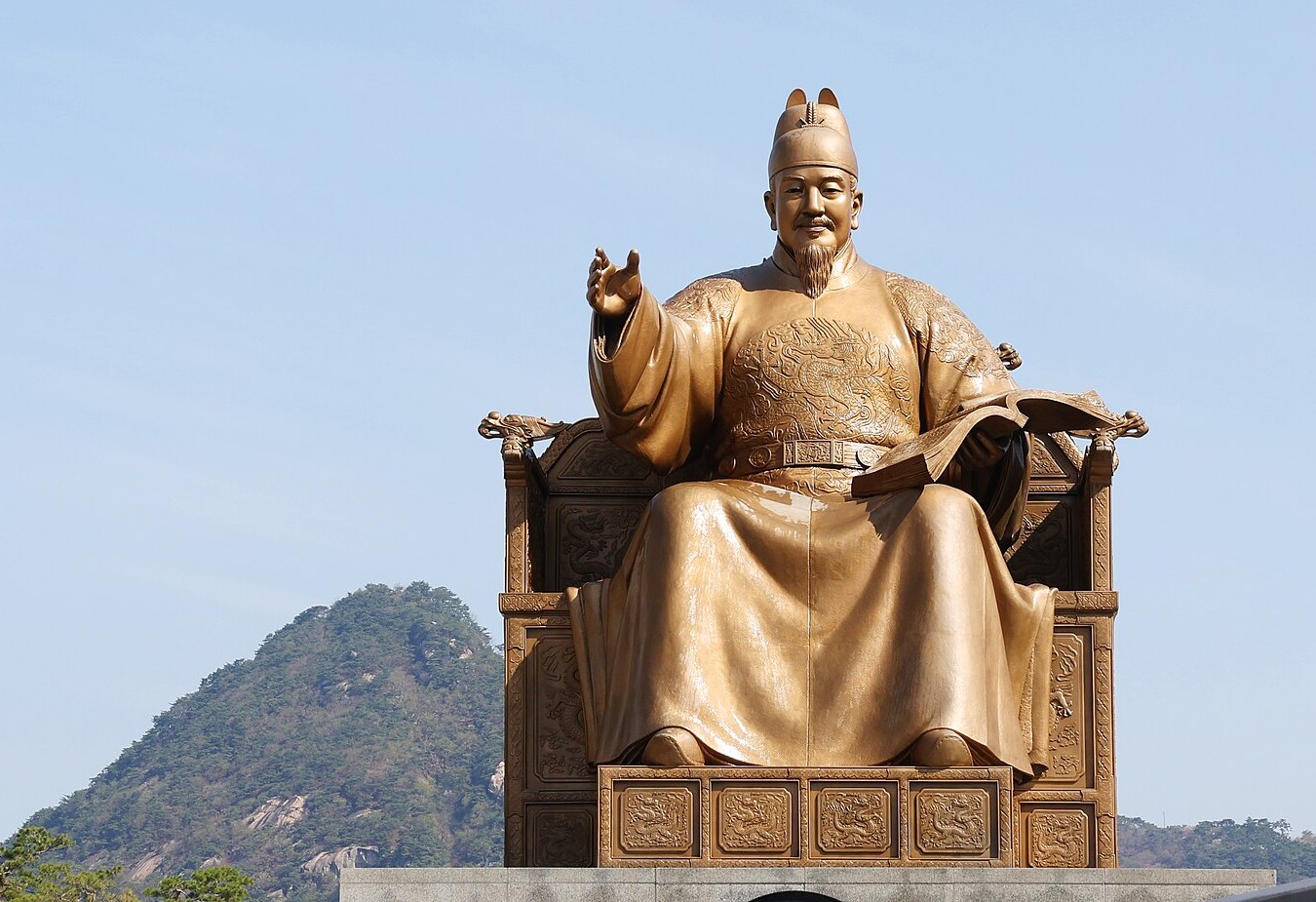
Before Hangul, Koreans wrote with Chinese characters, and most people never learned to read. The National Hangeul Museum notes that Hangul became the official national script only in 1894. South Korea celebrates the alphabet on Hangul Day, 9 October, a national holiday. You can meet King Sejong in bronze at Gwanghwamun Square, beside the palace in our Gyeongbokgung hanbok rules guide.
1. How the Korean Alphabet Works: Letters, Blocks and Sounds
Every block starts with a consonant, adds a vowel and may end with a final consonant. When a syllable starts with a vowel sound, a silent ㅇ fills the first slot, so 아 is simply a. Vowels sit to the right of the consonant (ㅏ, ㅓ, ㅣ) or underneath it (ㅗ, ㅜ, ㅡ). Read left to right, then top to bottom.
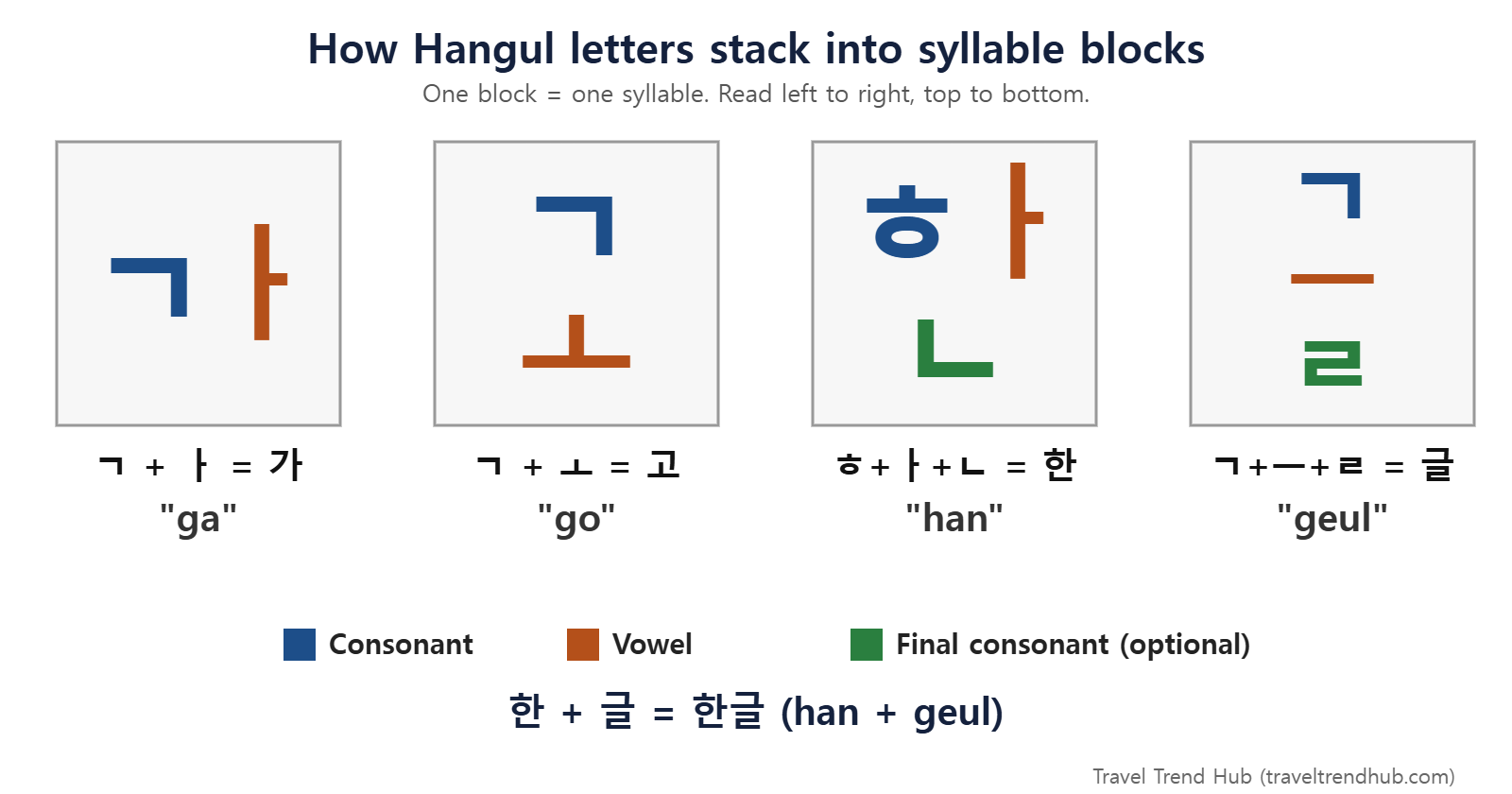
The shapes are not random. According to the National Hangeul Museum, the five basic consonants copy the mouth and throat: ㄱ the back of the tongue, ㄴ the tongue at the upper gums, ㅁ the lips, ㅅ the teeth and ㅇ the throat. Harder sounds add strokes, so ㄱ becomes ㅋ.
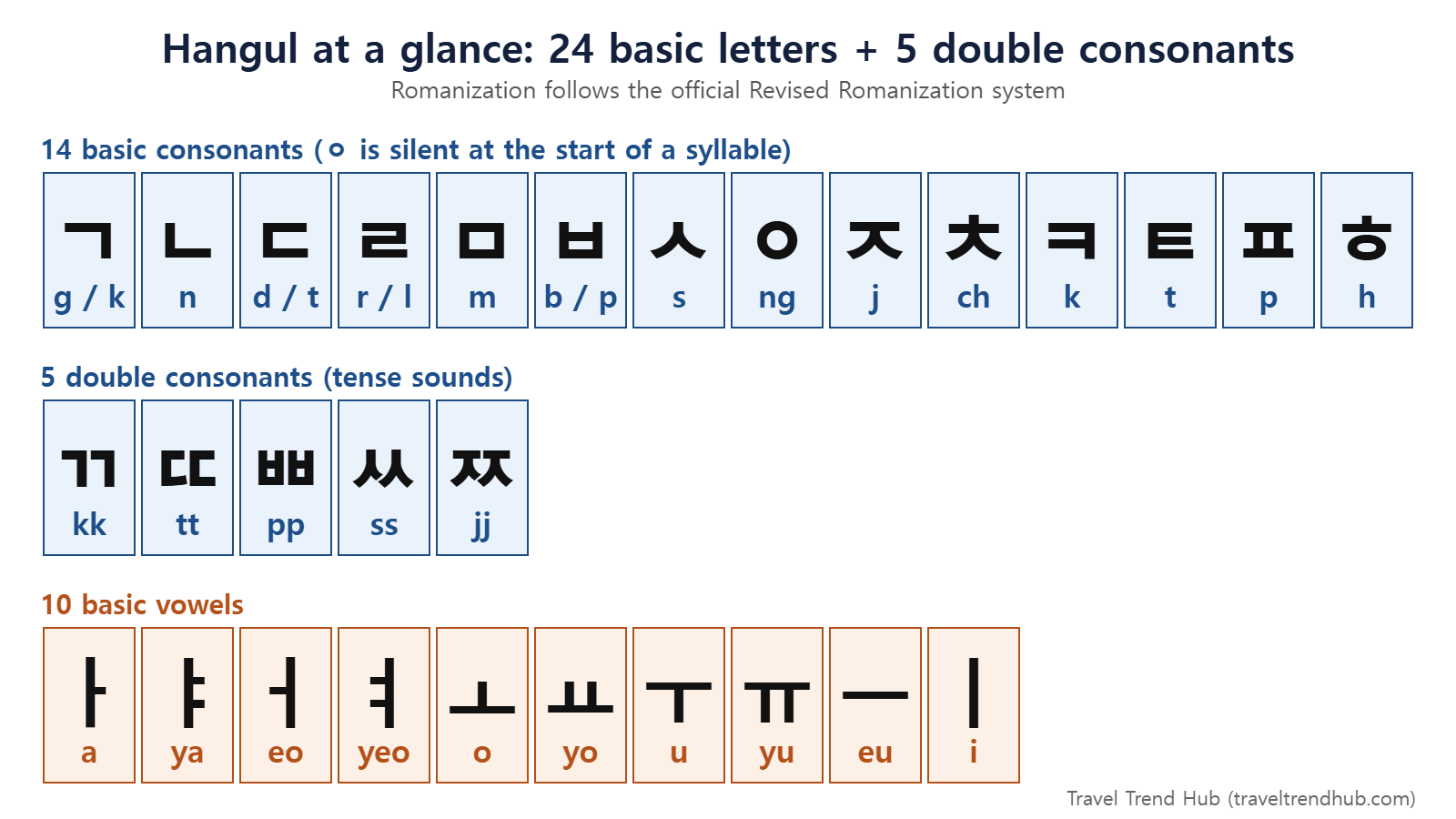
Consonants and vowels with romanization
| Letter | Romanization | Sounds like |
|---|---|---|
| ㄱ | g / k | g in “go”; k at the end |
| ㄴ | n | n in “no” |
| ㄷ | d / t | d in “do”; t at the end |
| ㄹ | r / l | between r and l |
| ㅁ | m | m in “moon” |
| ㅂ | b / p | b in “bus”; p at the end |
| ㅅ | s | s in “sun” |
| ㅇ | silent / ng | silent at the start; “ng” at the end |
| ㅈ | j | j in “jam” |
| ㅊ ㅋ ㅌ ㅍ | ch, k, t, p | ㅈ ㄱ ㄷ ㅂ with a puff of air |
| ㅎ | h | h in “hat” |
| ㄲ ㄸ ㅃ ㅆ ㅉ | kk, tt, pp, ss, jj | tense, no puff of air |
| ㅏ | a | a in “father” |
| ㅓ | eo | “uh” in “sun” |
| ㅗ | o | o in “go” |
| ㅜ | u | oo in “moon” |
| ㅡ | eu | “oo” with spread lips |
| ㅣ | i | ee in “see” |
| ㅑ ㅕ ㅛ ㅠ | ya, yeo, yo, yu | add a “y” sound |
| ㅐ ㅔ ㅘ ㅝ ㅢ | ae, e, wa, wo, ui | compound vowels |
Signs use the Revised Romanization system from the National Institute of Korean Language, which follows pronunciation: 종로 is Jongno and 신라 is Silla. The letters ㄱ, ㄷ and ㅂ become g, d and b before a vowel and k, t and p before a consonant or at the end of a word, so 백암 is Baegam and 합덕 is Hapdeok. “Eo” and “eu” are single vowels: Seoul is Seo-ul.
2. Read Real Signs: Subway, Convenience Stores and Menus
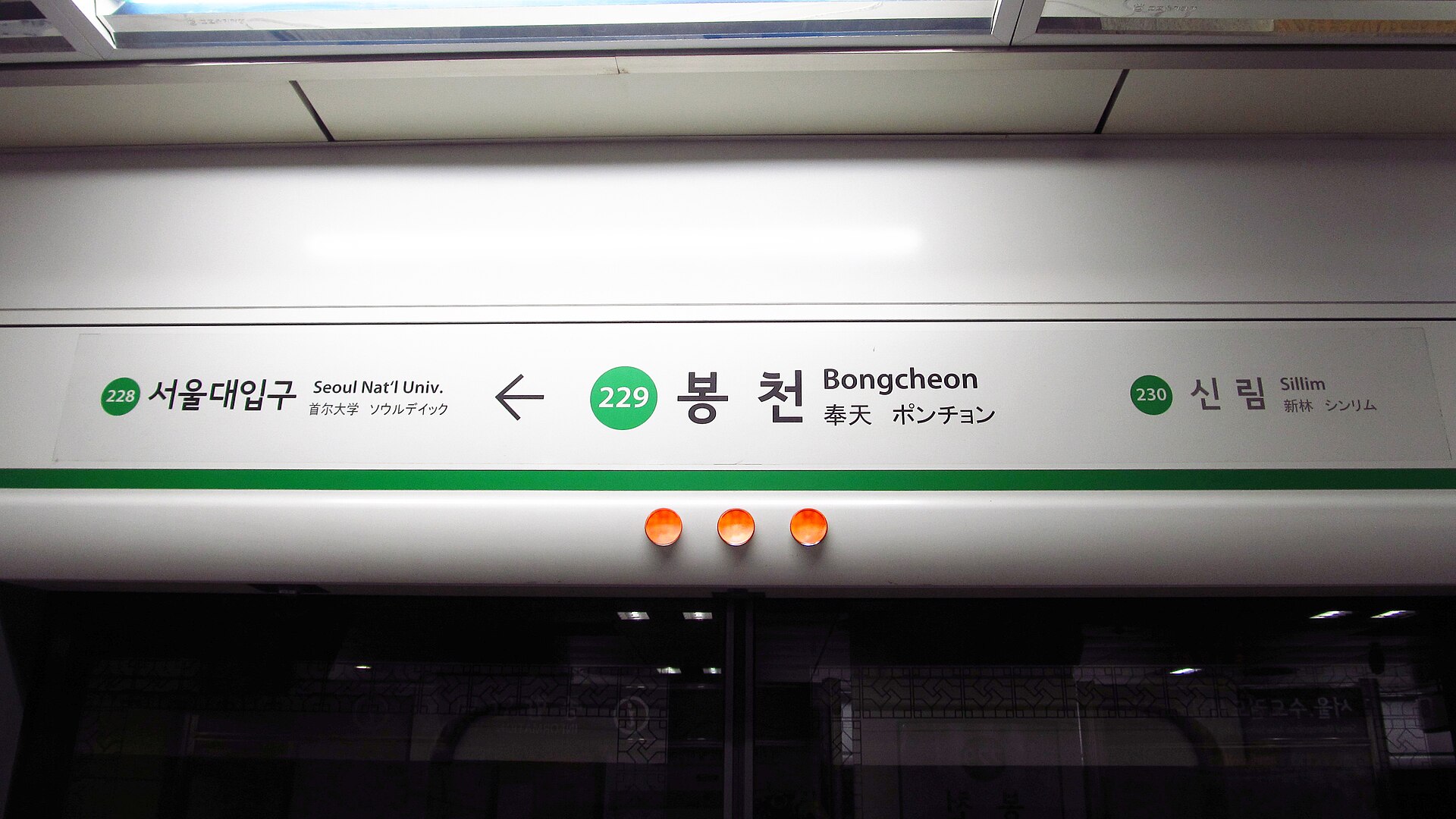
Start with a sign you will see within an hour of landing. The Seoul Metro sign below shows 봉천, Bongcheon, built from 봉 (ㅂ + ㅗ + ㅇ, bong) and 천 (ㅊ + ㅓ + ㄴ, cheon), with station number 229 and the neighbors 서울대입구 and 신림 (Sillim). Our Seoul subway guide explains lines and transfers, and subway etiquette covers the rules.
| Hangul | Romanization | Meaning and where you see it |
|---|---|---|
| 역 | yeok | station |
| 출구 | chulgu | exit, with a number |
| 환승 | hwanseung | transfer between lines |
| 호선 | hoseon | line number: 1호선 is Line 1 |
| 타는 곳 | taneun got | platform |
| 편의점 | pyeonuijeom | convenience store |
| 도시락 | dosirak | boxed lunch |
| 김밥 | gimbap | rice rolls |
| 비빔밥 | bibimbap | mixed rice bowl |
| 떡볶이 | tteokbokki | spicy rice cakes |
| 삼겹살 | samgyeopsal | pork belly for grilling |
| 매운 | maeun | spicy |
| 포장 | pojang | takeout |
Read the table aloud once, then test yourself in a convenience store; the Korea convenience store guide shows what is inside. Our guides to bibimbap, kimbap, tteokbokki, kimchi and Korean BBQ help you recognize the dishes.
3. Ten Survival Korean Phrases With Romanization
Polite Korean usually ends in 요 (yo) or 니다 (nida), which suits strangers and staff. There is no audio here, so read each syllable slowly with even stress.
| English | Korean | Romanization |
|---|---|---|
| 1. Hello | 안녕하세요 | annyeonghaseyo |
| 2. Thank you | 감사합니다 | gamsahamnida |
| 3. Excuse me (to call staff) | 저기요 | jeogiyo |
| 4. Yes / No | 네 / 아니요 | ne / aniyo |
| 5. How much is this? | 이거 얼마예요? | igeo eolmayeyo? |
| 6. Please give me this | 이거 주세요 | igeo juseyo |
| 7. Where is the restroom? | 화장실 어디예요? | hwajangsil eodiyeyo? |
| 8. Can you speak English? | 영어 할 수 있어요? | yeongeo hal su isseoyo? |
| 9. Not spicy, please | 안 맵게 해 주세요 | an maepge hae juseyo |
| 10. Can I pay by card? | 카드로 계산할 수 있어요? | kadeuro gyesanhal su isseoyo? |
Point at the menu and say “igeo juseyo” and you can order almost anything. In an emergency, say 도와주세요 (dowajuseyo, “please help me”) and see Korea emergency numbers. For paying, see how much cash to bring.
4. Free Ways to Learn the Korean Alphabet Before You Fly
- Online King Sejong Institute: a free online Korean learning service with beginner courses; not every course runs all year.
- Nuri King Sejong Institute portal: free downloadable textbooks, dictionaries that include English and a level test, as the Korea Herald reported in May 2026.
- King Sejong Institute apps: Mobile KSI for lessons and KSI AI Korean Teacher for practice, on iOS and Android.
- Duolingo Korean: the course updated in July 2026 has a Hangeul tab and optional transliterations; free to start.
- Talk To Me In Korean: a Hangeul course with one free lesson and a 7-day trial; full courses are paid.
Ten minutes a day is enough: consonants first, then vowels, then the words in the tables above. Pair the lessons with Naver Map in English, where Hangul place names appear beside romanization.
5. Hangul Classes in Seoul for Visitors
If you prefer a teacher, three listings were open for booking in October 2026. The calligraphy class on GetYourGuide above teaches the basics of the Korean alphabet and its history. The two below focus on reading.
Hangul class · Jongno · via KKday
Korean Alphabet (Hangul) Class in Jongno, Seoul
2 hours · taught in English · KRW 60,000 per traveler · tea and snacks included · ages 13 and up · free cancellation up to 4 days before · next listed date 22 Nov 2026 (as of Oct 2026)
The KKday Hangul class is a classroom session near Gyeongbokgung Station; see our Insadong guide for what to do nearby.
Hangul reading class + street practice · via GetYourGuide
Seoul: Read Hangul in Top Tourist Spots, Shop, Eat & Explore
3 to 4 hours · private group of up to 4 · ₩200,000 per group · 2-hour class plus 1 hour reading real signs and menus · street food meal included · new listing, no reviews yet · free cancellation up to 24 hours before (as of Oct 2026)
The GetYourGuide reading class is a private group session in a tourist area. Prices and dates change, so confirm both on the provider page.
The key rules at a glance
| Question | Answer (as of Oct 2026) |
|---|---|
| Basic letters? | 24: 14 consonants and 10 vowels |
| Who made it, and when? | King Sejong; finished 1443; book 1446 |
| Official romanization? | Revised Romanization |
| ㅇ at the start of a block? | Silent |
| Hangul Day? | 9 October |
| Class price? | From KRW 60,000 on KKday |
Mistakes to Avoid With the Korean Alphabet
- Reading ㅇ at the start of a block as “ng”; it is silent.
- Reading romanization like English: “eo” and “eu” are single vowels.
- Memorizing the chart but never reading real words on signs and menus.
- Mixing up ㅗ (o) and ㅓ (eo): 고 is go and 거 is geo.
- Expecting spelling and romanization to match: 종로 is Jongno.
- Saying ㄱ, ㄷ and ㅂ the same everywhere: g, d, b before a vowel, k, t, p at the end.
- Skipping polite endings: add 요 (yo) or use 주세요 (juseyo).
- Booking a class without checking the date and cancellation window.
Frequently Asked Questions
What is the Korean alphabet called?
The Korean alphabet is called Hangul (한글). Korean government and museum sites spell it Hangeul; both spellings mean the same writing system.
How many letters are in the Korean alphabet?
Modern Hangul uses 24 basic letters: 14 consonants and 10 vowels. Double consonants and compound vowels are built from them.
Who invented the Korean alphabet and when?
King Sejong the Great completed it in the twelfth lunar month of 1443, and the book Hunminjeongeum explaining it was published in 1446.
Is the Korean alphabet hard to learn?
Hangul has few letters and regular rules, so a traveler can learn to sound out signs and menus with practice. Grammar and vocabulary take much longer.
Do I need to read Hangul to travel in Korea?
No. Subway signs usually carry romanization, but many menus and shop labels are Hangul only, so knowing the letters helps.
Why do romanized Korean names look different from the Korean spelling?
Official Revised Romanization follows pronunciation, so 종로 is Jongno. Personal and company names may keep older spellings such as Lee, Yi or Rhee.
What is Hangul Day?
Hangul Day is a South Korean national holiday on 9 October that celebrates the alphabet, according to the Korea Heritage Service.
Is there a free way to learn the Korean alphabet?
Yes. The Online King Sejong Institute is a free online learning service, and the King Sejong Institute offers free apps and textbooks. Check course schedules first.
What Should You Learn Next?
After the Korean alphabet, set up data and navigation: a Korea eSIM from Airalo, then Naver Map and Kakao T. Then pack with the Korea packing list, and read living in Korea: the first month if you plan to stay longer.
Sources (official pages checked)
- UNESCO, Hunminjeongum Manuscript (Memory of the World, 1997)
- Korea Heritage Service, Hunminjeongeum Manuscript
- National Hangeul Museum, About Hangeul
- National Institute of Korean Language, Romanization of Korean
- King Sejong Institute Foundation, Online King Sejong Institute
- The Korea Herald, Want to learn Korean? (29 May 2026)
- Duolingo Blog, updated Korean course (7 July 2026)
Book the basics for your Korea trip
Affiliate links: we may earn a small commission at no extra cost to you.
Related Guides
- Korea Travel Toolkit
- Best Apps for Korea
- Naver Map in English
- Seoul Subway Guide
- Korea Convenience Store Guide
- Tteokbokki in Seoul
- Apple Pay in Korea
- T-money vs Climate Card
- Korea Packing List
- Living in Korea: First Month
- Gyeongbokgung Hanbok Rules
- Insadong, Seoul
- Korean Basic Phrases for Travelers
Korean alphabet facts last checked 26 October 2026 against UNESCO, the Korea Heritage Service, the National Hangeul Museum, the National Institute of Korean Language and the booking pages named above. Class prices, dates and schedules change; confirm them on the provider page.